

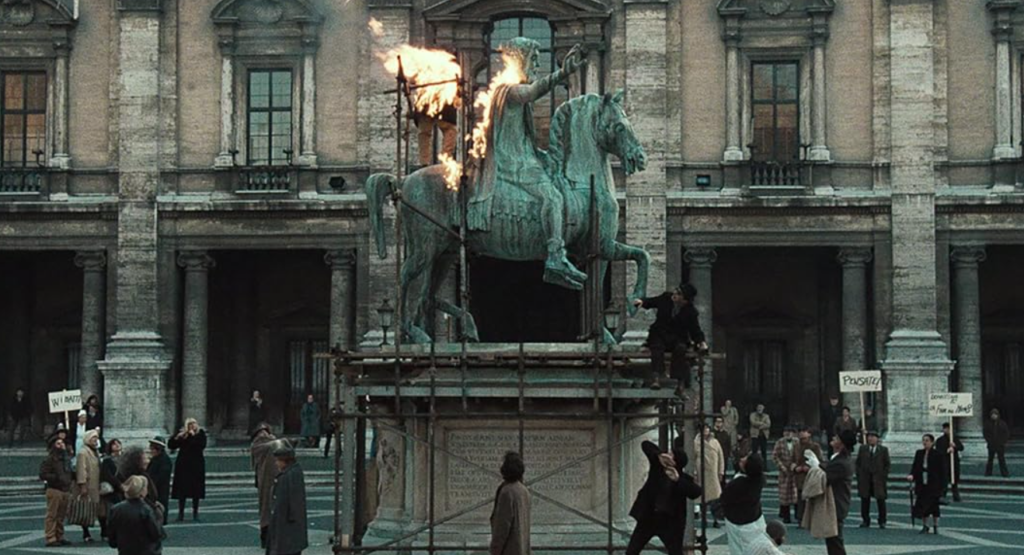
The 1983 masterpiece Nostalghia represents a pivotal moment in Andrei Tarkovsky‘s filmography, as it was his first film produced outside the Soviet Union.
The director’s own exile in Italy mirrors the journey of his protagonist, Andrei Gorchakov, a Russian poet researching the life of an 18th-century composer. This meta-textual layer adds a profound sense of authenticity to the film’s depiction of homesickness not merely as a longing for a place, but as a spiritual illness.
Gorchakov is accompanied by his beautiful Italian interpreter, Eugenia, whose presence highlights his emotional isolation. Despite the stunning Tuscan landscapes, Gorchakov remains trapped in his mind and unable to engage with the beauty of his surroundings. This disconnect emphasizes Tarkovsky’s central theme: that true nostalgia is a crushing weight that renders the present moment ghost-like and unreachable.
The Visual Language of Displacement and Memory in ‘Nostalghia’
Tarkovsky uses his signature long takes and slow pans to blend Gorchakov’s Russian memories with his Italian reality. The film famously utilizes sepia-toned dream sequences featuring Gorchakov’s wife and a loyal German Shepherd back in the Russian countryside. These images often bleed into the frame of the Italian ruins, suggesting that, for the displaced person, the “here” and “there” constantly overlap.
A key element of Nostalghia is its exploration of sacred spaces and how they lose their meaning when one is spiritually adrift. Gorchakov visits the sunken Abbey of San Galgano, but he cannot find the solace he seeks within its walls.
The physical architecture of Italy, while grand, feels hollow to him because it lacks the spirit of his homeland, illustrating that home is a collection of invisible histories rather than just a geographic coordinate.
The film also introduces the character of Domenico, a holy fool who once locked his family away for seven years to save them from the world’s perceived end.
Domenico and Gorchakov share a unique bond of suffering; while Gorchakov is a prisoner of his past, Domenico is a prisoner of his own idealism. This parallel suggests that the pain of being away from home is often linked to a deeper, more existential feeling of being away from God or a sense of universal truth.
The Candle Walk: A Literal Manifestation of Internal Struggle By Tarkovsky
The climax of the film is a nine-minute single-take sequence in which Gorchakov attempts to carry a lit candle across the drained mineral pool at Bagno Vignoni. This task, given to him by Domenico, serves as a grueling physical manifestation of his inner struggle to preserve a spark of faith in a foreign land.
Each time the wind snuffs out the flame, Gorchakov must return to the start, symbolizing the repetitive and exhausting nature of maintaining one’s identity in exile.
This sequence is often cited as one of the most intense depictions of human perseverance in cinema history. The camera lingers on Gorchakov’s face, capturing every bead of sweat and every flinch of anxiety. When he finally succeeds in placing the candle on the far ledge, the effort claims his life, suggesting that the ultimate return home for the exiled soul is often a transition into the spiritual realm.
The final shot of the film is a breathtaking visual metaphor for the synthesis of his two worlds. Gorchakov is seen sitting in the Russian countryside, but the entire scene is contained within the towering walls of the San Galgano Abbey.
By merging these two distinct locations into a single, impossible image, Tarkovsky concludes that for the artist in exile, home becomes a permanent, painful intersection of memory and reality.
You May Also Like:
Add us as a preferred source on Google.
Conversation