

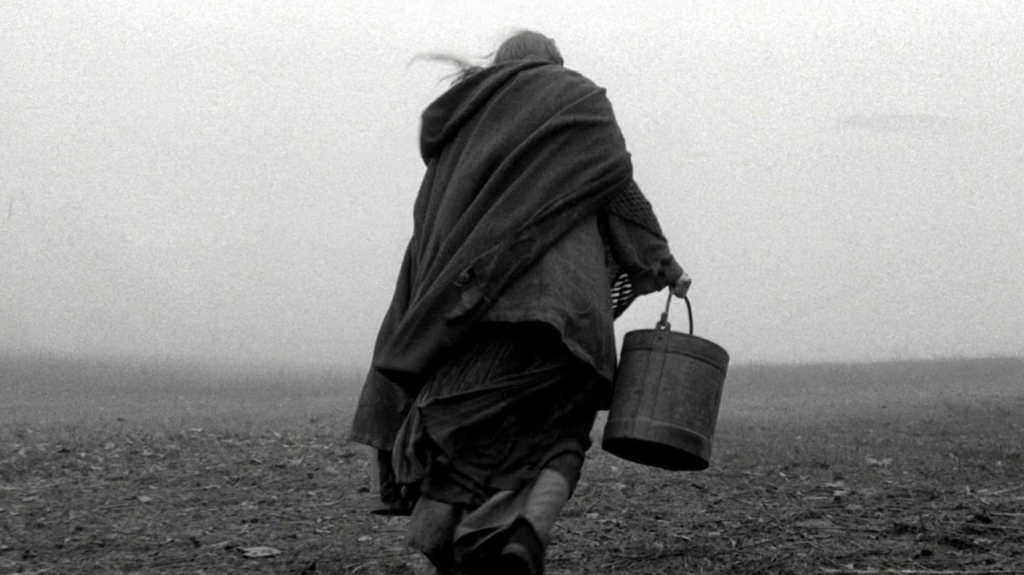
The Turin Horse doesn’t ask you whether life has meaning. It has already decided that it doesn’t, and it wants you to sit with that for two and a half hours.
Béla Tarr’s 2011 film, which he announced would be his last, is one of the most uncompromising works in cinema history. Shot in luminous black and white, structured around six days of grinding routine, and almost entirely devoid of plot, it is a film that does not perform despair. It simply lives inside it. And for anyone who has ever wondered what a truly nihilistic work of art actually looks like, this is it.
The Turin Horse and the Nietzsche Story It Never Tells You
The film opens with a narrator recounting a real event: in January 1889, Friedrich Nietzsche stepped out of his apartment in Turin, saw a coachman flogging a horse, and threw his arms around the animal’s neck, weeping. He never recovered his sanity. The narrator closes with a simple question: “What happened to the horse?”
Tarr never answers it directly. Instead, the film follows an aging coachman and his daughter living in a remote farmhouse, battered by a wind that never stops. They boil a potato. They eat it with their hands. They stare out the window. They do it again the next day. And the next.
The Nietzsche reference is doing quiet but enormous work here. Nietzsche is the philosopher most associated with the death of God and the arrival of nihilism as modernity’s defining crisis.
By opening with his breakdown, and specifically with his breakdown over an animal being beaten senselessly, Tarr is locating his film at the exact moment when the bottom fell out of Western meaning-making. The horse is the last straw. And then we follow the horse home.
What the Repetition Is Actually Doing
A lot of first-time viewers find The Turin Horse punishing, and that reaction is not wrong. It is designed to be felt physically. The same tasks repeated across six days, the same shots held for minutes at a time, the wind howling through every scene like something that wants in. But the repetition isn’t cruelty for its own sake.
What Tarr is building is a portrait of existence stripped of narrative comfort. Most films give us cause and effect, progress, and resolution. The Turin Horse refuses all of that. The days pass, and nothing improves. The well dries up. The horse stops eating. The lamp goes out. Each day, the world contracts a little further, and no one can explain why.
This is nihilism not as a philosophical position argued in dialogue, but as a lived texture. You don’t hear characters debating whether life has purpose. You watch them go through motions that seem increasingly purposeless, and you start to feel it yourself. That transfer of feeling from screen to viewer is what makes the film so extraordinary and so difficult.
The Apocalypse Tarr Shows Us Is Already Over
The most startling thing about The Turin Horse as an apocalypse film is that it never shows you the apocalypse arriving. There is no event, no catastrophe, no moment of rupture. Instead, the world just slowly comes to a halt. The wind howls. The horse refuses to move. The light fades earlier each day. By the sixth day, the lamp won’t stay lit, and they eat their potato in total darkness.
Tarr’s vision of the end is not fire and ash. It’s entropy. It’s the quiet failure of all the small systems that make life possible, one by one, until nothing is left. It is, in that way, far more terrifying than any disaster movie, because it doesn’t ask you to imagine something unlikely. It asks you to recognize something that already feels true.
The film ends without resolution, without hope, and without comment. The screen goes dark and stays dark. Tarr doesn’t explain what happened to the horse. He never needed to. You already know.
The Turin Horse won the Silver Bear Grand Jury Prize at the 2011 Berlin International Film Festival.
You May Also Like:
Add us as a preferred source on Google.
Conversation