

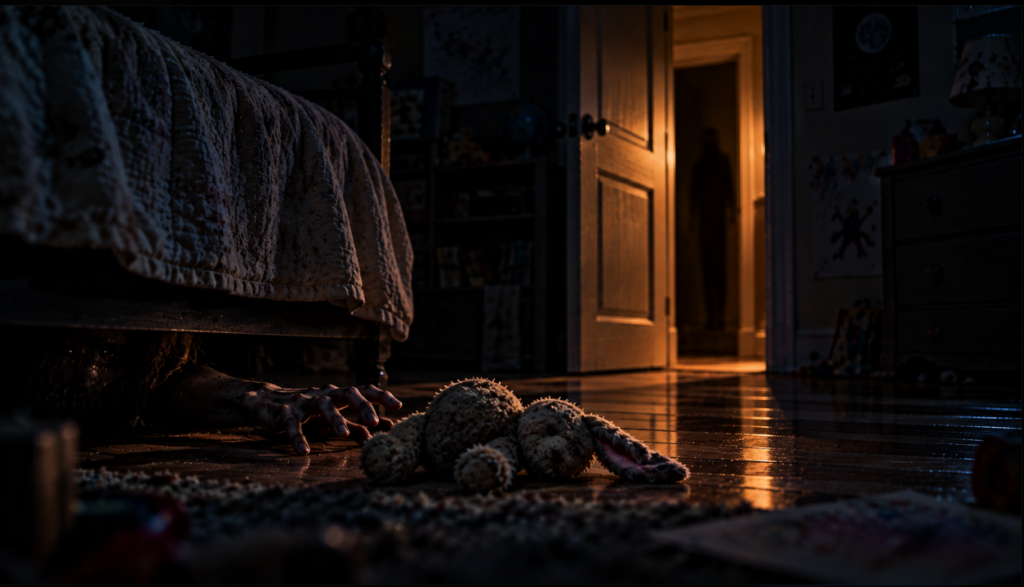
Sinister sent viewers’ heart rates soaring. Skinamarink made them physically tense without relying on the same explosive shocks. And somewhere in Japan, Pulse has been quietly ruining people’s relationships with dark hallways for the past 25 years.
Now, which one is actually scarier?
Think objectively. Is there a formula that can break down the essence of the scariest horror movies and definitively say, “Yeah, these!”? That’s the problem with naming the scariest horror movies ever made. A racing heartbeat can be measured. The feeling that something followed you home is considerably harder to quantify. And everyone thinks they’re the expert.
So, the cracked crew at NoScriptNeeded decided to try it, objectively.
Introducing the DREAD Index, our original six-part ranking system that puts horror movies through a different kind of examination. It considers what happens to viewers during a film, how effectively filmmakers build fear, whether the experience lives up to its reputation, and what remains after the credits roll.
Because a movie that makes somebody jump out of a chair isn’t necessarily the one that makes them afraid to sit alone in that chair tomorrow night. And we’re especially interested in that second chair.
How the DREAD Index Works
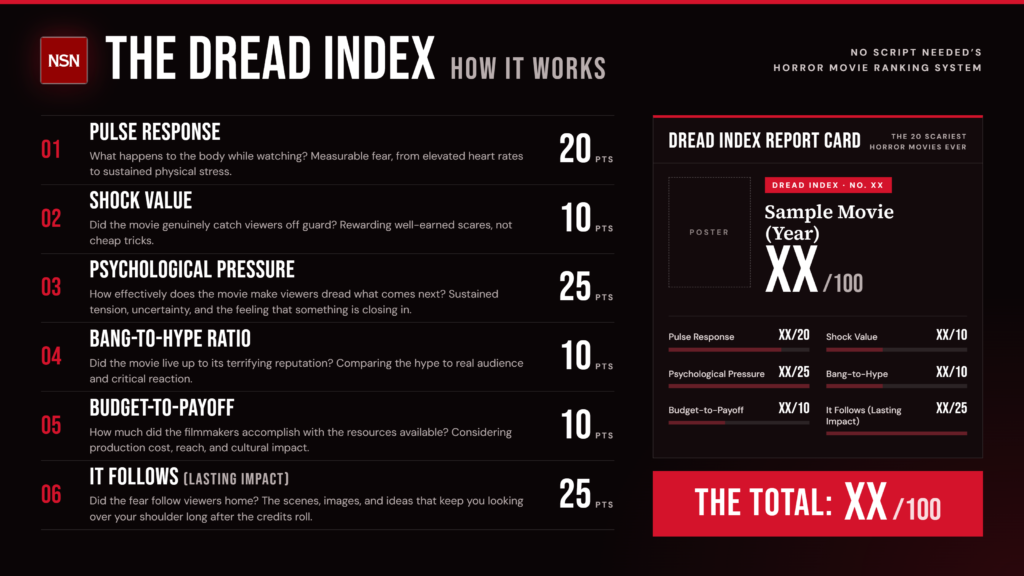
Every contender is evaluated across six categories totaling 100 points. The DREAD Index draws on available physiological research, critical reception, audience response, production information and editorial assessments.
The categories aren’t weighted equally, either. Sustained psychological terror and lasting unease matter more than a momentary shock, as it would in any one of the scariest horror movies ever. And a movie doesn’t earn extra credit simply for being famous, expensive, recent or exceptionally disgusting.
1. Pulse Response — 20 Points
What happens to the body while watching?
The Science of Scare Project measures viewers’ heart rates, peak heart rates and heart-rate variability during horror screenings. In its 2026 results, Sinister retained the overall crown, while Skinamarink and Undertone produced especially strong indicators of sustained stress.
The research is useful, although it comes with limitations. Its panel watches a selected group of English-language films, leaving international horror classics without comparable measurements.
We aren’t going to penalize a Japanese ghost for failing to attend an English-language screening.
2. Shock Value — 10 Points
Did the movie genuinely catch viewers off guard?
A great jump scare is a little act of cinematic robbery. For a split second, the filmmaker steals the audience’s composure, usually along with half its popcorn. Then comes the proverbial pee stain. (Admit it, that has been close to happening to you at least once.)
This category rewards well-executed surprises, unexpected revelations and shocks that feel earned. Loud noises, predictable ambushes and buckets of fake blood don’t automatically qualify.
Otherwise, we could crown a malfunctioning smoke detector.
3. Psychological Pressure — 25 Points
How effectively does the movie make viewers dread what comes next?
A shadow that doesn’t move. A sound nobody can explain. A character who knows something is wrong but cannot convince anyone else. Psychological Pressure measures sustained tension, uncertainty, helplessness and the creeping suspicion that something terrible is approaching.
Sometimes the most frightening thing is what the director refuses to show. Your imagination fills in the blanks, and unfortunately, it has an unlimited special-effects budget.
4. Bang-to-Hype Ratio — 10 Points
Did the movie live up to its terrifying reputation?
Horror marketing loves reports of fainting audiences, abandoned screenings and moviegoers supposedly too frightened to finish the film. Some movies earn that reputation. Others are considerably better at frightening publicity departments than paying customers.
This category considers expectations alongside critical and audience reactions. Independent films aren’t penalized for lacking a multimillion-dollar marketing campaign. And just because scary movies today are considerably scarier in HD than they were on VHS five decades ago doesn’t mean that when they came out five decades ago they didn’t throttle moviegoers then.
5. Budget-to-Payoff — 10 Points
How much did the filmmakers accomplish with the resources available?
Horror has a remarkable history of turning modest production budgets into enormous cultural and commercial returns. But theatrical gross isn’t profit, and financial success isn’t proof that a movie is frightening.
This category considers filmmaking efficiency, production resources and available commercial context without treating ticket sales as a fear meter. After all, a haunted house doesn’t become scarier because its owner qualified for a second mortgage.
6. It Follows — 25 Points
Did the fear follow viewers home?
Named with a nod to David Robert Mitchell’s It Follows (2014), this category separates a memorable fright from a lingering problem.
The movie is home to one of the best jump scares ever. And the film is about the human embodiment of an STD.
It’s the face remembered when the hallway light goes out. The scene returns three days later, while someone brushes their teeth. The ordinary noise that suddenly seems a little less ordinary.
The Index considers lasting imagery, critical assessments of cultural impact and the unsettling ideas that remain after the movie ends. This is the category responsible for grown adults checking beneath beds that sit approximately three inches above the floor.
What the DREAD Index Can—and Cannot—Prove
Fear is personal. No scoring system can establish that every viewer will find the same movie terrifying.
The DREAD Index combines available research with editorial judgment to make its rankings transparent and comparable. Physiological measurements are distinguished from critical assessments, and missing research isn’t treated as a failed test.
That matters when comparing a contemporary American release with a Japanese ghost story, a 1970s classic or an independent horror film that never received a wide theatrical release.
The Index also distinguishes fear from revulsion. A movie can be violent, controversial or extraordinarily difficult to watch without necessarily being frightening.
Our six category scores are editorial evaluations, not laboratory measurements. Each category is scored against its published maximum, producing a composite out of 100. Tied totals are separated by editorial judgment.
The goal is to find the movies that do the most with fear, whether they accomplish it through a racing pulse, a slow-building sense of doom or an image that refuses to leave the imagination.
The 20 (Truly) Scariest Horror Movies Ever, Ranked
Nobody at NoScriptNeeded strapped heart monitors to a roomful of unsuspecting volunteers. We leave that particular form of workplace harassment to the scientists.
What we have done is examine 20 films using the same six questions, providing readers with scorecards and the reasoning behind every placement.
Agree with our rankings? Wonderful.
Disagree? Even better. Horror fans haven’t survived decades of cursed videotapes, possessed dolls and hockey-masked murderers just to become agreeable now.
Turn down the lights. Bookmark the page. And watch at your peril.
20. A Nightmare on Elm Street (1984)
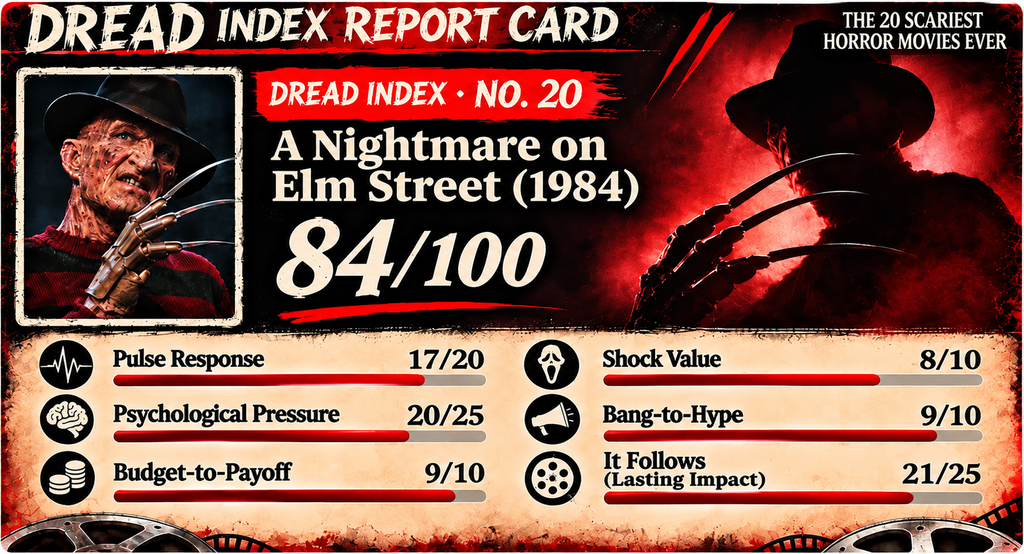
Wes Craven (The Hills Have Eyes, The Last House on the Left) discovered the one place horror fans couldn’t avoid forever: their own dreams.
Robert Englund (V, Eaten Alive) gave us Freddy Krueger, a razor-fingered psychopath who made bedtime considerably less appealing than a root canal. Forget the wisecracking mascot of later sequels. This Freddy is a sadistic predator who turns sleep into a death sentence.
Heather Langenkamp (Nickel Mountain, Just the Ten of Us) plays Nancy Thompson, a teenager clever enough to fight back, provided she can stay awake long enough to do it. Sure, this movie seems campy next to Hereditary or Sinister, but in the 1980s, kids were coming to school on insomnia binges. This formula worked as well as liquid fiber. Both get the ess right out of you!
That’s Craven’s wicked genius. This film literally changed sleeping habits. You can lock the doors, check beneath the bed, and sleep with the lights on. Eventually, biology wins. Sweet dreams. Freddy’s counting on them.
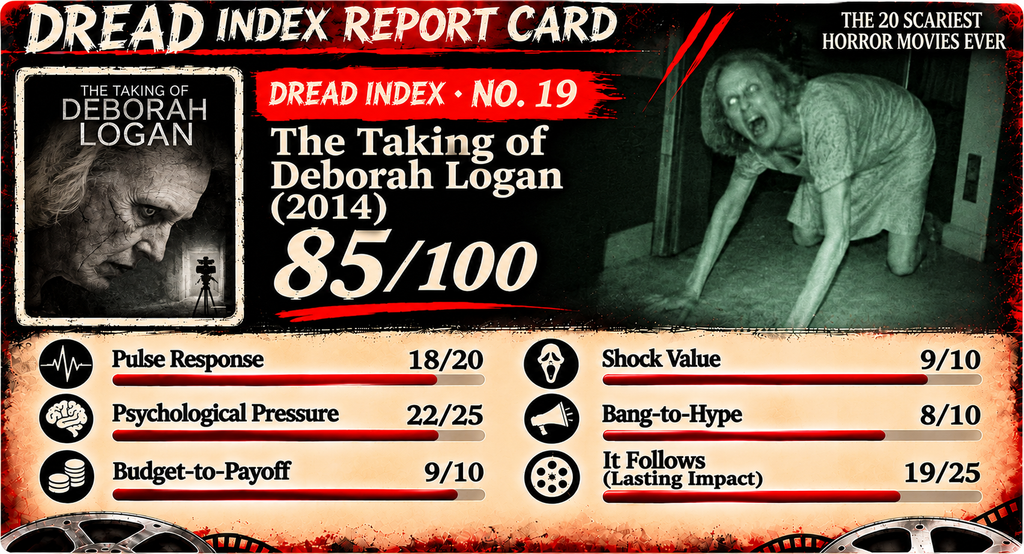
19. The Taking of Deborah Logan (2014)
Verdict
A documentary crew arrives to film an elderly woman struggling with Alzheimer’s disease. That’s heartbreaking enough without discovering that Grandma might have something considerably worse than dementia.
Director Adam Robitel’s feature debut stars Jill Larson (All My Children, Shutter Island) as Deborah Logan, whose increasingly bizarre behavior turns a family’s medical ordeal into a supernatural nightmare. The documentary format makes every outburst feel uncomfortably real, while daughter Sarah’s desperation gives the horror an emotional weight that most possession movies couldn’t lift with a forklift.
Then comes that scene involving Deborah’s mouth. You’ll know it when you see it. Let’s just say the human jaw was never designed to accommodate an entire entrée.
Released with relatively little fanfare, this found-footage sleeper has since developed a devoted following in horror. Some families worry about what Grandma might swallow. This one has an entirely different problem.
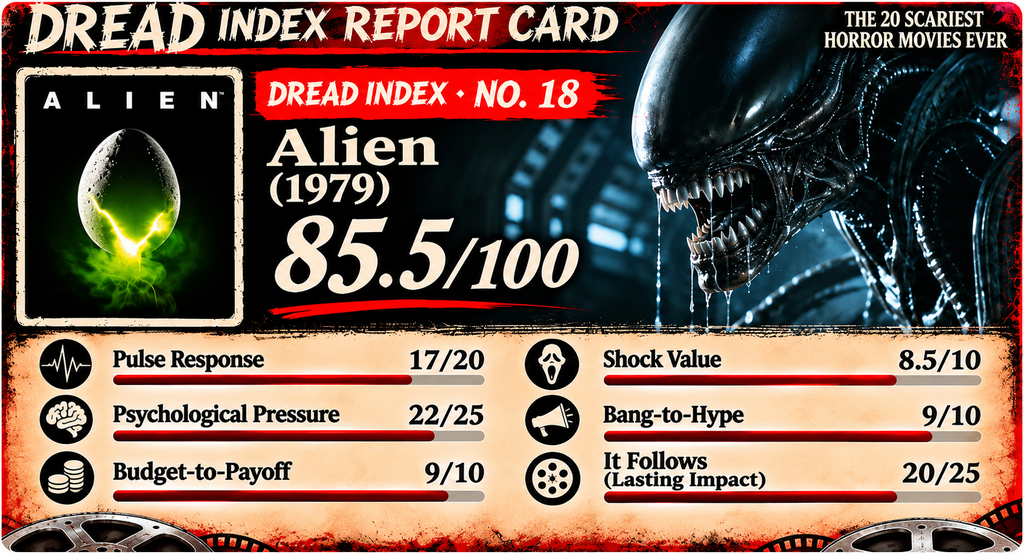
18. Alien (1979)
Verdict
Easily, this is the reason any sci-fi movie can be considered a horror movie! Why? Because “in space, no one can hear you scream.” Apparently, they can’t hear you file a workplace safety complaint, either.
Ridley Scott (The Duellists, Blade Runner) turns a routine commercial spaceflight into the worst company-sponsored team-building exercise in recorded history. Sigourney Weaver (Annie Hall, Ghostbusters) plays Ripley, the only crew member who seems to understand that bringing an unidentified organism aboard is a spectacularly stupid idea.
The chestburster scene remains one of cinema’s great violations of personal space. Yet the real terror comes from H.R. Giger’s creature design, the Nostromo’s suffocating corridors, and the awful realization that the crew is expendable to its employer.
Alien helped establish science-fiction horror as a genre capable of delivering genuine nightmares. Its influence is enormous, even if its extraterrestrial setting creates some distance from everyday fears.
The company wanted a specimen. The crew would’ve preferred dental coverage.
17. The Conjuring (2013)
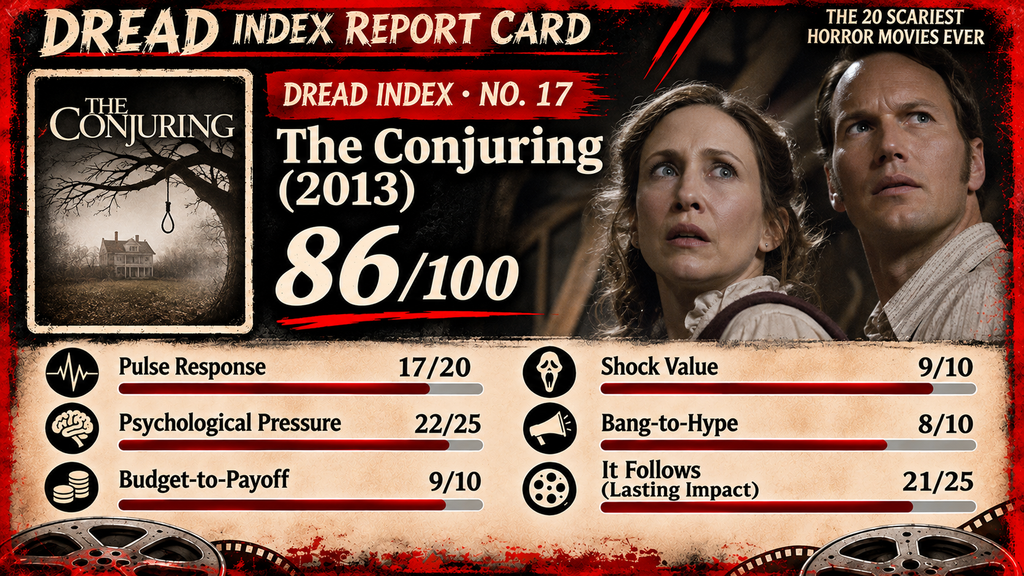
James Wan (Saw, Insidious) understands that haunted houses are a real estate agent’s worst nightmare. You can renovate the kitchen, repaint the bedrooms, and install new flooring. None of that matters when something in the basement keeps clapping at you.
There are 9 official movies in the Conjuring Universe as of Halloween 2026. And The Conjuring started it all—a franchise that has grossed more than $2.7 billion worldwide. That’s an enormous legacy for a haunted farmhouse.
Patrick Wilson (Hard Candy, Watchmen) and Vera Farmiga (Orphan, Up in the Air) portray paranormal investigators Ed and Lorraine Warren, called to help a family whose Rhode Island farmhouse has become a supernatural eviction notice.
Wan’s genius lies in making audiences stare into empty corners, waiting for something to move. His infamous clapping sequence turns a harmless childhood game into a legitimate reason to surrender the security deposit.
The Perrons wanted a family home. Instead, they got the kind of property disclosure that should require a priest and three attorneys.
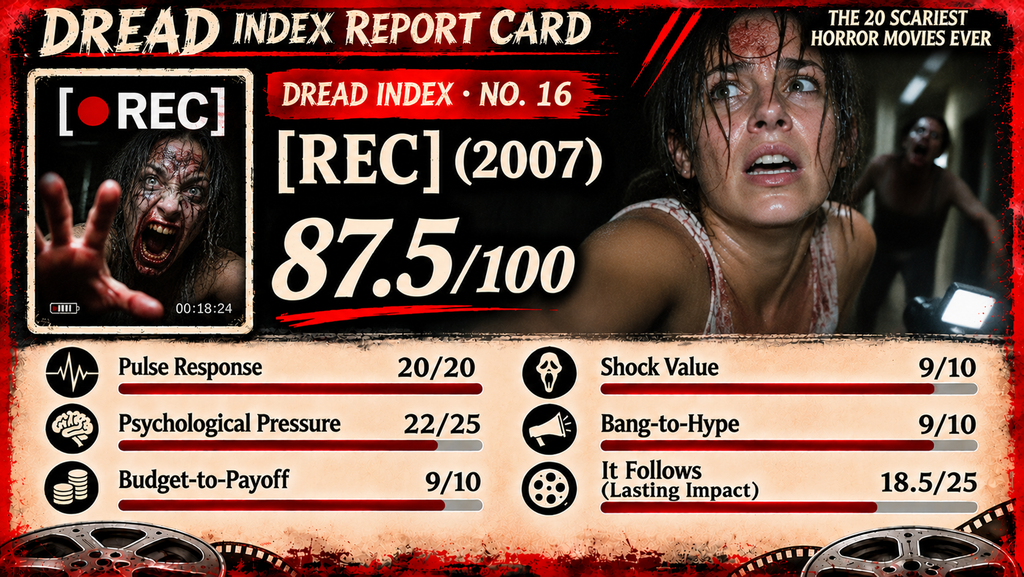
16. [REC] (2007)
Verdict
Some apartment buildings have noisy neighbors. The one in [REC] has neighbors who might eat your face, and the landlord is apparently unavailable for comment.
Spanish filmmakers Jaume Balagueró (Darkness, Fragile) and Paco Plaza (Verónica, Sister Death) trap a television reporter, her cameraman, and a crew of firefighters inside a Barcelona apartment building after an emergency call goes spectacularly sideways.
This is one of the few understated movies in the found-footage genre, but trust your sphincter is nonetheless clenched. The handheld camera makes every dark hallway feel like a colonoscopy performed by Satan. Worse, the authorities seal the building, leaving everyone inside to discover exactly how bad the situation has become.
By the time that night-vision camera switches on for the finale, you’ll be begging for the reassuring warmth of a power outage. Forget checking the locks. Check the lease for a zombie clause.
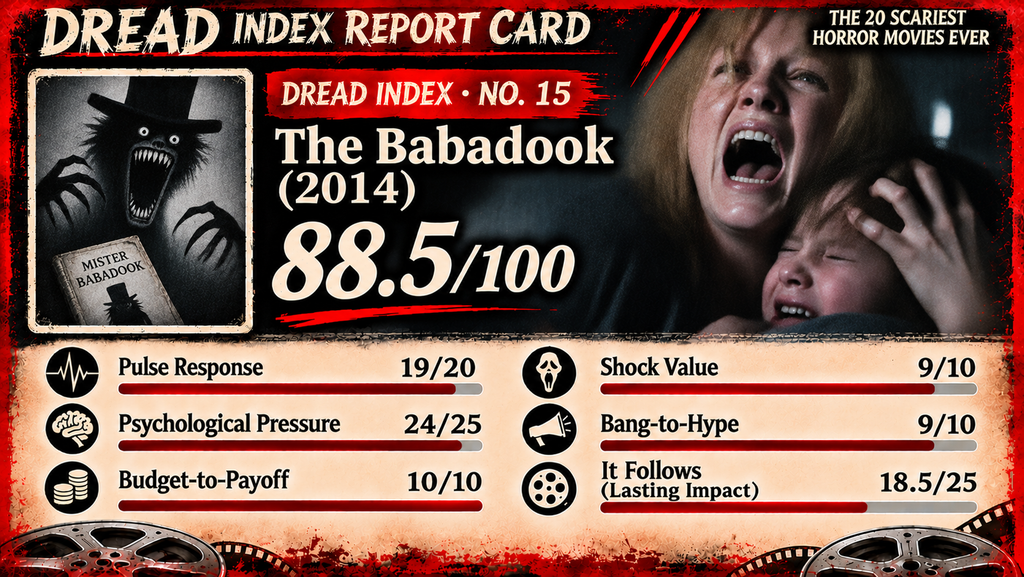
15. The Babadook (2014)
Verdict
Ah yes. If you know, you know. This movie is golden and was the catalyst for the horror renaissance.
Parenting is exhausting. Parenting a grieving six-year-old who keeps insisting a top-hated nightmare lives in your house? That’s enough to make Mary Poppins request a transfer.
Jennifer Kent’s feature debut follows widowed mother Amelia (Essie Davis, The Matrix Reloaded, Miss Fisher’s Murder Mysteries) as a sinister children’s book arrives at precisely the wrong time. Her son Samuel’s increasingly frantic warnings might be the least frightening thing about their household.
Kent makes grief feel like an unwanted houseguest glaring through your peephole and knows where you hide the spare key. The creature is terrifying, but Amelia’s unraveling is what gets under your skin. Sleep deprivation has rarely looked so much like a hostile takeover.
And that infernal book? Makes Goodnight Moon look like a restraining order waiting to happen.
14. The Descent (2005)
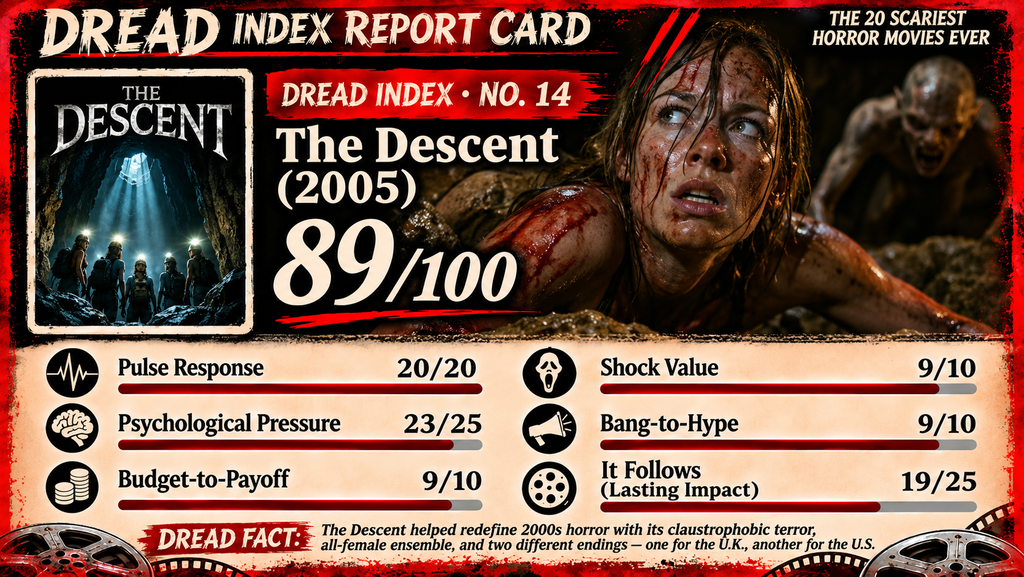
Verdict
Spelunking already sounds like something your insurance company should prohibit. Neil Marshall (Dog Soldiers, Doomsday) decided to make the argument considerably stronger.
Six women venture into an Appalachian cave system, where a collapsed passage leaves them trapped underground. The darkness, dwindling supplies, and increasingly fractured friendships would be plenty to contend with. Then they discover the locals, who haven’t seen daylight or a dentist in several generations.
Marshall’s masterstroke is making the caves terrifying long before the creatures appear. Every narrow passage feels like the earth is trying to swallow its guests without chewing.
The film also became a modern horror landmark for its all-female ensemble and famously different British and American endings. By the time the crawlers arrive, claustrophobia has already done the heavy lifting. The monsters are simply there to collect the deductible.
13. Sinister (2012)
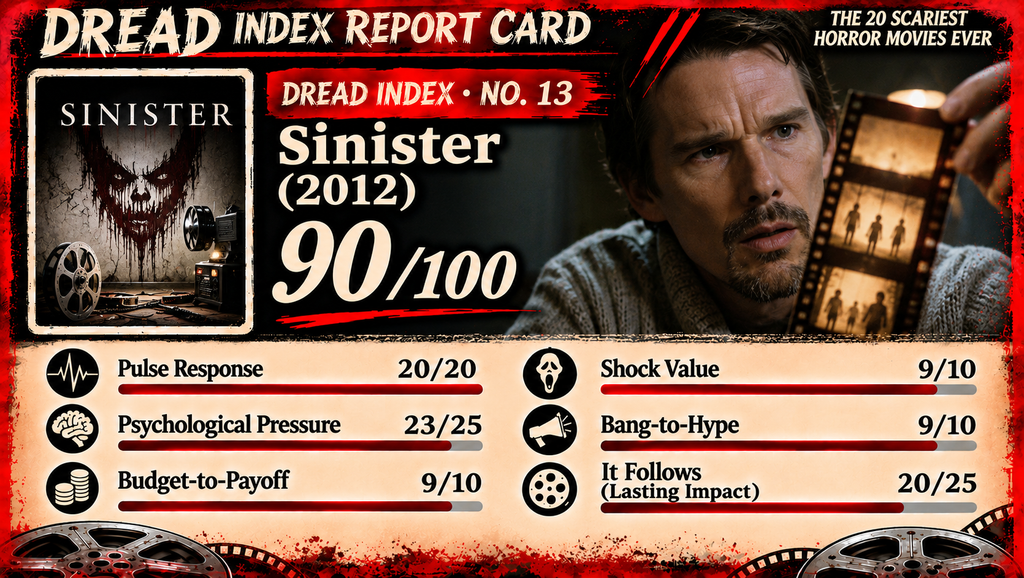
Verdict
True-crime writers will do almost anything for a bestseller. Ellison Oswalt moves his family into a murder house without telling them. That’s less investigative journalism than grounds for a divorce attorney to buy a yacht.
Ethan Hawke (Training Day, Before Sunrise) plays the struggling author who discovers a box of Super 8 home movies documenting gruesome family murders. Director Scott Derrickson (The Exorcism of Emily Rose, The Black Phone) makes each reel feel like evidence somebody buried for a very good reason.
Here’s the kicker: a 2020 study measuring viewers’ heart rates named Sinister the scariest movie tested. Its combination of grainy footage, dreadful sound design, and Bughuul’s ghastly face certainly makes the case.
Ellison wanted a publishing comeback. Instead, he found a home-video collection that makes the Kardashians look camera-shy.
12. Host (2020)
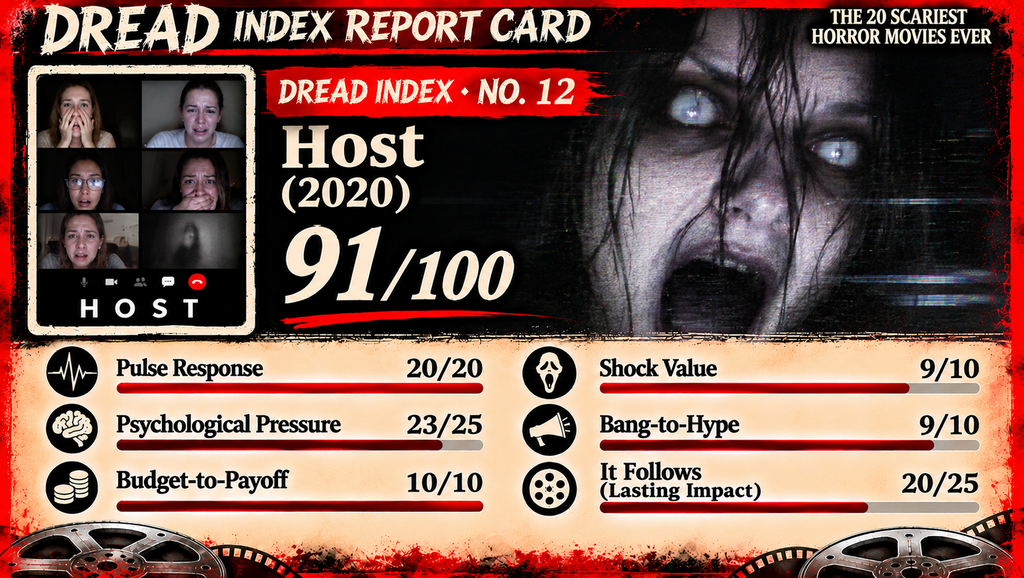
Verdict
Remember when the worst thing that could happen on a Zoom call was somebody forgetting to mute themselves? Rob Savage (Dawn of the Deaf, Salt) had considerably more ambitious technical difficulties in mind.
Filmed during the COVID-19 lockdown, Host follows six friends who invite a medium to conduct an online séance. One participant treats the supernatural like a party trick, and before long, the group discovers that whatever they’ve summoned has excellent broadband and absolutely no respect for personal boundaries.
At just 57 minutes, Host has barely enough time to introduce itself before it starts rearranging your nervous system. The webcam windows become tiny rooms you desperately want to inspect, and every frozen screen feels like a death threat.
The film’s extraordinary efficiency helped it top the 2021 Science of Scare rankings. Turns out the most terrifying words on Zoom aren’t “You’re on mute.” They’re “Your meeting has been joined by an uninvited participant.”
11. Sleep Tight (Mientras Duermes, 2011)
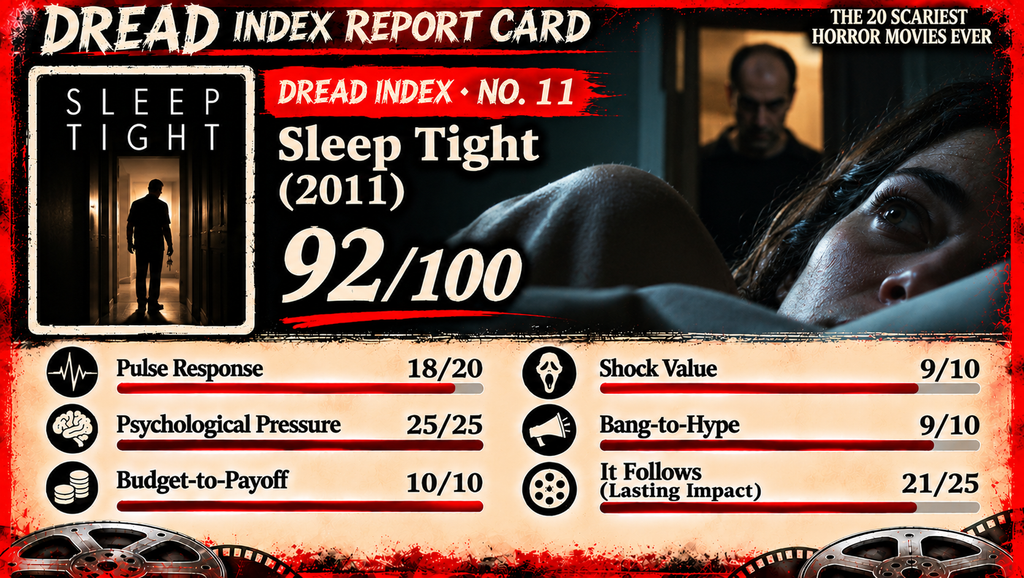
Verdict
Most apartment residents worry about noisy neighbors, lousy plumbing, or somebody stealing their Amazon packages. In Sleep Tight, the real problem is the man downstairs who has a master key and the emotional stability of a rabid badger.
Jaume Balagueró (Darkness, [REC]) directs this Spanish psychological nightmare about César (Luis Tosar, Cell 211, Take My Eyes), a building concierge whose inability to feel happiness becomes everybody else’s problem. He develops a particularly vicious obsession with Clara, a tenant whose cheerful disposition apparently constitutes a personal insult.
Balagueró lets us watch César’s intrusions unfold in agonizing detail. There’s no demon to blame, no supernatural escape hatch, and no comforting assurance that this couldn’t happen in an ordinary apartment building.
The film’s cruelest trick is making a familiar place feel permanently contaminated. Forget checking under the bed. Check who has a copy of your key.
10. The Witch (2015)
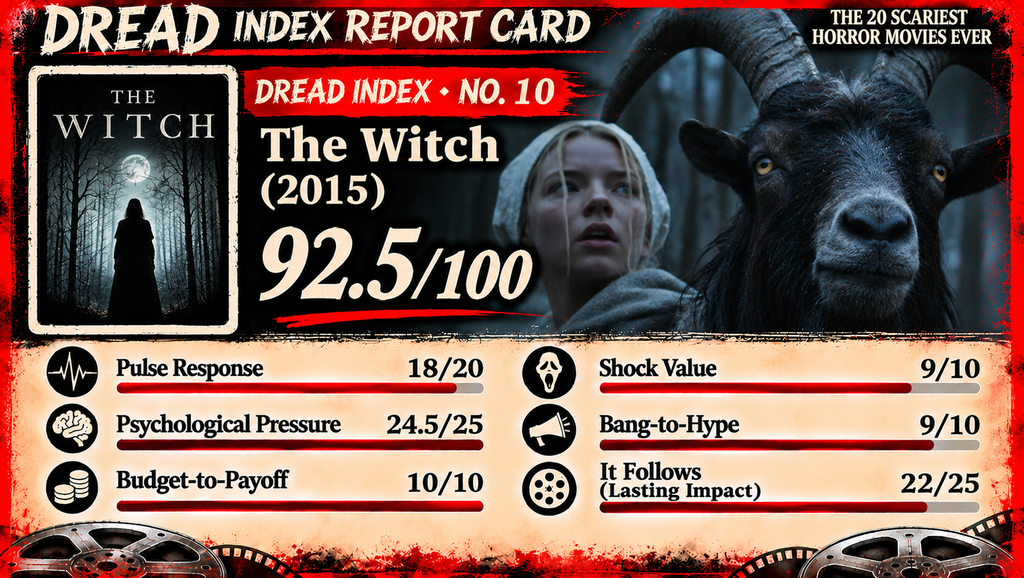
Verdict
Most families have disagreements about religion, parenting, and whose turn it is to milk the goat. In The Witch, those disagreements end with everyone wondering whether the goat works for Satan. Or actually is Satan!
Robert Eggers (The Lighthouse, Nosferatu) makes his feature debut with a Puritan family banished to the edge of a New England wilderness, where an infant disappears, and suspicion begins eating the household alive. Anya Taylor-Joy (Split, The Queen’s Gambit) plays Thomasin, a teenager whose family increasingly mistakes fear for faith.
Eggers researched period language and beliefs, giving the supernatural terror an unnerving authenticity. The forest barely moves, yet every tree seems to be keeping a secret.
And Black Phillip? That goat accomplishes more with a stare than most horror villains manage with an entire slaughterhouse. Admit it: You’ll never hear “Wouldst thou like to live deliciously?” quite the same way again.
9. The Blair Witch Project (1999)
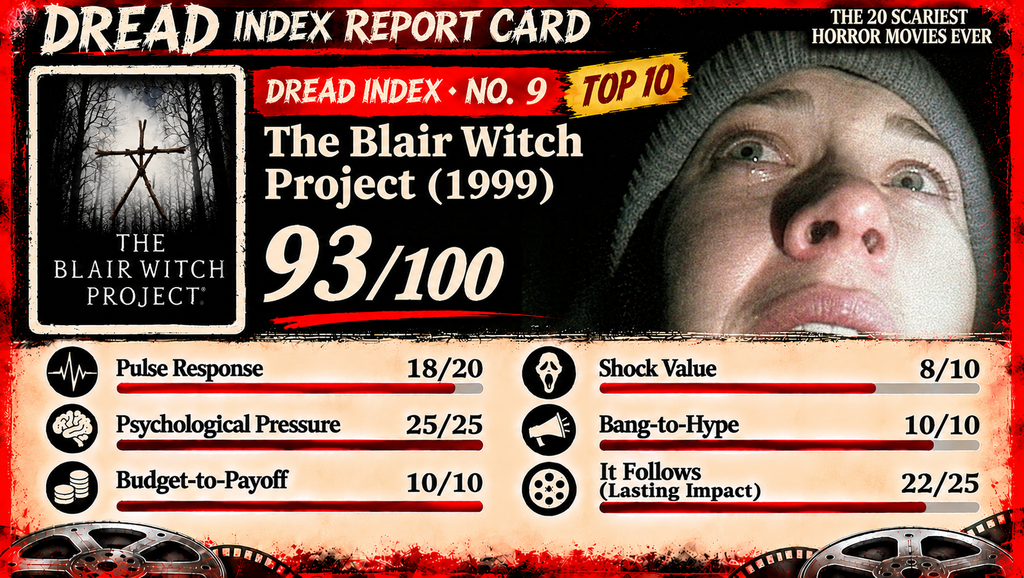
Verdict
Before anyone entered those Maryland woods, The Blair Witch Project had already scared the hell out of America. This is something those who weren’t there find difficult to believe.
Daniel Myrick and Eduardo Sánchez launched a website presenting three missing filmmakers as real people, complete with police reports, fabricated evidence, and a centuries-old curse. The actors were even listed as missing on IMDb. Millions followed the mystery, and plenty arrived at theaters wondering whether they were about to watch someone’s final moments.
Then came the movie: three terrified students, an increasingly hostile forest, and a camera that never shows what everyone desperately wants to see. Every snapped twig sounds like a death sentence. That final figure standing in the corner still makes your stomach drop.
Hollywood had spent fortunes showing audiences monsters. These guys spent pocket change convincing people one might actually exist. And trust, it did.
8. Talk to Me (2023)
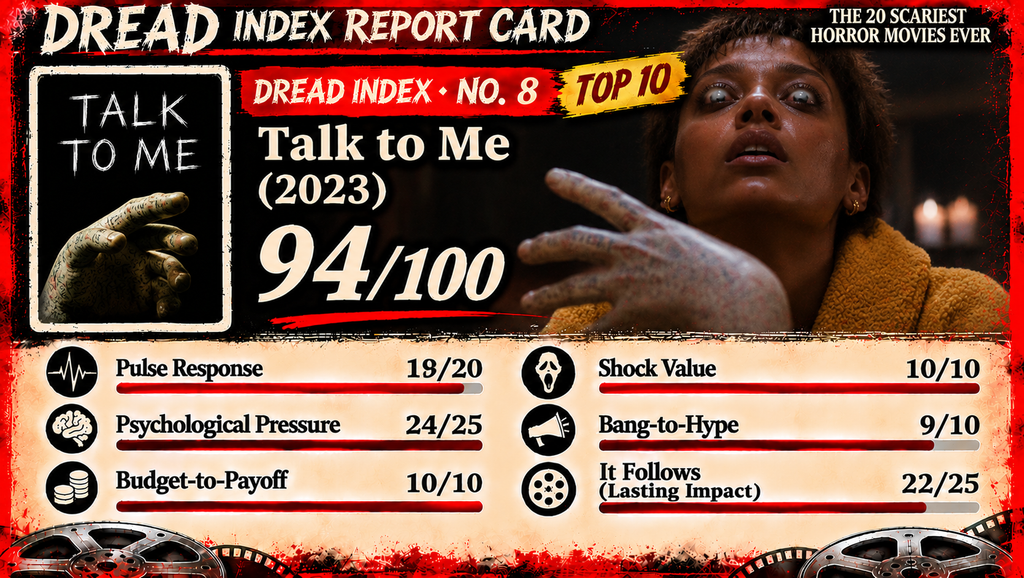
Verdict
Teenagers have always found spectacularly stupid ways to entertain themselves. The kids in Talk to Me discover an embalmed hand that lets them invite the dead into their bodies, then treat demonic possession like the latest TikTok challenge.
Because sure, that’s fun. Somebody should probably confiscate their phones. And that cursed hand.
Australian filmmakers Danny and Michael Philippou turn that premise into a merciless nightmare, with Sophie Wilde (The Portable Door, Babygirl) delivering a devastating performance as Mia, a grieving teenager desperate to reconnect with her mother. What begins as a party trick becomes a horrifying addiction, complete with peer pressure, withdrawal, and consequences nobody can swipe away.
The possession scenes are viciously physical, particularly one involving a teenager and a bathroom that will make you wish the filmmakers had settled for a tasteful cutaway.
By the end, the scariest thing about opening a door to the dead is discovering how eagerly the living will hold it open.
7. The Autopsy of Jane Doe (2016)
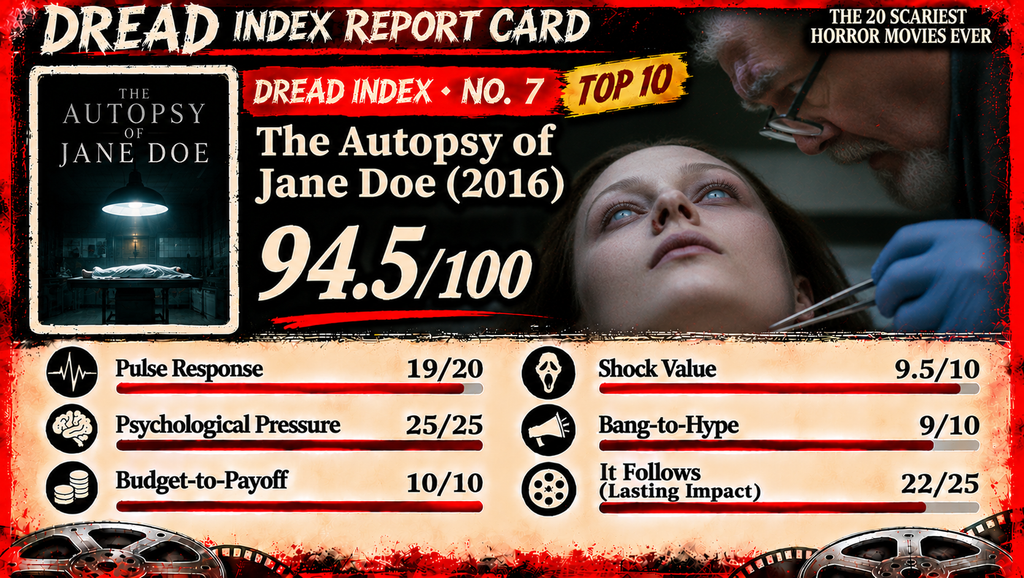
Verdict
There’s something profoundly wrong with the body on the table. No wounds. No identification. No explanation for why an entire house looks like a massacre while its most mysterious occupant hasn’t suffered a scratch.
In André Øvredal’s (Trollhunter, The Last Voyage of the Demeter) suffocating little nightmare, Brian Cox (Succession, Manhunter) and Emile Hirsch (Into the Wild, Lone Survivor) begin an autopsy that slowly becomes an excavation of something unspeakable. Bones are broken beneath unblemished skin. Impossible objects turn up inside the corpse. Somewhere beyond the morgue doors, a bell begins to ring.
The genius is in the waiting. Jane Doe lies perfectly still while everything around her becomes increasingly, horribly wrong. Every new discovery tightens the room around you until even the fluorescent lights feel hostile.
You’ll spend the entire film begging that corpse not to move. Then you’ll realize she doesn’t have to.
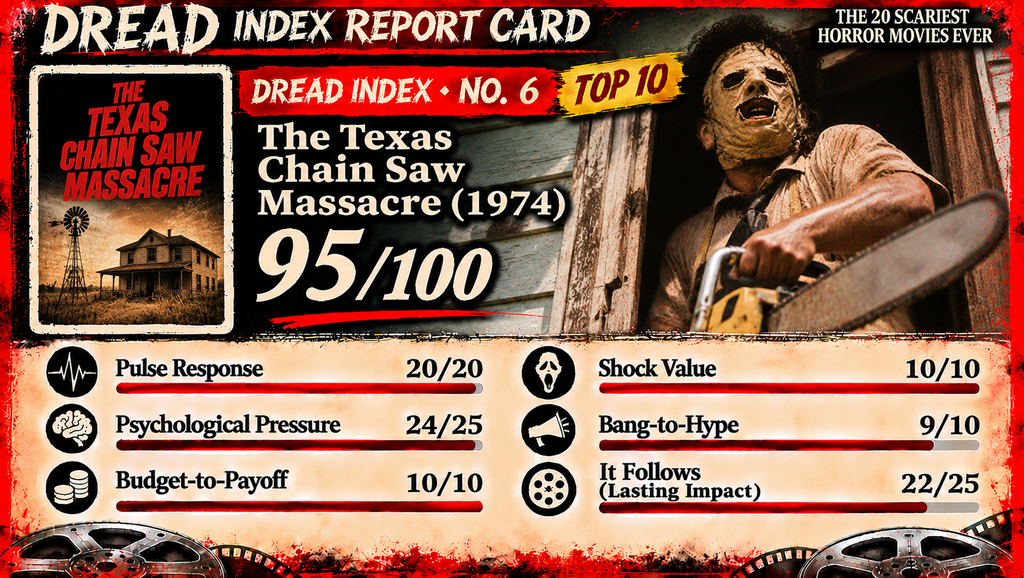
6. The Texas Chainsaw Massacre (1974)
Verdict
Before Leatherface ever started his chainsaw, the acclaimed Austin-born Tobe Hooper had already committed his first act of cruelty: convincing audiences they were watching a true story.
The opening narration, lurid advertising, and echoes of real killer Ed Gein gave The Texas Chain Saw Massacre (1974) the stink of an actual crime scene. Then Hooper (Poltergeist, Salem’s Lot) dropped five unsuspecting travelers into a sweltering Texas nightmare of rotting meat, human bones, and a farmhouse where the family business is murder.
Leatherface’s first appearance is horrifyingly abrupt. A hammer falls. A steel door slams. And suddenly the movie feels dangerously unscripted.
Marilyn Burns’s screams and that sadistic dinner sequence finish the job. Hooper shows remarkably little gore, yet your brain supplies enough carnage to stock a slaughterhouse.
The massacre never happened. Fifty years of nightmares certainly did.
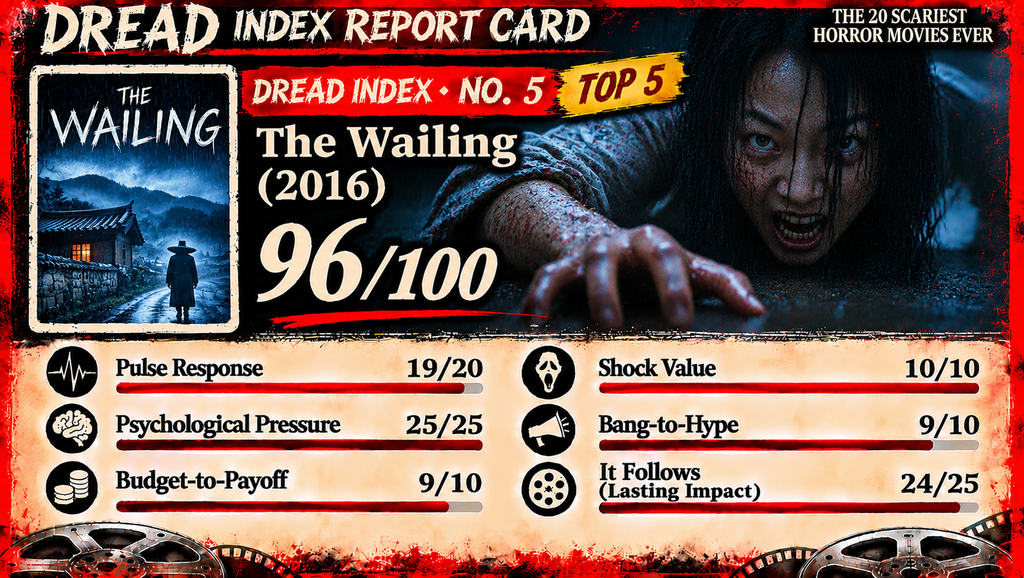
5. The Wailing (2006)
Verdict
A stranger arrives in a rain-soaked Korean village. People begin developing grotesque rashes, slaughtering their families, and behaving as though hell has opened a branch office in the countryside. The local police are spectacularly unprepared. Their training apparently covered traffic violations, not demonic outbreaks.
Na Hong-jin (The Chaser, The Yellow Sea) builds The Wailing into a nearly three-hour, cold-sweat fever dream that keeps changing the rules of its own nightmare. Kwak Do-won (The Attorney, Steel Rain) plays Jong-goo, a bumbling policeman whose investigation becomes unbearable when his young daughter starts showing symptoms.
A shaman’s frantic exorcism collides with Christian imagery, Korean folklore, and a stranger whose true nature remains terrifyingly uncertain. Every apparent answer makes the next revelation worse.
By the final act, you’re so desperate to know whom to trust that you’ll practically beg the devil for clarification. Good luck with that. He’s remarkably persuasive.
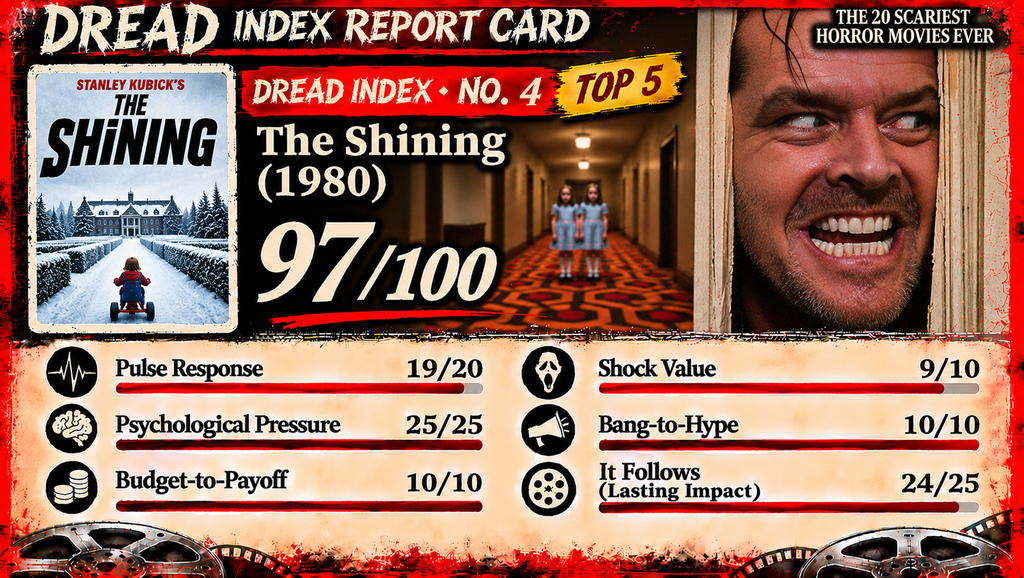
4. The Shining (1980)
Verdict
The Overlook Hotel is empty for the winter. That’s the first lie Stanley Kubrick tells you. There’s something in every corridor, behind every locked door, and inside the man who’s supposed to keep his family safe.
Jack Nicholson (One Flew Over the Cuckoo’s Nest, Chinatown) plays Jack Torrance, a recovering alcoholic whose caretaker job gives him months of isolation, a typewriter, and a hotel delighted to have him. His son Danny sees murdered twins in the hallway. Room 237 offers an embrace that curdles into decay. Blood pours from an elevator as casually as room service arriving late.
Kubrick (2001: A Space Odyssey, A Clockwork Orange) makes every symmetrical hallway feel like a trap. Danny’s tricycle rattles across hardwood, falls silent on carpet, and rounds another corner you desperately wish he’d avoid.
Then Jack picks up an axe. (BTW, he was a real-life volunteer firefighter. Those whacks were real.)
The Shining remains one of the most terrifying adaptations in Stephen King’s celebrated catalog. The delicious irony? King famously hated Kubrick’s vision.
Imagine what might have happened if he’d loved it.
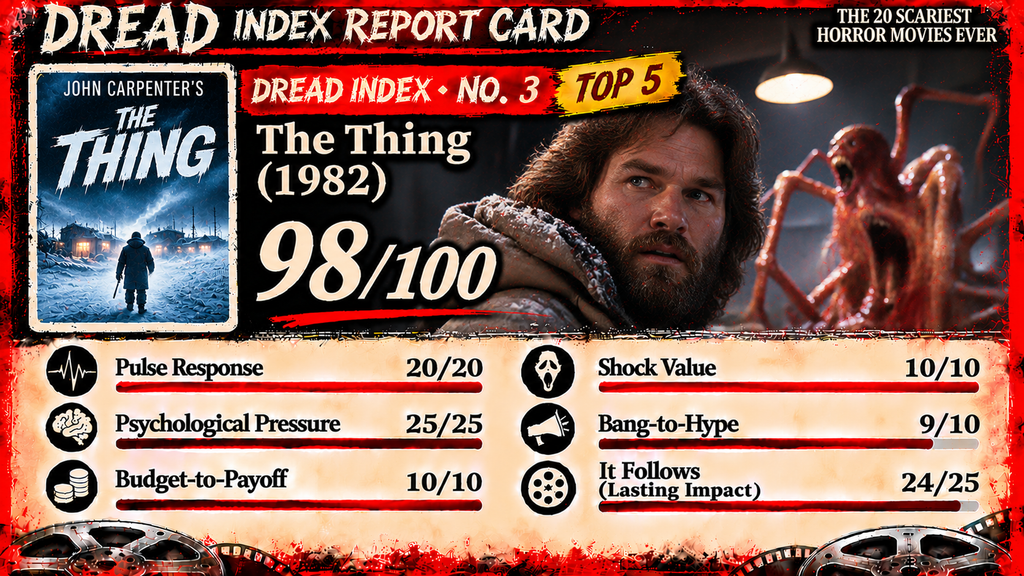
3. The Thing (1982)
Verdict
A dog trots into an Antarctic research station. Within minutes, John Carpenter has turned man’s best friend into an argument for owning a goldfish.
In The Thing, Kurt Russell (Escape from New York, Big Trouble in Little China) leads twelve isolated men against an extraterrestrial organism that can imitate any living creature perfectly. A colleague might be your friend. He might also be something that has eaten your friend and learned how to wear him.
Rob Bottin’s practical effects remain gloriously obscene. Flesh splits, limbs mutate, a severed head sprouts legs, and one unfortunate doctor’s attempt at CPR becomes the worst medical malpractice case in Antarctic history. Carpenter (Halloween, They Live) makes the gore almost secondary to the paranoia. That blood-test sequence is a master class in making an audience afraid of a wire touching a dish.
The film was savaged upon release. Four decades later, its monsters still look hideously alive, and its ending refuses to tell you who’s human.
You can survive the cold. Good luck surviving the person sharing your blanket.
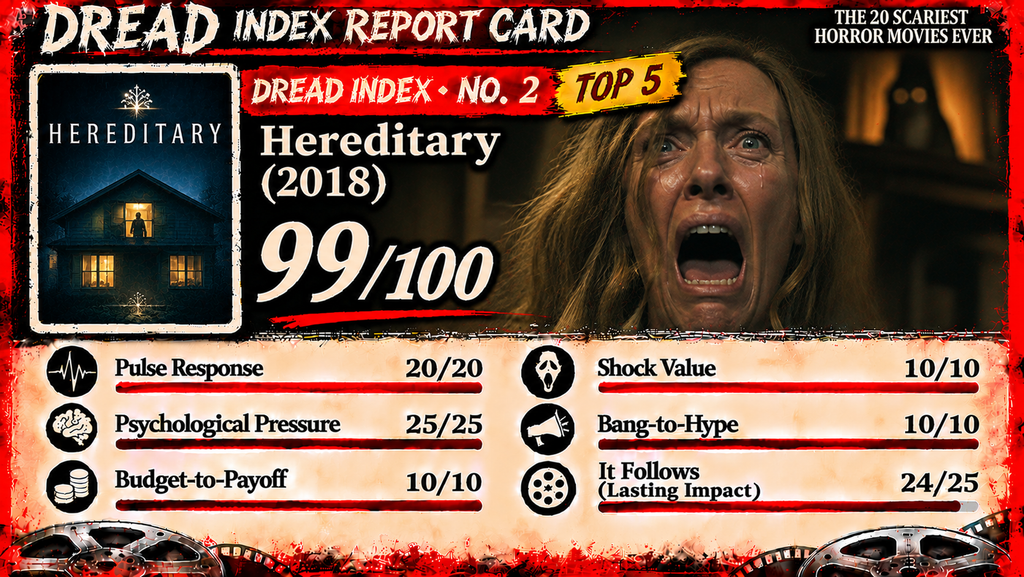
2. Hereditary (2018)
Verdict
There’s a sound in Hereditary that will ruin your relationship with your own tongue. A small, deliberate click. By the time you understand what it means, Ari Aster has already made certain you’ll never hear it innocently again.
Aster (Midsommar, Beau Is Afraid) begins with a funeral and slowly dismantles a family already cracking under grief. Toni Collette (The Sixth Sense, Little Miss Sunshine) delivers a ferocious performance as Annie Graham, a mother whose household becomes a museum of unspeakable loss. One roadside accident leaves you staring at the screen, praying the camera won’t show what you know is coming. The following morning is worse.
Then the shadows start moving. Something watches from the ceiling. A family dinner turns into emotional vivisection. By the final act, even the house seems to have joined the conspiracy.
Hereditary may be the cruelest horror film of its generation. It makes grief feel contagious and evil feel hereditary.
But its nightmare ultimately has an explanation. Our No. 1 makes you confront the possibility that no explanation can ever make you safe.
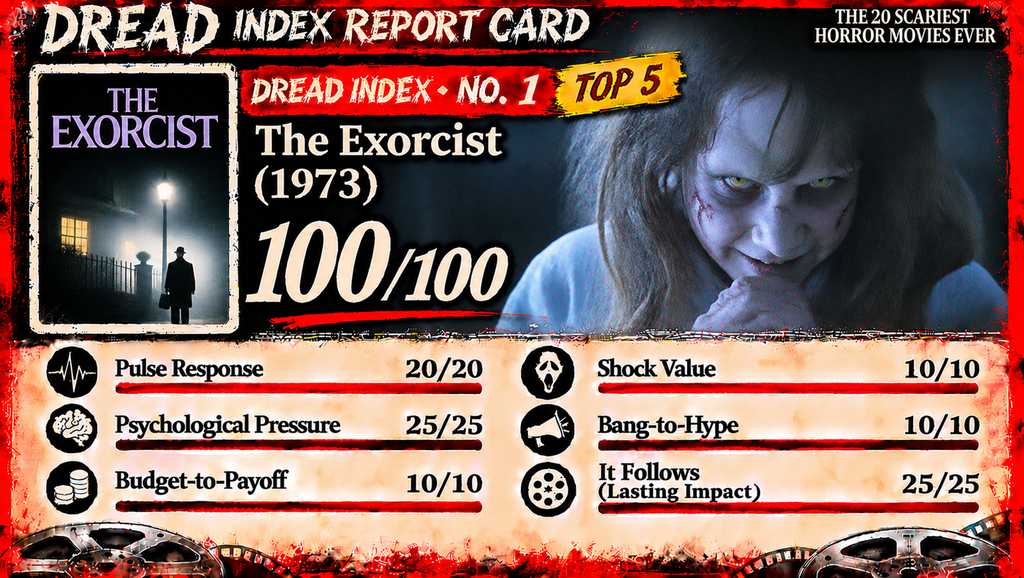
1. The Exorcist (1973)
Verdict
People went to see The Exorcist in 1973 and reportedly came out vomiting, fainting, or fleeing for the nearest exit. Some never made it through the screening. Theaters had lines stretching around blocks, and the movie had barely opened before America began debating whether the devil was real.
William Friedkin (The French Connection, Sorcerer) took William Peter Blatty’s story of a possessed girl and made the impossible feel horribly plausible. Linda Blair’s Regan begins with strange noises and a shaking bed. Doctors subject her to terrifying examinations. Her mother, played by Ellen Burstyn (Alice Doesn’t Live Here Anymore, Requiem for a Dream), watches helplessly as her daughter’s voice changes, her body contorts, and her bedroom becomes a place nobody should enter alone.
Then the terror escaped the screen. Newspapers reported nervous breakdowns, psychiatric consultations, and people calling Catholic rectories to ask about exorcisms. Clergy found themselves fielding questions about demonic possession. The movie became a national obsession, with religious arguments, alleged production curses, and frightened audiences feeding the frenzy.
Hereditary is a masterpiece of calculated cruelty. Its evil has a plan, a bloodline, and an eventual explanation. The Exorcist frightened people into questioning the world beyond the theater doors. It reached into medicine, religion, parenthood, and the uneasy possibility that evil might exist independently of our belief in it.
Fifty-three years later, we’re still arguing about what happened inside that Georgetown bedroom.
That’s the difference between a horror movie that scares the hell out of you and one that makes you wonder whether hell is real.
You May Also Like:
Add us as a preferred source on Google.