

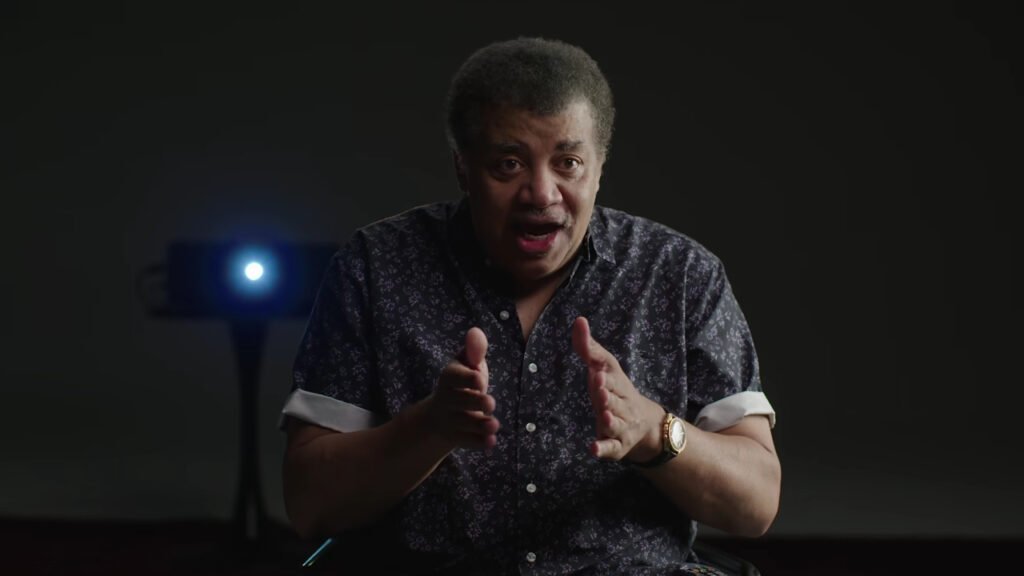
Neil deGrasse Tyson has built a side career out of dismantling Hollywood’s scientific liberties, but disaster movies give the astrophysicist more target-rich material than almost any other genre. Yet, among all the absurd physics and impossible explosions, there is one particular screenwriting trope that still manages to get under his skin every single time.
Why Tornadoes Always Seem to Know Exactly Where the Hollywood Sign Is
In a new breakdown for GQ, the astrophysicist zeroed in on what disasters in movies always seem to target.
“I’ve never understood why in disaster films the objects of disaster tend to aim for monuments and things we especially care about,” he said, singling out Roland Emmerich’s The Day After Tomorrow (2004). “You have all the area of California the tornado is hitting the Hollywood sign”.
Tyson pointed to a scene of a tornado bearing down on the sign as his latest example. It clearly still gets to him.
“Have you ever been to the Hollywood sign? There’s so much else it could have hit and it’s not. It aimed for the Hollywood sign. So that pisses me off,” he added.
It’s far from the only film guilty of geographical pinpointing. Tyson also pointed to 1998’s Armageddon, where shattered pieces of a planet-killing asteroid somehow manage to strike the Chrysler Building in New York City rather than the vast, uninhabited ocean or open wilderness that covers most of Earth’s surface.
He favorably contrasted it with Deep Impact, which used actual NASA advisers to portray a meteor landing in the ocean and jokingly quipped, “First of all, it’s not a disaster movie unless you take out the Statue of Liberty.”
Beyond bad targeting, The Day After Tomorrow managed to irritate him on fluid dynamics alone. While the film accurately showed northern hemisphere storm systems rotating counterclockwise, it featured two giant tornadoes side-by-side for cinematic effect, a physical impossibility.
“We’re looking at these two tornadoes adjacent to one another that thermodynamically and the fluid dynamics of air will not permit that. And so while I was watching this movie, I was just pissed off the whole time.” he said.
Not every film earned his frustration. Tyson singled out Ridley Scott‘s The Martian (2015) as having some of the highest physics integrity of any sci-fi film ever made.
He credited author Andy Weir, a software engineer turned novelist, for staying scientifically grounded even when he could have taken shortcuts. Tyson has made these breakdowns something of a signature, and disaster movies remain one of his favorite targets for both praise and frustration.
Add us as a preferred source on Google.
Conversation