
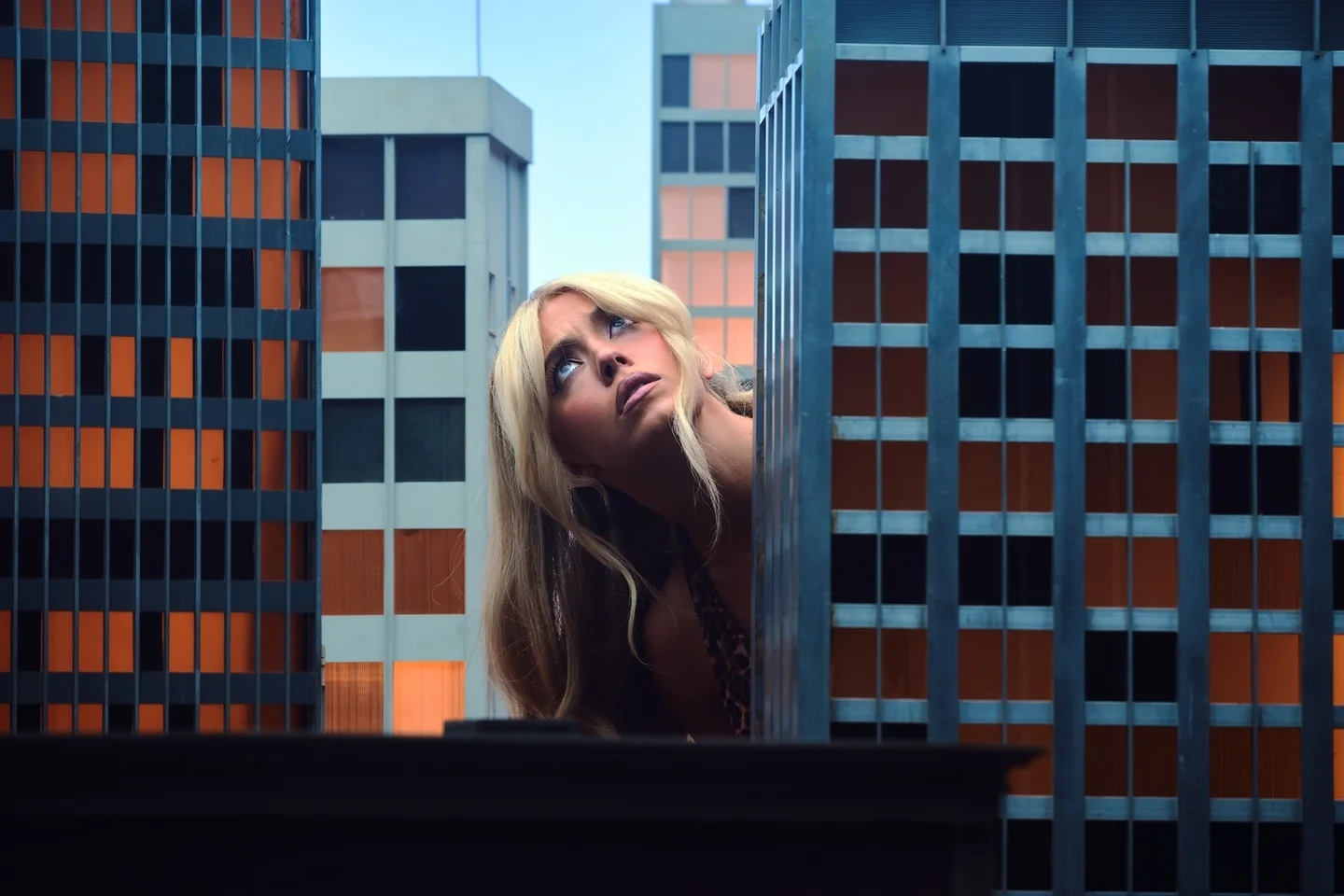
By the time Euphoria reached the middle stretch of its third season, the show’s reality had pushed into full absurdist territory. In Season 3, Episode 5, viewers were treated to a highly stylized visual sequence: Cassie Howard, framed like a towering movie monster, glaring through windows and stomping through a sprawling city landscape.
The moment, quickly dubbed “Cassie-Zilla” by viewers, looked like the kind of shot most modern shows would build with a green screen and a large VFX budget. But Euphoria took a more tactile route. Instead of dropping Sydney Sweeney into a purely digital environment, the production built miniatures, shot practical elements on a soundstage, and used old-school compositing to create one of the season’s strangest visual jokes.
The Scene Started With A Miniature Build, Not A Green Screen Shortcut
Cassie-Zilla appears as a surreal visual metaphor tracking Cassie’s pursuit of Hollywood fame and her rapidly expanding online persona. Sam Levinson wanted that transformation to tip into something surreal, so the show turned Cassie into a giant looming presence, breathing heavily and staring down at the city below. It is a ridiculous image, but it fits the episode’s B-movie satirical logic.
To pull it off, the art department spent an entire year constructing a large-scale miniature version of the exterior cityscape, featuring iconic landmarks from Hollywood and Downtown Los Angeles. This was not a tiny tabletop model designed for distant photography. The structures were built large enough for Sweeney to lean over them and place her face in the windows, allowing the production to treat her as part of the set rather than a separate digital element.
That choice immediately changed the texture of the scene. Sweeney could rest her hands against the buildings, hover over the windows, and move within the miniature space with clear physical reference points. The performers did not have to guess where the edges of the set were because the set was actually there.
It also gave the image the slightly artificial quality the sequence needed. The sequence operates in a heightened, self-conscious space where realism matters little. A practical miniature kept the shot rooted in that classic cinematic world. Cassie does not look like a polished superhero-sized visual effect; she looks like a giant figure invading a handmade stage illusion, which suits the scene far better.
Sydney Sweeney’s Performance Worked Because She Had A Real Environment To Play Against
The miniature setup was not just an art-direction flex. It gave Sweeney something concrete to work with at a moment that depends on physical comedy as much as visual scale. Cassie-Zilla is funny because of the image itself, but it only lands if Sweeney knows exactly how to position her body within that tiny world.
Inside the build, she could judge where to place her hands, how far to lower her face toward the windows, and how to angle her shoulders so Cassie felt huge without blocking the details of the set. Those are small decisions, but they matter in a shot where the comedy comes from seeing an oversized human body invade a delicate little city.
The practical setup also helped the scene photograph more naturally. Because Sweeney stood inside an actual environment, the lighting on her face and body matched the miniature around her. Shadows from the buildings fell where they should, and the camera captured real interactions between the performer and the set rather than asking post-production to fake every piece of contact.
That is a big reason the shot does not read like a simple digital insert. Even after the compositing work, the foundation still came from something tangible. The audience may not consciously register the difference, but they can feel it. Cassie seems present in the scene rather than pasted onto it.
The Final Illusion Came Together Through Careful Camera Matching
Once the crew had Sweeney’s miniature footage, they still needed to merge it with the rest of the sequence. The elements inside the buildings were filmed separately on full-size sets, which meant the production had to line up the perspective of both shoots with real precision. Camera position, lens choice, and angle all had to match, or the scale illusion would collapse.
That is where the trick becomes less about one special effect and more about coordination. The miniature footage and the main footage had to feel as if they belonged to the same space, even though they were captured separately. By matching focal length and framing across both setups, the production created a clean visual bridge between giant Cassie and the world below.
It is an old filmmaking principle dressed up for a modern HBO drama. Long before CGI became the default solution, filmmakers used miniatures, compositing, and forced perspective to build oversized creatures and impossible spaces. Euphoria borrowed from that toolbox rather than chasing a sleek digital finish, and the result suits the scene’s bizarre tone much better.
Cassie-Zilla works because it feels slightly strange in all the right ways. The image is too theatrical to be fully real and too tactile to feel like a throwaway digital gag. For a show built on emotional excess and stylized imagery, that balance makes the scene memorable. Instead of relying on CGI to do all the heavy lifting, Euphoria used practical craftsmanship to turn a meltdown into one of its most surreal visual swings.