

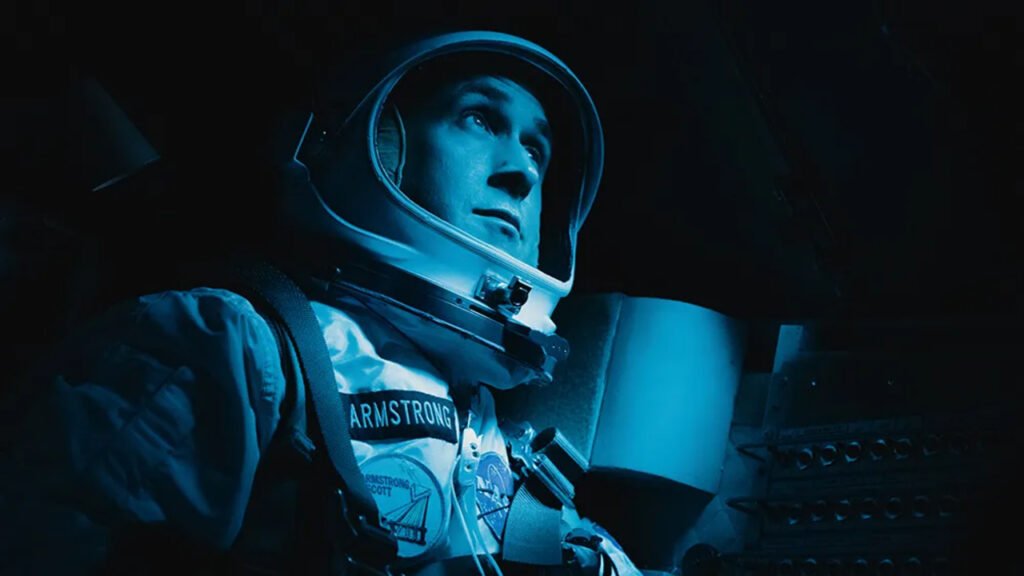
Damien Chazelle’s First Man has spent years carrying the reputation of a box office disappointment. That reputation comes from its theatrical performance, not from its filmmaking.
Released in 2018, the film earned $105.7 million worldwide against a reported net production budget of $59 million. Once global marketing costs were added, it finished an estimated $40 to $50 million short of breaking even, placing it among the year’s commercial underperformers.
That financial result has often overshadowed everything else the film accomplished. First Man received widespread critical praise, earned major awards recognition, and won the Academy Award for Best Visual Effects. It also approached the Apollo 11 mission differently from most space dramas, trading patriotic spectacle for historical realism and an intimate portrait of Neil Armstrong.
The Numbers Created a Reputation the Film Still Carries
First Man arrived with high expectations. Chazelle had just won the Academy Award for Best Director for La La Land, and Universal positioned the film as one of its major prestige releases. The studio also increased its scale. At a reported $59 million net production budget, First Man cost roughly twice as much as La La Land, though it remained far less expensive than most modern science fiction productions.
Its theatrical run never reached the level expected of a space epic. The film opened with $16 million domestically, debuting behind Venom and A Star Is Born. It finished with $44.9 million in North America and added $60.8 million overseas. The United Kingdom became its strongest international market, contributing about $10 million.
Those totals created the box office flop narrative. Using the industry standard multiplier that accounts for production costs, distribution, and global marketing, First Man needed roughly $147.5 million worldwide to break even during its theatrical run. Universal reportedly spent more than $32 million on television advertising in the United States alone. The film never recovered those costs in cinemas.
Commercial performance, though, says little about artistic achievement. Many films that underperform financially fade from discussion within months. First Man has remained part of conversations about modern filmmaking because its technical execution and thematic focus continue to attract attention years after its release.
Every Technical Decision Supported the Film’s Realism
Chazelle avoided the polished look that defines many recent space films. Instead of presenting NASA missions as smooth technological triumphs, he wanted audiences to experience how fragile early spaceflight felt. Every creative department worked toward that goal.
Cinematographer Linus Sandgren used three different film formats to separate the film’s environments. Grainy 16mm film captured Armstrong’s family life, giving those scenes an intimate, documentary-like texture. Super 35mm covered NASA facilities and training sequences.
The Moon landing alone expanded into 15/70mm IMAX, opening the frame after nearly two hours of confined interiors. The shift changes both the visual scale and the emotional impact of Armstrong’s arrival.
The production also relied on practical photography instead of filling every cockpit with green screens. Engineers built a 60-foot LED display that projected realistic flight simulations outside the spacecraft windows. Those projections produced natural reflections across Ryan Gosling‘s visor and the capsule interiors, making the flight sequences feel grounded in physical space rather than digital environments.
The Academy recognized that approach. First Man won the Oscar for Best Visual Effects, awarded to Paul Lambert, Ian Hunter, Tristan Myles, and J.D. Schwalm. The film also received Academy Award nominations for Sound Editing, Sound Mixing, and Production Design, recognizing the craftsmanship behind nearly every major technical department.
Space Travel Rarely Sounded This Dangerous
One of the film’s defining achievements is its sound design. Most space films emphasize the wonder of exploration. First Man emphasizes mechanical failure.
Every launch is filled with metallic groans, loose rivets, vibrating panels, and violent shaking. The spacecraft sound less like advanced machines and more like experimental vehicles barely holding together. Rather than treating astronauts as fearless heroes, the sound reminds viewers that every mission carried the possibility of catastrophic failure.
That approach supports the film’s visual style. Cockpits remain cramped, noisy, and uncomfortable throughout the Gemini and Apollo missions. Instead of cutting away from the violence inside the spacecraft, Chazelle keeps the audience locked beside Armstrong as each launch pushes both the vehicle and its crew to their limits.
The work earned Academy Award nominations for both Sound Editing and Sound Mixing. Those nominations reflected how central the audio design was to the film’s identity rather than functioning as a technical achievement separated from the storytelling.
The Film Chose Grief Over Triumph
Many films about the space race focus on competition, patriotism, or scientific achievement. First Man builds its story around personal loss. The death of Neil Armstrong’s two-year-old daughter, Karen, becomes the emotional event that shapes everything that follows.
Ryan Gosling reflects that direction through an intentionally restrained performance. Armstrong rarely expresses emotion openly, keeping grief buried beneath routine, work, and preparation. The performance mirrors historical descriptions of Armstrong’s reserved personality instead of reshaping him into a conventional Hollywood protagonist.
Claire Foy provides the emotional perspective the film needs. As Janet Armstrong, she confronts the risks of Neil’s career directly and refuses to romanticize the sacrifices expected from astronauts’ families. Her performance earned nominations from BAFTA and several critics’ organizations because it gives the domestic story equal importance alongside NASA’s missions.
That focus separated First Man from audience expectations. Many viewers expected a triumphant space adventure similar to Apollo 13 or The Martian. Chazelle delivered a quiet character study built around grief, emotional distance, and survival. Opening weekend audiences responded with a B+ CinemaScore, suggesting the film’s tone differed from what many expected.
A Political Controversy Changed the Conversation
Weeks before release, First Man became the center of a political debate unrelated to its filmmaking. Reports from the Venice Film Festival revealed that Chazelle had chosen not to depict the specific moment when Neil Armstrong planted the American flag on the Moon, although the flag remains visible throughout several shots during the lunar sequence.
The decision triggered criticism from politicians and commentators who argued that the omission diminished one of America’s defining historical achievements. The controversy dominated media coverage during the film’s marketing campaign, shifting attention away from reviews and technical accomplishments.
Box office analysts later pointed to that backlash as one factor behind the film’s muted domestic performance. It arrived at a time when audiences were discussing what the film supposedly excluded rather than what it presented on screen.
Critical reception moved in the opposite direction. First Man holds an 87% approval rating on Rotten Tomatoes with an average score of 8.1 out of 10 and an 84 on Metacritic. It received four Academy Award nominations, seven BAFTA nominations, ten Critics’ Choice nominations, and won major awards for Justin Hurwitz’s score, Tom Cross’ editing, and its visual effects.
The 2018 box office records list First Man as an underperformer. Its filmmaking tells a different story. Chazelle built a space drama that favors realism over spectacle, grief over celebration, and technical precision over blockbuster scale. Those choices limited its commercial appeal in theaters, but they are also why the film continues to earn appreciation long after its opening weekend.
You May Also Like
Add us as a preferred source on Google.