


David Fincher’s Se7en arrived in 1995 and has refused to leave. The film follows detectives Mills (Brad Pitt) and Somerset (Morgan Freeman) as they hunt a killer staging murders around the seven deadly sins. But it’s the ending, a sun-scorched finale in an empty field, that turned a great thriller into something genuinely unforgettable.
If you’ve seen it, you remember exactly where you were. If you’re here trying to piece it together, here’s everything you need to know.
John Doe’s Plan Was Never Really About the Murders
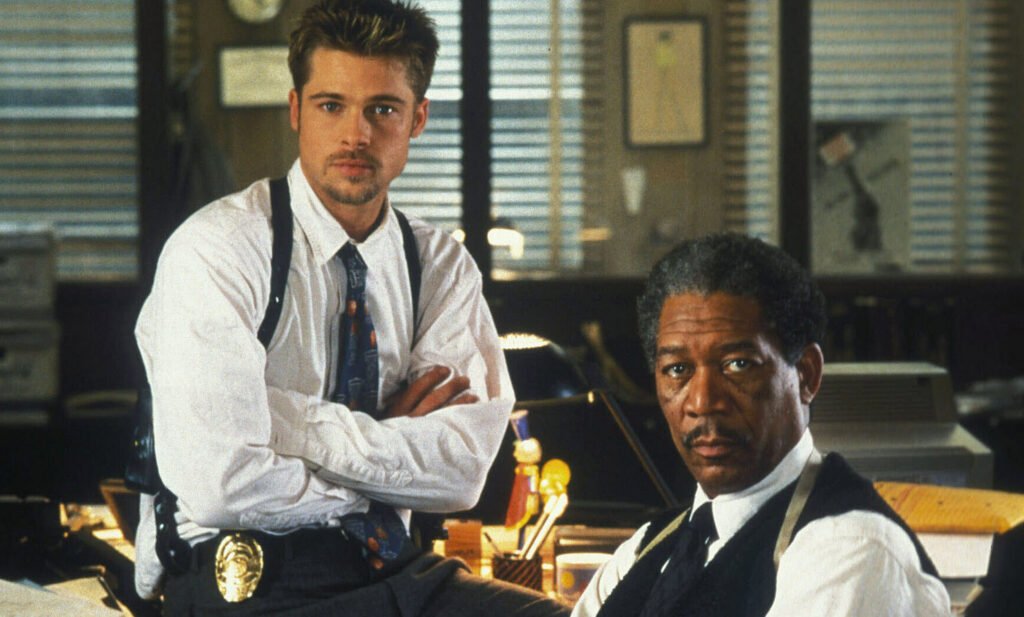
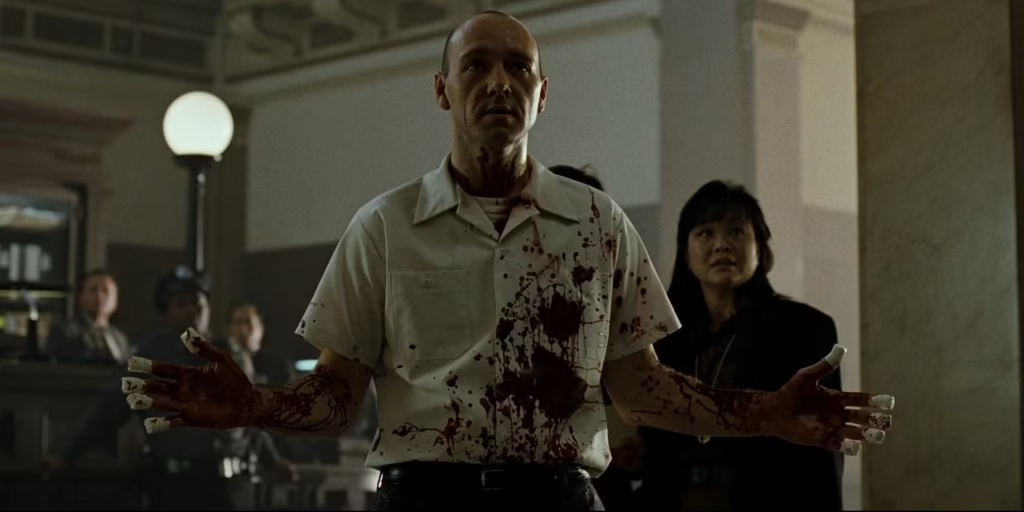
Most serial killer films are about catching the villain. Se7en tricks you into believing that’s the game, right up until the moment John Doe (Kevin Spacey) walks into the police station and surrenders voluntarily.
From that point, the film shifts entirely. The murders we’ve already seen represent five sins: Gluttony, Greed, Sloth, Lust, and Pride. Two are still missing. Doe tells Mills and Somerset he’ll reveal the final two bodies, but only if they drive with him to a remote location outside the city.
| Sin | Victim & Method of Killing |
| Gluttony | The Fat Man: Forced at gunpoint to eat food until his internal organs ruptured. |
| Greed | The Defense Attorney: Forced to cut a pound of his own flesh from his body or be killed. |
| Sloth | The Drug Dealer: Tied to a bed, restrained, and left in a vegetative, immobile state for a year. |
| Lust | The Prostitute: Killed using a custom blade-shaped weapon strapped to a man under duress. |
| Pride | The Model: Her face was severely slashed; she chose to take sleeping pills rather than live disfigured. |
| Envy | Tracy Mills: Decapitated, with her head delivered in a box to break Detective Mills. |
| Wrath | John Doe: Shot and killed in cold blood by Detective Mills in a fit of rage. |
What Was Actually in the Box?
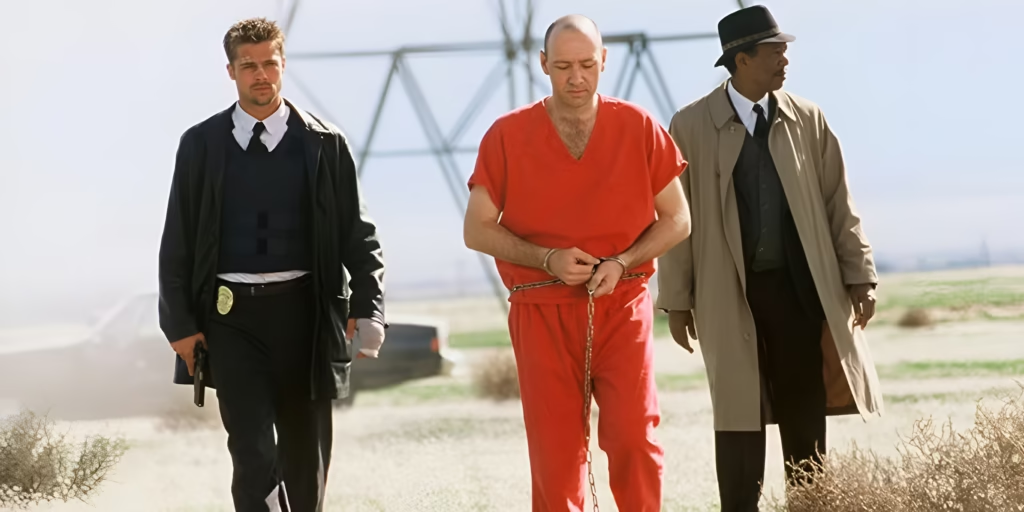
When a delivery van arrives at that barren field, Somerset opens the box. The camera never shows us its contents. What we learn from Somerset’s reaction, and then from Doe’s own confession, is that the box contains the severed head of Tracy Mills, Detective Mills’ pregnant wife.
Doe has killed her to embody the sixth sin: Envy. He tells Mills he envied his normal life, his wife, and the things he himself could never have.
Addressing persistent fan rumors about whether a prosthetic mold of Gwyneth Paltrow’s head was actually hidden inside, director David Fincher dismissed the idea, calling the notion of a detailed prop “entirely ridiculous.”
Discussing the filming logistics behind the sequence with Entertainment Weekly, Fincher explained:
“I think we had a seven- or eight-pound shot bag. We had done the research to figure out, if Gwyneth Paltrow’s body mass index was X, what portion of that would be attributable to her head. And so we had an idea of what that would weigh, and I think there was a weight in it.”
Fincher deliberately chose never to show the contents on camera, noting:
“Remember, I think Morgan opened 16 or 17 of those things. But as I always say, you don’t need to see what’s in the box if you have Morgan Freeman.”
This is where the trap snaps shut. Doe’s plan was never to escape. It was to become the seventh sin himself by provoking Mills into committing Wrath.
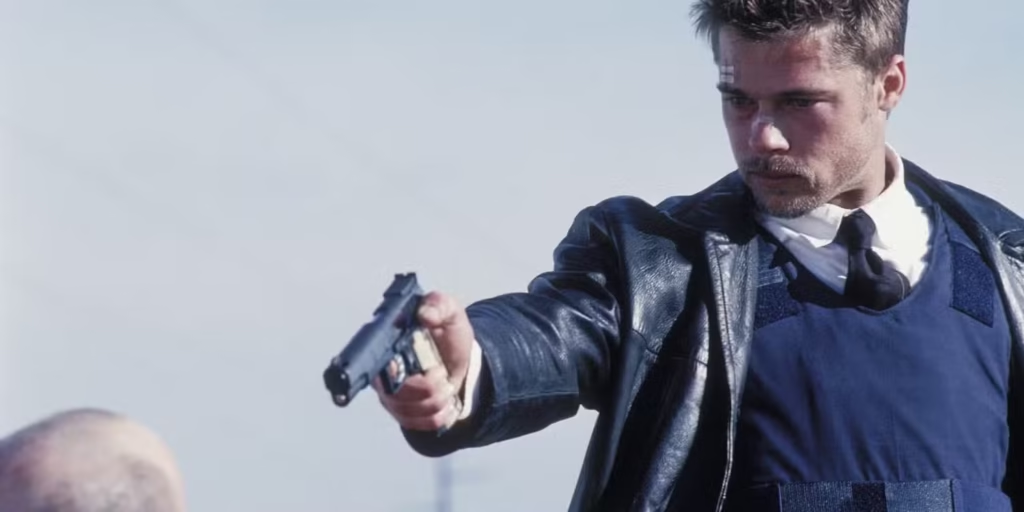
He succeeds. Mills shoots Doe dead on the spot, fulfilling the final chapter in Doe’s designed narrative. The killer wins, in his own grotesque terms, from beyond the moment of his death.
Why the Ending Still Works After All These Years
What makes the ending so suffocating is how completely it dismantles the detective genre’s core promise. In almost every thriller, the hero’s emotional investment is a strength. It fuels the chase.
Se7en reveals that investment is the weapon used against Mills. His love for his wife is precisely what Doe needed to complete the plan. There is no version of events where Mills walks away clean.
Somerset survives, but barely in spirit. Crucially, when asked earlier in the film if he will stay on the force after his retirement is due, Somerset states he cannot. Yet at the very end, when a police officer asks him what he’s going to do, Somerset replies, “I’ll be around.”
That subtle shift changes everything. Somerset isn’t walking away to a peaceful retirement anymore; he is choosing to stay behind in a broken, rotting city because he recognizes the full weight of what just happened. He remains on the job not out of optimism, but because he knows the darkness won’t stop, and walking away is no longer an option.
Somerset’s final voiceover, drawn from Ernest Hemingway, carries the film’s real thesis: “The world is a fine place and worth fighting for.” He tells us he agrees with the second part. It’s one of the bleakest and most honest endings in mainstream cinema, because it refuses to pretend the world is redeemable.
Beyond the formal count of seven, the film’s true underlying engine is apathy, the unwritten eighth sin. John Doe targets a society so numb, indifferent, and disconnected to its own moral rot that people routinely ignore violence and suffering. Somerset’s entire arc is a grueling war against this exact numbness.
The box itself never needed to be shown. Fincher understood that what the imagination fills in is always worse than anything on screen. The choice to keep the camera on Brad Pitt’s face, on his collapse from rage to devastation, is the film’s masterstroke. We feel what’s in the box because we see it destroy a man in real time.
Mills is destroyed, Doe achieved everything he set out to do, and Somerset stays behind to bear witness to the wreckage, realizing that giving in to apathy is the ultimate defeat.
Your May Also Like:
Add us as a preferred source on Google.