
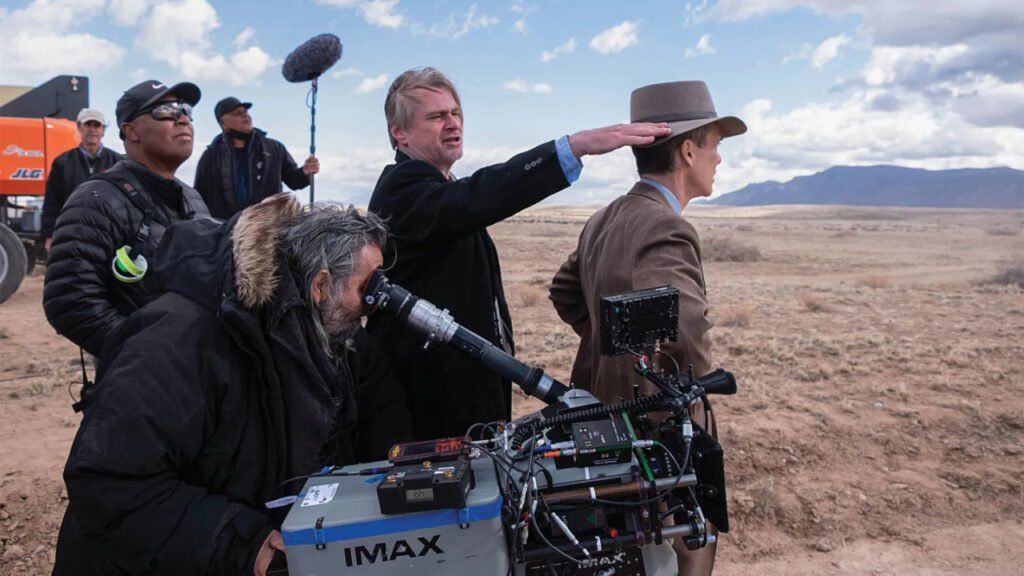
Christopher Nolan is one of the rare filmmakers whose name alone can sell a movie. Over the past three decades, he has built a filmography that includes modern classics like Memento, The Dark Knight, Inception, Interstellar, Dunkirk, and Oppenheimer, earning both critical acclaim and billions at the global box office.
His films continue to spark discussion long after the credits roll, with audiences dissecting their timelines, themes, and endings for years. That level of attention has also made Nolan one of contemporary cinema’s most debated directors. Admirers praise his ambition, technical craftsmanship, and willingness to challenge audiences, while critics argue that his films sometimes prioritize ideas over emotion.
Perhaps that’s why one line from Tenet has become so closely associated with his work: “Don’t try to understand it. Feel it.” Whether intended as filmmaking advice or not, the quote perfectly captures how many audiences experience a Christopher Nolan film.
Table of Contents
How Christopher Nolan Builds A Movie
Nolan has spent nearly three decades proving that blockbuster filmmaking doesn’t have to come at the expense of ambitious storytelling. While many directors become associated with a single franchise or genre, Nolan has moved effortlessly between noir mysteries, superhero epics, war dramas, science fiction, historical biographies, and now Greek mythology.
Yet regardless of whether he’s exploring dreams in Inception, time in Interstellar, moral compromise in The Dark Knight, or the invention of the atomic bomb in Oppenheimer, every project carries the same unmistakable creative signature.
That consistency doesn’t happen by accident.
Nolan approaches filmmaking with a level of discipline that has become almost legendary in Hollywood. He writes away from the internet, guards his scripts with extraordinary secrecy, shoots on large-format film whenever possible, favors practical effects over digital shortcuts, and surrounds himself with a trusted circle of collaborators who understand exactly how he likes to work. Every decision, from casting to camera placement, follows a philosophy he has refined across more than a dozen feature films.
His latest film, The Odyssey, may seem like a dramatic change of pace. Homer’s epic poem has inspired countless adaptations over the last three millennia, and on paper, it couldn’t look more different from Oppenheimer, the historical drama that won Nolan his first Academy Award for Best Director and Best Picture.
Yet the more Nolan has spoken about the project, the clearer it becomes that this isn’t a departure from his filmmaking style at all. Instead, it feels like the culmination of many of the ideas that have fascinated him throughout his career.
Nolan has often gravitated toward protagonists whose understanding of the world is incomplete, distorted, or shaped by their own experiences. Leonard Shelby reconstructs reality through unreliable memories in Memento, Cobb questions whether he’s still dreaming in Inception, and Robert Angier and Alfred Borden sacrifice pieces of themselves in pursuit of obsession in The Prestige.
Even J. Robert Oppenheimer struggles to reconcile his scientific achievements with the consequences they unleash. Their stories rarely present a single objective truth. Instead, Nolan invites audiences to experience events through deeply subjective perspectives before asking them to decide what they believe.
That makes Odysseus an especially compelling character for Nolan to explore. Throughout Homer’s poem, the legendary king survives not because he is the strongest warrior, but because he is the cleverest storyteller. He constantly disguises his identity, manipulates those around him, and recounts his adventures in ways that blur the line between history and performance.
Whether every monster and miracle happened exactly as described has remained a subject of debate for centuries, making The Odyssey a natural fit for a filmmaker who has built his career around perception, memory, and competing versions of the truth.
This guide explores Nolan’s complete creative process through the lens of The Odyssey. Rather than focusing only on the finished film, we’ll follow every stage of how Nolan develops a project, from the first spark of an idea and the screenplay to casting, production, practical effects, IMAX photography, and the recurring themes that connect his entire filmography.
Together, they reveal why Nolan remains one of the few directors whose filmmaking process has become almost as fascinating as the movies themselves.
Every Christopher Nolan Film Begins With One Central Idea
Nolan doesn’t begin with action sequences, visual effects, or even characters. He begins with a question. Before a screenplay takes shape, he spends months thinking about a single concept that can sustain an entire film. Everything else, the plot, the structure, the performances, and even the visual style, grows out of that central idea.
That approach explains why Nolan’s filmography feels remarkably consistent despite constantly changing genres. On the surface, The Dark Knight and Interstellar have very little in common. One is a grounded superhero crime drama, while the other is an ambitious science-fiction epic.
Yet both explore how ordinary people respond when they’re forced to make impossible moral choices. Likewise, Dunkirk isn’t simply a war movie about a famous evacuation. It examines survival from multiple perspectives while using time itself as a storytelling device.
Rather than asking audiences to follow a straightforward chain of events, Nolan often builds stories around the way people experience reality. Memory, identity, guilt, obsession, sacrifice, and the passage of time repeatedly appear throughout his work because those ideas interest him more than any particular genre.
That philosophy becomes especially clear when looking across his career. Memento asks whether a person can ever know the truth when memory itself becomes unreliable. The Prestige explores the destructive cost of obsession and the sacrifices people make in pursuit of greatness.
Inception blurs the boundary between dreams and reality, while Oppenheimer examines the burden of scientific achievement and whether its consequences can ever remain under the creator’s control.
Those films vary enormously in scale, but they all begin with the same process. Nolan identifies an idea that fascinates him and builds every creative decision around exploring it from multiple angles.
Why The Odyssey Fits Nolan’s Storytelling Style
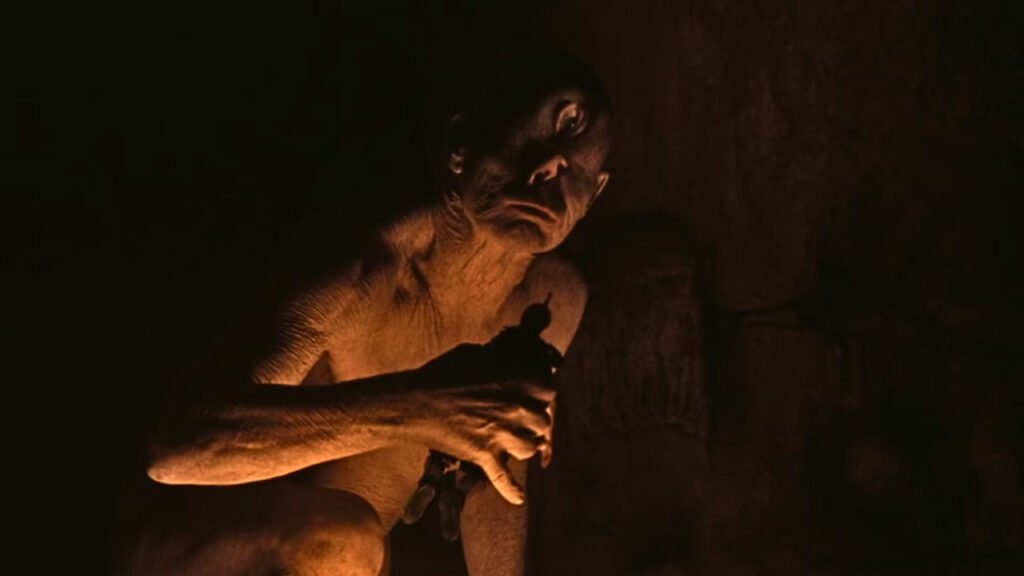
Adapting Homer’s The Odyssey may seem like a dramatic shift after Oppenheimer. One follows the physicist who helped create the atomic bomb, while the other centers on a mythical king trying to return home after the Trojan War.
Yet Nolan himself sees far more overlap between the projects than their settings suggest.
Speaking about The Odyssey, Nolan explained that he didn’t want to reinvent Homer’s story simply for the sake of novelty. Instead, he began by writing down the moments that had stayed with him since childhood.
“I just scribbled down, ‘What are the things I remember from it?'” he said. “I didn’t want to do a revisionist version; I wanted to be true to my expectations of it.”
That philosophy reflects the way Nolan has approached many of his films. Rather than discarding familiar stories, he looks for the emotional core that first drew him to them. Whether adapting Batman, telling the story of J. Robert Oppenheimer, or bringing Homer’s epic to the screen, he starts by identifying the central idea that continues to resonate, then builds everything else around it.
Odysseus also fits naturally alongside many of Nolan’s protagonists. He survives not because he is physically stronger than everyone around him, but because he constantly adapts, deceives, and reshapes the narrative around himself.
Throughout Homer’s epic, he hides his identity, invents false names, and recounts extraordinary events that have sparked debate for centuries over how literally they should be interpreted.
Nolan has long gravitated toward characters whose understanding of reality is incomplete or deeply subjective. Leonard Shelby reconstructs his life through fragmented memories in Memento. Cobb struggles to distinguish dreams from reality in Inception.
Even Oppenheimer spends much of his film wrestling with how history will remember his actions. Odysseus belongs comfortably within that tradition, making The Odyssey feel less like a departure and more like the latest expression of ideas Nolan has explored throughout his career.
Why Christopher Nolan Still Writes Offline
Christopher Nolan has embraced nearly every major advance in filmmaking technology during his career, but one part of his creative process remains stubbornly old-fashioned. While many modern screenwriters bounce between online research, email notifications, cloud documents, and collaborative writing software, Nolan deliberately separates his writing from the internet.
His office contains two different computers, each serving a specific purpose. One handles research, while the other exists solely for writing and remains disconnected from the internet.
The setup removes distractions, eliminates the temptation to multitask, and adds another layer of protection against leaks. For a filmmaker whose projects routinely become some of Hollywood’s most closely guarded productions, keeping a screenplay offline is as much about concentration as it is about secrecy.
That discipline extends well beyond the computer itself. Rather than waiting for inspiration to strike, Nolan approaches writing like a conventional full-time job.
He keeps regular office hours, sits down to write every day, and avoids the marathon overnight sessions that many writers associate with creativity. The routine reflects his belief that consistency produces better work than relying on unpredictable bursts of inspiration.
Planning also takes up far more of Nolan’s time than the writing itself. Before he types a single scene, he spends months researching, sketching diagrams, and building the story’s underlying structure.
Only after he feels confident that the narrative framework is complete does he begin writing the screenplay.
Unlike many screenwriters who jump between scenes before assembling the finished script, Nolan writes sequentially from beginning to end. As new scenes emerge, he frequently returns to earlier pages to refine character moments, strengthen setups, and weave later ideas naturally into the opening acts.
The screenplay evolves continuously, but it always grows in the same direction as the finished film.
One writing habit has remained particularly important throughout his career. Nolan has often spoken about learning a valuable lesson from novelist Julian Barnes: never stop writing at the end of an idea.
Instead, finish each day in the middle of a thought, sentence, or scene. That unfinished thread provides an immediate starting point the following morning and prevents the paralysis that often comes with facing a completely blank page.
Ideas rarely arrive on schedule, though, and Nolan makes sure they never disappear before reaching the page. He keeps paper close to his bed and has admitted to waking up during the night to write down scenes or ideas before they fade. Once inspiration arrives, he captures it immediately rather than trusting memory to preserve it until morning.
Music also plays a surprisingly important role in his routine. Before writing begins, Nolan assembles playlists that reflect the emotional atmosphere of the project he is working on. Rather than listening while searching for ideas, he uses music to immerse himself in the film’s world before beginning another day’s work.
Emma Thomas Shapes The Script Before Anyone Else Reads It
Although Nolan writes alone, he never develops a screenplay entirely in isolation. His wife and longtime producing partner, Emma Thomas, serves as the first person to read every completed draft.
Thomas’s role extends far beyond proofreading. As Nolan’s closest creative collaborator, she challenges story decisions, questions character motivations, and helps ensure that the emotional core remains as strong as the intellectual framework.
Their collaboration also balances artistic ambition with practical filmmaking. While Nolan explores ideas on the page, Thomas simultaneously evaluates how those ideas might translate into an actual production.
Her influence has shaped several of Nolan’s films over the years. She famously introduced him to the historical account that eventually inspired Dunkirk, illustrating that her contributions often begin long before cameras start rolling.
The Secrecy Starts As Soon As The Script Is Finished
Once Nolan completes a screenplay, protecting it becomes almost as important as writing it.
Instead of circulating digital copies, he keeps distribution extremely limited. Actors often travel to Syncopy’s offices to read scripts inside secure rooms before returning them immediately afterward.
On other occasions, Nolan personally flies to meet cast members rather than sending electronic files across the internet. Printed copies are often printed on distinctive red paper, making them difficult to photocopy or reproduce without authorization.
Robert Pattinson experienced that process firsthand before joining Nolan’s Tenet. He later recalled locking himself in a room to read the screenplay and described it simply as “unreal.”
The experience reinforced Nolan’s reputation for treating every screenplay as confidential until the film is ready to reveal itself.
That level of secrecy has become one of Nolan’s trademarks, but it also reflects his approach to storytelling. Every twist, revelation, and emotional payoff depends on audiences experiencing the story exactly as he intended.
Protecting the script isn’t just about avoiding spoilers. It’s about preserving the experience of discovering the film for the first time.
Why Christopher Nolan Keeps Working With The Same Actors

Christopher Nolan’s films rarely feature the same story twice, but they often feature many of the same faces. Over the past two decades, he has assembled one of Hollywood’s most recognizable groups of recurring collaborators.
Michael Caine appeared in eight Nolan films. Cillian Murphy worked with the director for years before finally taking the lead in Oppenheimer.
Christian Bale became the definitive Batman of his generation, while actors like Tom Hardy, Anne Hathaway, Kenneth Branagh, Gary Oldman, Marion Cotillard, Robert Pattinson, Matt Damon, and now Jon Bernthal have all become part of Nolan’s growing creative circle.
That pattern isn’t unique to Nolan. Directors such as Martin Scorsese, Quentin Tarantino, Wes Anderson, and Christopher McQuarrie frequently return to the same performers because trust shortens the distance between an idea and its execution.
Nolan follows that philosophy, but his productions make those relationships even more valuable because of the technical precision his films demand.
Trust Creates A Creative Shortcut
Nolan’s stories often involve unconventional structures, large practical set pieces, and emotionally restrained performances that unfold across multiple timelines. Actors returning to their sets already understand that rhythm.
They know he prefers preparation over rehearsal, practical filmmaking over green screens, and subtle performances over excessive exposition.
That familiarity allows Nolan to spend less time explaining his methods and more time refining the details of each scene. Instead of establishing a new working relationship on every project, he builds upon years of shared experience.
The progression of Cillian Murphy’s career with Nolan illustrates that trust particularly well. Murphy first appeared as Dr. Jonathan Crane in Batman Begins before returning for both sequels.
He later played supporting roles in Inception and Dunkirk, eventually taking center stage as J. Robert Oppenheimer. Rather than immediately casting Murphy as a lead, Nolan gradually expanded his responsibilities across nearly two decades of collaboration.
Michael Caine followed a similar path. Whether playing Alfred Pennyworth, Professor Brand, Cutter, or another mentor figure, he often served as the emotional anchor in Nolan’s films.
His presence brought a sense of familiarity to stories centered on ambitious concepts, helping audiences connect with characters even as the narratives grew increasingly complex.
Returning Actors Already Understand Nolan’s Process
Working on a Christopher Nolan production requires actors to adapt to a filmmaking style that differs from that of many modern blockbusters. Large practical sets, IMAX cameras, limited takes, strict secrecy, and an intense production schedule leave little room for uncertainty.
Actors who have worked with Nolan before arrive knowing exactly what to expect. They understand the production pace, the importance of preparation, and the director’s preference for capturing as much as possible in-camera.
That experience reduces friction in productions that often involve enormous logistical challenges.
The trust extends beyond technical execution. Nolan frequently explores similar themes across different stories, including memory, guilt, sacrifice, obsession, and identity.
Returning collaborators already understand the emotional restraint those films often require, allowing them to deliver performances that fit naturally within his storytelling style.
The Odyssey Continues A Familiar Pattern
Although The Odyssey introduces new collaborators such as Jon Bernthal, its cast also reflects Nolan’s long-standing preference for working with actors he already knows.
Matt Damon returns after Oppenheimer to play Odysseus, while Anne Hathaway reunites with Nolan following The Dark Knight Rises and Interstellar. Robert Pattinson, who previously led Tenet, joins another Nolan production alongside familiar collaborators who already understand the director’s demanding workflow.
That consistency isn’t about loyalty alone. Every returning actor allows Nolan to spend less time explaining how he works and more time focusing on the story itself.
Anne Hathaway has often spoken about that experience, noting that even when Nolan becomes completely immersed in a project, he never loses sight of the people making it.
“Even though Chris gets so consumed by his projects, he’s a real person through it all, too,” Hathaway said.
Jon Bernthal, who joined Nolan’s circle for the first time on The Odyssey, echoed a similar sentiment. Despite Nolan’s reputation as one of modern cinema’s most meticulous directors, Bernthal described him as remarkably grounded, even with his legendary status.
“He’s very aware of the aura and the legend around him, but he doesn’t trade off of it at all.”
Those comments help explain why so many actors return whenever Nolan calls. They aren’t simply joining another blockbuster. They’re stepping back into a creative process built on preparation, trust, and collaboration, where every new film benefits from relationships that have often taken years to develop.
Christopher Nolan Runs His Sets Differently From Most Directors
Walking onto a Christopher Nolan set means stepping into a production that operates very differently from most modern Hollywood films. While many big-budget productions rely on dozens of monitors, constant digital playback, and crew members communicating through phones, Nolan strips away as many distractions as possible.
The result is a working environment built around preparation, concentration, and momentum. That philosophy starts with something surprisingly simple: phones.
No Phones, No Video Village, No Distractions
Cell phones have no place on a Christopher Nolan set. Cast and crew leave them behind before work begins, allowing everyone to focus entirely on the day’s filming instead of checking messages between takes.
The policy also reinforces the secrecy surrounding every Nolan production, reducing the chances of behind-the-scenes photos or story details leaking online.
Nolan also avoids one of the defining features of modern filmmaking: the video village. Most directors spend much of the day inside a tent surrounded by monitors, watching performances through camera feeds before discussing adjustments with actors.
Nolan prefers something much more direct. Rather than observing through a screen, he stands beside the camera itself.
Watching performances in person allows him to react to actors as they move through a scene, rather than viewing everything on a monitor. It also keeps him physically close to the crew, enabling a faster, more collaborative workflow.
That hands-on approach reflects Nolan’s broader philosophy. He wants filmmaking to remain a physical process rather than one mediated through technology.
The Pace Rarely Slows Down
Preparation carries much of the workload before production ever begins, allowing Nolan to move quickly once cameras roll. His sets have earned a reputation for efficiency because everyone arrives knowing exactly what the day requires.
Actors come prepared. Departments already understand the schedule. Crew members solve problems without unnecessary delays.
One reason the production maintains that pace is Nolan’s belief that momentum matters. Although stories about a strict “no chairs” rule have become Hollywood folklore over the years, the underlying principle remains true.
Nolan dislikes anything that unnecessarily slows production. If the crew can keep moving, they keep moving. He reinforces that professionalism in other ways as well. While many directors dress casually on set, Nolan famously arrives wearing tailored suits or blazers almost every day.
The wardrobe isn’t about appearance for its own sake. Instead, it reflects the seriousness with which he approaches filmmaking and quietly sets the tone for everyone around him.
Preparation Replaces Endless Retakes
Nolan’s productions rarely rely on dozens of takes to discover a performance. Instead, he expects much of that work to happen before filming begins.
Because actors receive detailed conversations about their characters well in advance and often spend weeks preparing for complex scenes, they arrive ready to perform rather than experiment endlessly on camera. That preparation becomes especially important when filming with IMAX cameras, which are expensive to operate and consume large amounts of film stock.
The approach creates an atmosphere where every department works toward the same objective. Rather than solving problems during production, Nolan tries to eliminate as many of them as possible before the cameras ever roll.
Why Actors Keep Coming Back
Christopher Nolan’s productions demand a great deal from the people involved. His films often feature complex narratives, practical stunts, large-format cameras, and tightly organized shooting schedules that leave little room for improvisation.
Yet despite those demands, many actors choose to work with him again and again. A big reason is trust. Once actors experience Nolan’s process, they know exactly what to expect on future projects.
They understand how thoroughly he prepares, how clearly he communicates his vision, and how much confidence he places in the cast once filming begins. That familiarity allows everyone to spend less time adjusting to the director’s style and more time focusing on the performance.
Those long-term collaborations also create a valuable creative shorthand. Actors who have worked with Nolan before already understand the understated performances his films often require, the technical precision required for shooting practical sequences, and the pace of his sets.
Instead of rebuilding that relationship from scratch on every production, Nolan continues developing it over multiple films. The results are easy to see throughout his filmography. Michael Caine became one of Nolan’s most frequent collaborators, appearing in eight of his films.
Cillian Murphy spent years in supporting roles before taking the lead in Oppenheimer. Christian Bale, Tom Hardy, Anne Hathaway, Kenneth Branagh, Matt Damon, and Robert Pattinson have all returned after successful collaborations, while The Odyssey continues that tradition by bringing several familiar faces back into Nolan’s creative circle.
Those repeat partnerships aren’t simply about loyalty. They reflect a director who values preparation, consistency, and mutual trust just as much as technical innovation.
By surrounding himself with collaborators who already understand his filmmaking philosophy, Nolan creates an environment where everyone can focus on telling the story instead of learning how the production works.
Why Christopher Nolan Still Believes In Practical Filmmaking
Christopher Nolan has never hidden his preference for practical filmmaking. At a time when many blockbuster productions rely heavily on digital environments and computer-generated action, Nolan continues to build as much as possible on set.
His films still use visual effects, but he treats CGI as a tool to enhance reality rather than replace it.
That philosophy influences almost every creative decision he makes. Instead of asking actors to imagine worlds that will be added months later, Nolan prefers to put them inside real environments, surround them with practical sets, and capture genuine physical interactions whenever possible.
The result is a filmmaking style that often feels more tactile than many modern blockbusters, even when the stories venture into dreams, outer space, or ancient mythology.
Frequent collaborator and cinematographer Hoyte van Hoytema shares that philosophy. Speaking about his preference for shooting on film, he once explained, “Celluloid is alive and kicking. I really think that the way I see the world is best represented by the way film sees the world.”
He has also argued that even the most sophisticated computer-generated imagery loses something when it isn’t grounded in reality, adding, “I prefer films that feel more like real life, so any CGI has to be very carefully handled to fit into that.” Those principles have shaped some of the most memorable sequences in Nolan’s career.
Building Reality Instead Of Simulating It
One of the clearest examples arrived in The Dark Knight.
The spectacular sequence in which the Joker sends an eighteen-wheeler flipping end over end through the streets of Chicago wasn’t created on a computer. Nolan’s stunt team engineered the effect using a specially designed air piston hidden inside the truck’s trailer.
Small explosive charges drove the heavy metal piston into the pavement at precisely the right moment, generating enough force to launch the rear of the truck into the air before it completed a full forward flip.
The stunt destroyed the vehicle, leaving the crew with only one opportunity to capture the shot. Instead of constructing the moment digitally afterward, Nolan committed to achieving it in real life.
A similar philosophy guided Inception.
Rather than relying on visual effects for the now-famous hallway fight, Nolan commissioned a massive rotating corridor nearly 100 feet long and 30 feet wide. Engineers mounted the entire set inside a giant gimbal capable of rotating a full 360 degrees.
As the corridor spun, actors performed the choreography while gravity shifted around them, creating one of the film’s most memorable action scenes almost entirely through practical engineering.
The effect remains remarkable because audiences instinctively recognize that the performers occupy a genuine physical space. The camera records real movement rather than trying to digitally imitate it.
Real Worlds Create Better Performances
Nolan applies the same philosophy even when building quieter scenes. While developing Interstellar, he rejected the idea of creating Cooper’s farm with green screens or computer-generated landscapes.
Instead, the production planted approximately 500 acres of real corn in Alberta, Canada. The decision gave actors an authentic environment to inhabit throughout filming. Vehicles could naturally drive through the fields.
Fire sequences unfolded inside actual crops rather than digital recreations. Even the changing light across the landscape became part of the production rather than something artists needed to recreate later. The practical decision also produced an unexpected financial benefit. After filming concluded, the crew harvested and sold the corn, recovering part of the production costs.
That attention to physical reality extended beyond Earth. Rather than depending entirely on digital spacecraft, Nolan built detailed miniature models for many of Interstellar’s ships.
Combining those practical elements with carefully integrated visual effects gave the spacecraft a convincing physical presence that many audiences still associate with the film.
Pushing IMAX Further Than Anyone Else
Nolan’s commitment to practical filmmaking naturally extends to the camera itself. For years, he has championed large-format IMAX film, arguing that its enormous negative captures a level of detail and immersion that digital cameras still struggle to replicate. That relationship has now reached another milestone with The Odyssey, which became the first feature film to be filmed entirely with the new Keighley IMAX camera.
Developed in collaboration with IMAX and named after longtime executive David Keighley, the next-generation system addresses one of the format’s biggest limitations. Earlier IMAX cameras produced so much mechanical noise that recording intimate dialogue often became difficult.
The new design operates roughly 30 percent more quietly, while the production enclosed the camera inside a massive carbon-fiber blimp to reduce sound even further.
The technical improvements allow Nolan to shoot close, dramatic scenes without sacrificing the image quality that makes IMAX so distinctive. Every 15-perforation 70mm frame captures an extraordinary amount of detail, producing an image equivalent to roughly 14K-16K resolution per color channel.
For a story as visually ambitious as The Odyssey, that combination of practical photography and large-format film allows Nolan to present towering landscapes, vast oceans, and mythical creatures with a level of clarity rarely achieved in film.
CGI Still Has A Place, Just Not The Leading Role
Despite his reputation, Nolan has never argued that computer-generated imagery should disappear entirely. His films use visual effects extensively, but almost always as invisible support rather than the main attraction.
Digital artists remove safety equipment, extend practical sets, erase modern buildings, and enhance environments that already exist in front of the camera. Instead of asking CGI to create reality from nothing, Nolan asks it to strengthen what the audience already believes.
That philosophy explains why his films often age remarkably well. Practical explosions remain practical explosions. Physical sets continue to feel tangible decades later. Real locations preserve textures and imperfections that computers still struggle to reproduce completely.
As blockbuster filmmaking increasingly embraces virtual production and digital environments, Nolan continues moving in the opposite direction. Whether flipping an actual truck through downtown Chicago, constructing a rotating hallway, planting hundreds of acres of corn, or pushing IMAX technology forward for The Odyssey, he consistently chooses to solve problems physically before turning to a computer.
For Nolan, realism isn’t simply about visual authenticity. It’s about giving actors something real to perform against, giving cameras something real to capture, and giving audiences an experience that feels grounded, no matter how extraordinary the story becomes.
Why The Odyssey Feels Like A Christopher Nolan Movie
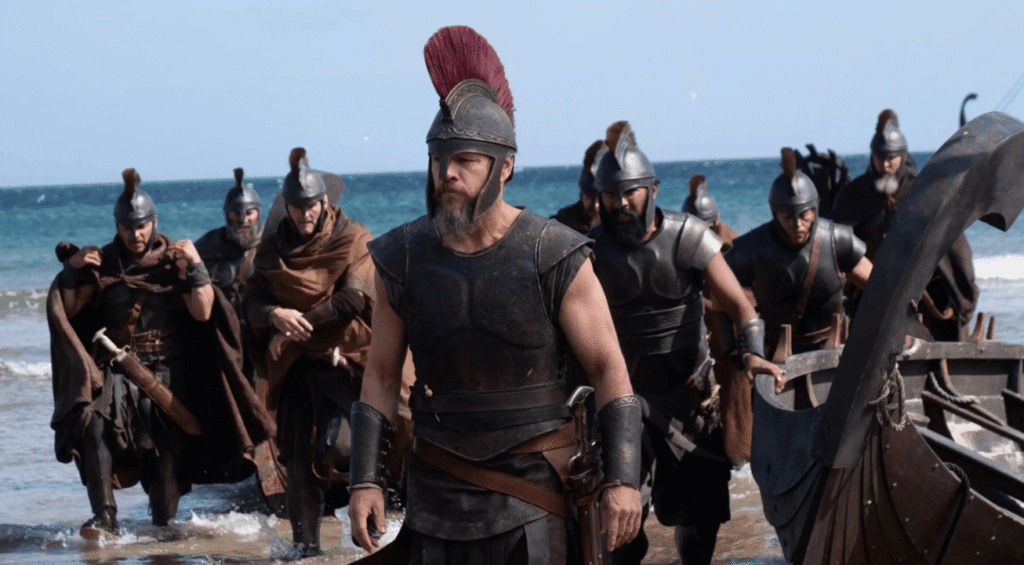
Christopher Nolan has never been interested in adapting familiar stories exactly as audiences expect them. Whether working with Batman, historical figures, or original science fiction, he looks for an emotional and philosophical question that makes the material feel relevant to the present day.
That same approach guided his adaptation of Homer’s The Odyssey.
Although the epic poem has inspired countless books, films, and television series over nearly 3,000 years, Nolan resisted the temptation to modernize it through a revisionist lens. Instead, he returned to the version of the story that first captured his imagination as a child.
“I remember the horse; I remember them tying Odysseus to the mast,” Nolan recalled while discussing the project. “It’s in our bones.”
Rather than beginning with historical research, he started by writing down the moments he remembered most vividly from the ancient poem.
“I just scribbled down, ‘What are the things I remember from it?'” “I didn’t want to do a revisionist version; I wanted to be true to my expectations of it.”
That decision reflects a pattern visible throughout Nolan’s career. His films rarely try to dismantle beloved stories or challenge audiences’ memories of them. Instead, he embraces the elements that made those stories endure, then seeks new emotional depth within them.
A Hero Who Fits Nolan’s World
Odysseus may carry a sword instead of a briefcase or cape, but he shares many qualities with Nolan’s most memorable protagonists.
Like Leonard Shelby in Memento, he navigates a reality shaped by incomplete information. Like Bruce Wayne in The Dark Knight, he struggles with the burden of becoming a symbol larger than himself.
Like Cobb in Inception, he spends years trying to return home to his family while carrying the weight of guilt and loss. Nolan himself discovered another surprising connection while making the film.
“What I was more surprised by was the relationship with Batman and the Dark Knight trilogy.” “It has to do with creating an icon that is relatable and yet larger than life.”
That realization became one of the creative foundations for The Odyssey. Throughout the Dark Knight trilogy, Nolan explored how Bruce Wayne balanced his humanity with the myth of Batman.
He found himself asking similar questions while shaping Odysseus, a legendary hero remembered not only for his victories but also for his flaws, doubts, and failures.
“You want to be human,” Nolan explained, describing the balance he sought. “Coming to The Odyssey, it’s that same balance.”
Monsters With Emotional Weight
One of the biggest creative challenges involved bringing Homer’s legendary creatures to the screen without reducing them to spectacle. Rather than presenting monsters merely as visual effects showcases, Nolan sought ways to make them feel emotionally believable.
He drew inspiration from classics such as Jaws and Alien, both of which carefully build suspense before fully revealing their creatures. Sound, shadows, and suggestion often become more powerful than constant visibility. Nolan also credited filmmaker Guillermo del Toro for influencing his thinking.
“We have to give the audience a reason to believe in these things.” “A huge influence is my friend Guillermo del Toro, because with Guillermo, a monster is never just a monster. It’s about: What is their inner life?”
That philosophy shaped the development of creatures such as the Cyclops. Working alongside production designer Ruth De Jong, Nolan began experimenting with surprisingly simple ideas before arriving at the final design.
He even started by manipulating photographs of his own face, exploring what a single vertical eye might look like before the concept evolved into the finished creature. For Nolan, convincing audiences to believe in mythical beings required much more than impressive visual effects. Every monster needed personality, emotion, and a sense of existence beyond the immediate scene.
The Emotional Shadow Of Oppenheimer
Although The Odyssey represents a dramatic shift in genre, Nolan has acknowledged that his previous film remained with him throughout the writing process.
Oppenheimer, he admitted, left him carrying “a funny combination of despair and optimism.”
The director described living with the subject of nuclear war for several years while making the Academy Award-winning drama, calling it “almost a horror film” because of the questions it forced him to confront about humanity.
“I was quite glad to move out of that,” Nolan said. “But when you see The Odyssey, you start to realize that I didn’t quite manage to escape it.”
That lingering emotional perspective helps explain why his version of Odysseus isn’t simply an invincible mythical hero. Like many Nolan protagonists, he carries the consequences of earlier decisions while searching for redemption.
His greatest battle isn’t only against monsters or gods, but against the psychological weight of everything that happened before his journey home began.
In that sense, The Odyssey doesn’t represent a departure from Christopher Nolan’s filmmaking. It brings together many of the ideas he has explored throughout his career: identity, memory, guilt, sacrifice, myth, and human resilience, and places them inside one of the oldest stories ever told.
Why Christopher Nolan’s Process Still Stands Apart
Christopher Nolan’s filmmaking process isn’t defined by one signature technique. It isn’t just the IMAX cameras, the practical effects, the nonlinear storytelling, or the secrecy surrounding his productions. Those elements work because they all support the same philosophy: every creative decision should serve the story rather than the technology.
That mindset explains why Nolan has remained one of the few filmmakers capable of turning original ideas into global theatrical events. Whether audiences walk into Inception, Interstellar, Dunkirk, Oppenheimer, or The Odyssey, they know they aren’t simply watching another blockbuster assembled through the same production pipeline as every other studio film.
They expect something crafted with a distinct point of view.
Much of that consistency comes from the discipline established long before cameras began rolling. Nolan spends months refining the structure of a screenplay before writing scenes.
He protects that script with extraordinary secrecy until production begins. He surrounds himself with collaborators who understand his methods, builds practical environments whenever possible, and embraces technology only when it genuinely strengthens the finished film.
The approach also explains why Nolan’s movies rarely chase industry trends. When superhero films dominated Hollywood, he finished the Dark Knight trilogy and moved to original science fiction.
As streaming transformed the business, he continued making large-format theatrical experiences. Even as virtual production stages became increasingly common, he doubled down on practical photography and real locations. That willingness to follow his own creative instincts has shaped every stage of his career. Each new project expands his technical ambitions while remaining rooted in the same storytelling principles that defined his earliest films.
The Odyssey continues that evolution rather than breaking from it. On the surface, it introduces Nolan to mythological fantasy for the first time.
Beneath the spectacle, however, it explores many of the same questions that have fascinated him for decades. Memory, identity, guilt, heroism, sacrifice, and the search for truth remain central to the story, even as the setting shifts from Gotham City or outer space to ancient Greece.
Perhaps that’s why Nolan’s films continue to inspire discussion years after their release. Audiences don’t simply debate plot twists or ambiguous endings. They return to the films because each one invites them to reconsider what they have seen and what it ultimately means.
For Nolan, filmmaking has never been about creating the biggest explosion, the most elaborate visual effect, or the most complicated narrative. Those elements matter only if they deepen the audience’s emotional connection to the story. Everything else, the cameras, the sets, the practical effects, the secrecy, and the meticulous preparation, exists to support that single objective.
As The Odyssey arrives in theaters, it represents more than Christopher Nolan’s latest film. It showcases a creative process refined across more than three decades, proving that even one of history’s oldest stories can feel new when approached with clarity, discipline, and an unwavering commitment to cinematic storytelling.
FAQs
How does Christopher Nolan write his movies?
Christopher Nolan begins with a central idea rather than individual scenes. He spends months researching, outlining, and mapping the story’s structure before writing the screenplay from beginning to end. He also writes on an offline computer, follows a disciplined daily routine, and prefers planning extensively before typing the first scene.
Why does Christopher Nolan prefer practical effects over CGI?
Nolan believes practical effects create a stronger sense of realism for both actors and audiences. Whenever possible, he builds physical sets, performs real stunts, and shoots on location. He still uses CGI, but mainly to enhance practical footage rather than create entire sequences from scratch.
Does Christopher Nolan use CGI in his films?
Yes. Although Nolan is known for practical filmmaking, he regularly uses computer-generated imagery to remove equipment, extend sets, enhance environments, and refine visual effects. His philosophy is to use CGI as a supporting tool rather than the foundation of a scene.
Why does Christopher Nolan shoot on IMAX film?
Nolan considers IMAX film the best format for delivering image quality, scale, and immersion. He has consistently pushed the technology forward throughout his career, with ‘The Odyssey’ becoming the first feature film shot entirely using the new Keighley IMAX camera system.
Why does Christopher Nolan work with the same actors?
Nolan frequently collaborates with actors such as Michael Caine, Cillian Murphy, Christian Bale, Tom Hardy, Anne Hathaway, Matt Damon, and Robert Pattinson because they understand his filmmaking style. Those long-term relationships create trust, streamline communication, and help productions run more efficiently.
Why are Christopher Nolan’s scripts kept so secret?
Nolan takes extraordinary measures to prevent story details from leaking before release. Actors often read scripts in secure locations rather than receive digital copies, while printed versions are tightly controlled and distributed only when necessary.
Does Christopher Nolan allow phones on set?
No. Nolan is known for banning cell phones on set to reduce distractions and protect production secrecy. He also avoids using a traditional video village, choosing instead to stay beside the camera so he can watch performances unfold in person.
Why did Christopher Nolan choose to adapt ‘The Odyssey’?
Nolan has said he wanted to stay true to the version of Homer’s epic that stayed with him from childhood rather than create a revisionist adaptation. He focused on preserving the story’s emotional core while using modern filmmaking techniques to bring its world to life.
Who is Christopher Nolan’s longtime producing partner?
Emma Thomas, Christopher Nolan’s wife and producing partner, has worked alongside him on every feature film he has directed. She serves as his first reader during the writing process and helps shape each project creatively while overseeing its practical production.
What makes Christopher Nolan’s filmmaking style unique?
Nolan combines intricate storytelling with practical filmmaking, large-format IMAX photography, disciplined production methods, and an emphasis on theatrical experiences. His ability to balance ambitious ideas with emotional storytelling has made him one of the most distinctive filmmakers of the modern era.