


The demon king is rising. The fate of the world hangs in the balance. The chosen heroine and saint with the power to stop it all is standing in a grimy mansion kitchen deciding whether the floors need a second scrub. That is Heroine? Saint? No, I’m an All-Works Maid (And Proud of It)! in one image, and it has been the most quietly delightful show of the summer for eight episodes running.
A Girl Who Died on the Way to Become a Maid and Got a Second Chance to Do It Right

Before she was Melody Wave, she was Celeste McMarden, the unknown child of a count in the kingdom of Théolas. Before that, she was Ritsuko Mizunami, a Japanese girl who discovered her life’s purpose the moment, as a child, she saw a maid on a trip to England.
She dedicated everything to becoming the perfect maid after that. Trained obsessively. Died in a plane crash on her way to England to train further.
The universe apparently felt bad about that because it gave her another shot. Two shots, actually, since Celeste is technically the second life, and Melody is the version of Celeste who finally has everything in place to do what she has always wanted.
Her mother dies when she is fifteen, the age of legal adulthood in Théolas, and rather than follow whatever destiny the kingdom might have mapped out for her, she packs up, uses her newly unlocked magical abilities to alter her appearance, and gets herself hired as an all-works maid for the poor count’s family in the next town over.
The show spends its first episode establishing all of this with a warmth that caught a lot of people off guard. The cold open is Melody standing in a freshly restored mansion she has single-handedly cleaned and renovated in two weeks, smiling quietly while Liliana, the count’s daughter, prepares to welcome friends for tea.
The contrast between the dark, grimy mansion in the show’s first frame and the bright, spotless version two weeks later tells you everything you need to know about what Melody is and what she does with access to powerful magic.
The reincarnation reveal comes later in the episode, and this is where Heroine? Saint? No, I’m an All-Works Maid gets its first genuine criticism out of the way. The reveal adds essentially nothing to the story. Melody being Ritsuko being Celeste does not change how she behaves or what she wants. It just explains the intensity of her maid fixation and confirms that she has memories of her past lives.
Anime News Network’s preview guide called this out directly, pointing out that if the show had never addressed the reincarnation angle, it would not have changed a single thing about the story. That criticism lands. The isekai wrapper is the show’s least interesting element, and the story beneath it is genuinely good enough to do without it.
Work Comes First and the World Is Going to Have to Figure That Out
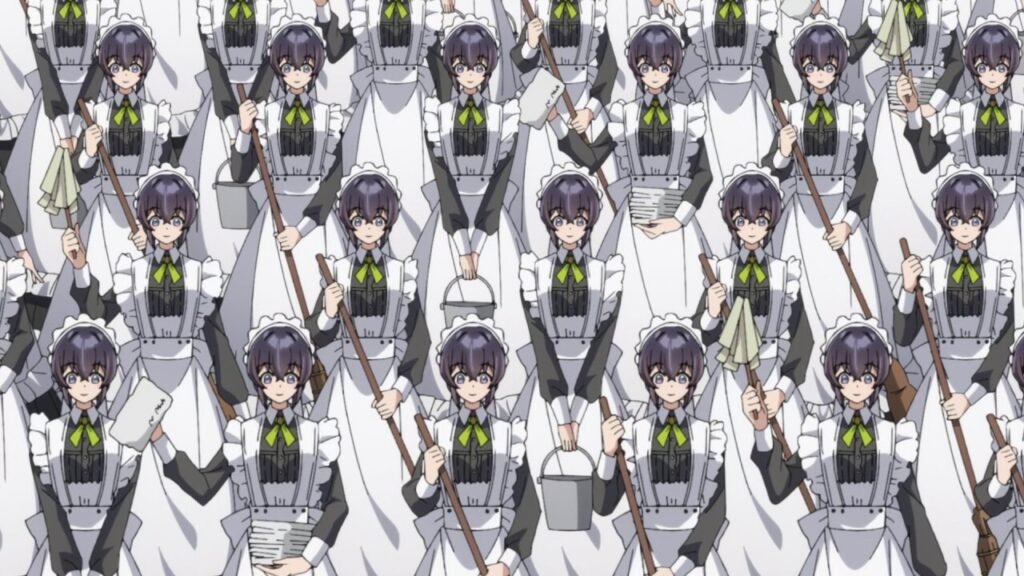
What makes Melody work as a protagonist is the specificity of her wants and how completely she refuses to be distracted from them. Romance with handsome men? She notices that she is not a rock, but it does not move her off task. Demon lord attacks? She handles them with whatever is available and goes back to what she was doing.
The plot of the otome game she is supposedly the heroine of keeps trying to pull her into its story, and she keeps walking past it because she has a schedule.
Unbeknownst to Melody, this world is actually an otome game, and she is the most powerful and invincible heroine, the saint. Yet, she remains oblivious to this fact. That obliviousness is not played as stupidity. Melody is clearly intelligent and perceptive in most things.
She just does not care about the game’s plot because her actual goal was never to be a heroine. It was to be the best maid who ever lived, and she is on track to do exactly that.
The magic she uses for maid work is the show’s funniest recurring bit. She has saint-level power that could theoretically reshape the world. She uses it to make cheap tea taste like a luxury brew, restore dilapidated furniture, and hunt game for dinner when the pantry runs low. The gap between what she could do and what she chooses to do with it is where most of the comedy lives and it lands consistently across eight episodes.
Liliana, as her employer, is the perfect foil. She is not a bad person, but she is very much a noblewoman who did not expect her new maid to be supernaturally capable of everything and is constantly recalibrating her understanding of the situation. Their dynamic is warm without being saccharine, and the show is smart enough not to make Liliana’s growing dependence on Melody a source of drama.
Eight Episodes In and the Plot Is Finally Catching Up to the Character

The show’s structural weakness in its early run is the one Anime News Network flagged. Episodes two and three lean into jokes and clichés that the first episode had mostly avoided, and the result is a dip in quality that had some viewers checking out.
The reincarnation angle is revisited in ways that add nothing, and the otome game mechanics are explained in ways that feel more like the source material’s light-novel scaffolding than actual story. If you pushed through those episodes, the show finds its feet again by episode four and does not really stumble again after that.
By episode six, the world is starting to push back against Melody’s refusal to engage with it. Characters connected to the otome game’s plot are circling closer. The demon king’s influence is being felt in ways that even Melody’s cleaning schedule cannot entirely ignore.
The show is clearly building toward a situation where her avoidance strategy stops being an option, which is the right direction for the story to go because eight episodes of the same joke eventually run out of runway.
Episodes seven and eight pull Luciana Rudleberg properly into the picture. Luciana is Melody’s opposite in almost every way, a character who is keenly aware of the game’s plot and watches Melody derail it with a mix of disbelief and reluctant admiration. Their dynamic in these two episodes is the best writing the show has produced since the first episode and suggests the second half of the season knows where it wants to go.
Heroine? Saint? No, I’m an All-Works Maid (And Proud of It)! is not a perfect show. The isekai wrapper is unnecessary, the middle episodes dip, and the plot takes its time announcing itself.
However, Melody is one of the more genuinely original isekai protagonists in recent memory, and the show around her is funny and warm in ways that make the rough edges easy to forgive. Summer 2026 has been a strong season, and this one deserves more attention than it is getting.
You May Also Like:
Add us as a preferred source on Google.
[…] Is ‘Heroine? Saint? No, I’m an All-Works Maid (and Proud of it!)’ One Of The Underrate… […]
[…] Read the Episodes 1-8 Review here. […]