

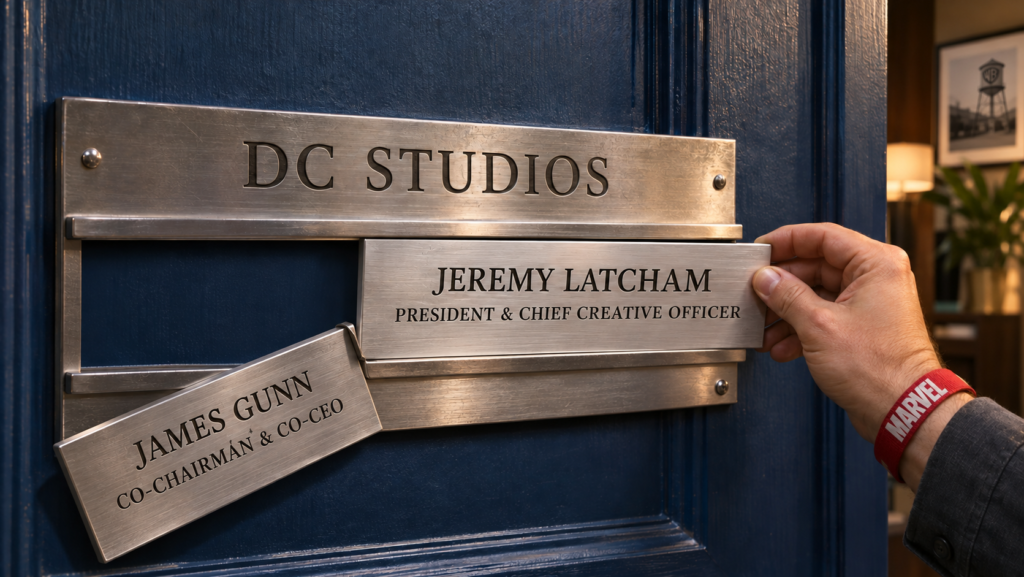
Jeremy Latcham begins leading DC Studios on Dec. 1, and the first person who deserves a raise might be whoever changes the office nameplates. After years of executive reshuffling, DC fans could identify the sound of a departing studio chief before (yet another) Bruce Wayne recognizes the Bat-Signal.
Those same fans find themselves in an all-too-familiar position: Eagerly anticipating what in the H-E-double-hockeysticks is going on with DC Studios and Warner Bros.
Skydance announced the leadership change on Nov. 9. James Gunn and his trusty, silent sidekick, Peter Safran, left their executive posts while continuing their creative work. Their successor inherits film, television, and animation, reporting to Skydance Motion Picture Group co-chairs Dana Goldberg and Josh Greenstein.
Before Jeremy Latcham announces another destination for Batman, he needs to address the people wondering whether DC will finish the trip. You see, Warner Bros. has given jacked-up and broken GPS units to previous regimes, and no one can find their way around the DC Comics universe with duct tape and a divining rod.
That’s why trust must become Latcham’s first mission. The timeline explains why.
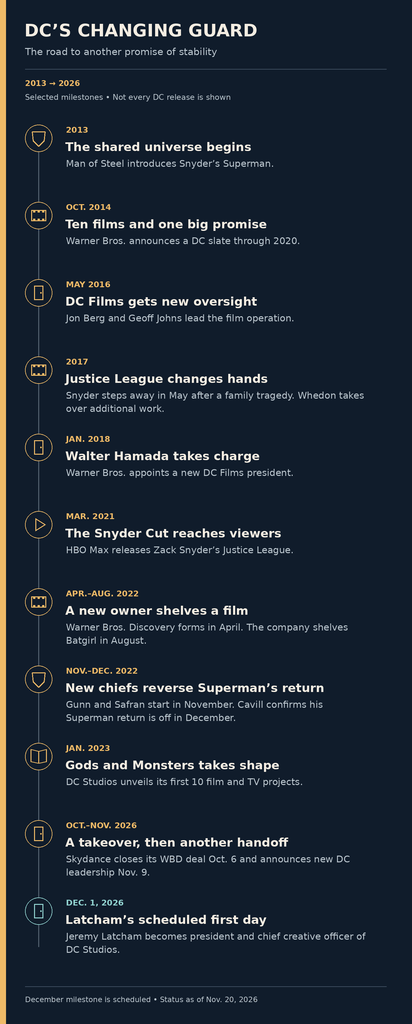
2013–2016 brought a universe and its first course correction
Zack Snyder (“Watchmen,” “300”) launched the modern shared universe with “Man of Steel” in 2013. Warner Bros. then announced 10 DC films in October 2014, including “Cyborg” and “Green Lantern” for 2020 and a second “Justice League” installment for 2019. There were dates, stars, and a procession of expensive spandex. The destination looked settled.
In May 2016, following “Batman v Superman,” Warner Bros. put Jon Berg and Geoff Johns over DC Films. Johns advocated more hope and optimism as the screen universe adjusted its direction. Creative oversight is part of running a studio. The problem develops when audiences cannot tell which promises will survive that oversight.
Jeremy Latcham inherits the accumulated effect. That 2014 slate remains a useful artifact because fans can compare the advertised universe with what reached theaters. “The Flash” eventually arrived in 2023. The promised 2020 “Cyborg” film never did (and that sucked out loud).
Somewhere between the announcement and the screen, the itinerary acquired more revisions than a Riddler confession.
2017 left a wound that another reboot cannot erase

Snyder stepped away from “Justice League” in May 2017 after his daughter Autumn’s death. Joss Whedon (“The Avengers,” “Much Ado About Nothing”) took over additional work. Snyder later described losing the will to fight further studio battles while grieving.
Vanity Fair’s reconstruction of events detailed the creative conflict and extensive changes. The theatrical release bore Snyder’s directing credit, yet presented a substantially altered film. A family’s bereavement belongs outside the franchise scoreboard. The studio’s handling of the production belongs squarely inside this history.
For Jeremy Latcham, that distinction matters. The lesson concerns how a company treats filmmakers and communicates changes to their work. It also concerns fans who thought buying into one creative direction meant the studio intended to carry it through.
Defending Snyder’s right to humane treatment requires no oath to restore every abandoned sequel. Calling every criticism of his films a betrayal turns a serious production history into a loyalty test. DC already has Darkseid. It can survive without everybody demanding that the comments section kneel.
2018–2021 proved DC could win without settling its identity

Warner Bros. appointed Walter Hamada in January 2018. He arrived with experience overseeing successful horror productions, including “It” and “The Conjuring” franchise. The studio had again identified a capable executive who could presumably bring order to the superhero pantry.
“Aquaman” and “Joker” subsequently demonstrated that DC could attract enormous audiences through very different films. “Aquaman” passed $1 billion worldwide (that atrocious film soundtrack notwithstanding). Those achievements deserve space in any account of the period, even when an argument about Hamada’s broader direction gets heated enough to melt Mr. Freeze’s helmet.
Jeremy Latcham should study that success alongside the uncertainty. A self-contained hit can reward an audience immediately. A shared universe also asks viewers to believe that relationships and unfinished stories will matter later. Those are separate promises, and DC has repeatedly blurred the lines between them.
Much to the glory and hallelujah of DC stans everywhere, HBO Max released Snyder’s “Justice League” in March 2021. Fans finally saw his version, but its arrival did not restore the original theatrical roadmap. Warner Bros. had made room for the film while leaving the larger argument unresolved.
2022 made a shelved film, and a provisional Superman return
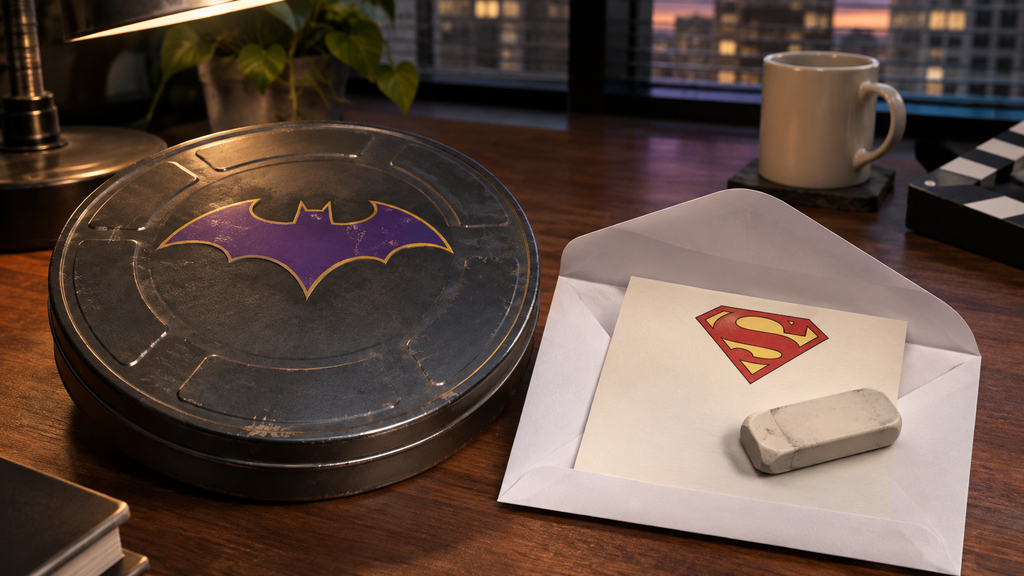
Discovery and WarnerMedia completed their merger in April 2022, putting David Zaslav at the helm of Warner Bros. Discovery. In August, the company shelved “Batgirl” after filming, while it remained unfinished.
Directors Adil El Arbi and Bilall Fallah (“Bad Boys for Life,” “Ms. Marvel”) responded to the shelving with an unusually plain statement.
“We are saddened and shocked by the news. We still can’t believe it.”
Jeremy Latcham inherits the expectations that the decision helped create. Fans learned that even a short movie could disappear before they had a chance to judge it. Filmmakers received the same lesson at considerably greater personal expense.
Then Henry Cavill (“The Witcher,” “Mission: Impossible — Fallout”) returned as Superman in “Black Adam” and announced his comeback. In December, after Gunn and Safran took charge, Cavill confirmed that he would not return.
“After being told by the studio to announce my return back in October, prior to their hire, this news isn’t the easiest, but that’s life.”
That sentence practically belongs under glass in the Fortress of Solitude. The studio authorized an announcement, changed leadership, and changed direction. Fans who celebrated the return had followed an official signal. Their disappointment had a paper trail.
Jeremy Latcham cannot erase those episodes with a better presentation. Their cumulative effect gives every new commitment a question mark.
2023–2026 gave fans another foundation and another handoff
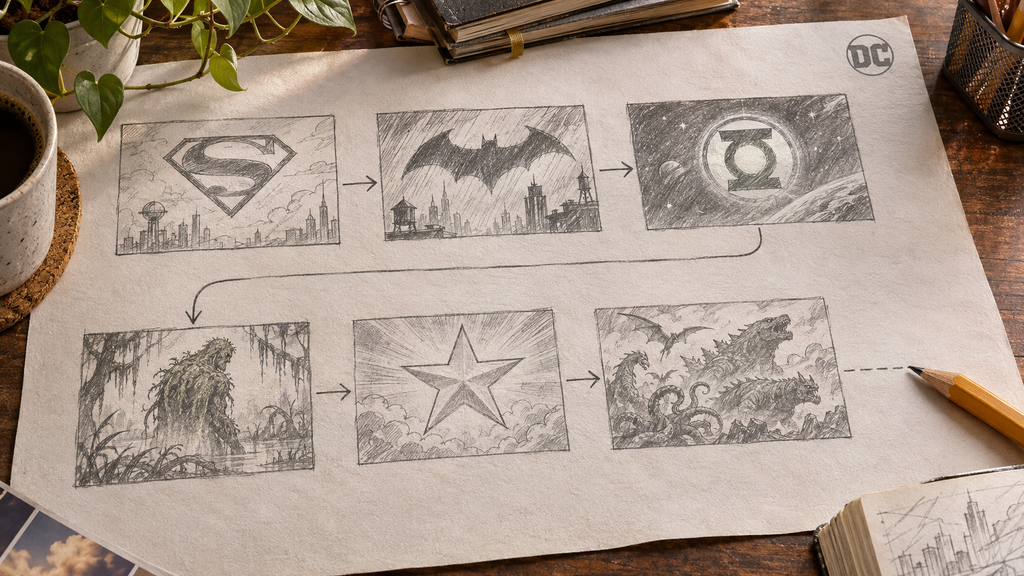
Gunn and Safran officially began running DC Studios in November 2022. Their January 2023 “Gods and Monsters” announcement offered 10 initial film and television projects and a long-term interconnected story.
Safran described an ambition especially relevant now.
“Chapter 1 tells cohesive stories that highlight love, compassion, and the innate goodness of the human spirit”
The slate made room for Superman, Batman and Robin, Supergirl, Swamp Thing and less familiar characters. Introducing unfamiliar heroes was a defensible creative choice. Gunn had helped turn the Guardians into household names. “Peacemaker” also gave DC fans reason to believe his affection for misfits could produce compelling television.
Jeremy Latcham arrives after that experiment produced both achievements and disappointments. Screen International’s account of the transition puts Superman above $618 million worldwide and Supergirl at $126.5 million. It also notes Clayface had reached $126 million without tentpole costs as of writing. One blanket verdict would flatten very different outcomes.
Skydance completed its acquisition of Warner Bros. Discovery on Oct. 6. Another owner then announced another change at DC. As NSN covered the Gunn–Safran departure, the leadership question again overtook the characters.
Jeremy Latcham also shares a creative history with Gunn.
Treating his arrival as a declaration of war against the outgoing filmmaker ignores their professional overlap. Skydance says Gunn and Safran remain involved in “Man of Tomorrow,” due July 9, 2027. Audiences deserve clarity about the work that continues.
The comics offer Jeremy Latcham a useful lesson about legacy
DC readers have survived “Crisis on Infinite Earths,” “Flashpoint” and enough continuity surgery to qualify for a medical discount. They understand that a universe can change. The emotional question is what those changes allow them to keep.
When DC introduced “Rebirth” in 2016, Jim Lee and Dan DiDio emphasized the characters’ enduring essence. The relaunch also restored legacy numbering to “Action Comics” and “Detective Comics.” That made history visible on the covers.
Jeremy Latcham can take a principle from that approach. People attach themselves to these characters through accumulated experiences. A studio should understand what a cast, a relationship, or a half-finished story means to the audience before announcing its replacement.
Warner Bros. has too often displayed a touch of pyrite—”fools’ gold.” Fitting, right?
A glittering plan arrives, then fans discover how much of it survives handling. The cure requires judgment about what deserves protection, including good work made under the previous administration.
Jeremy Latcham’s own résumé offers a reason to listen. As an executive producer on “The Avengers” and “Guardians of the Galaxy,” he worked on films that brought very different personalities together.
His challenge at DC includes persuading audiences that the company values their investment with comparable care. Experience earns him an introduction. Follow-through will determine the relationship.
Trust will require more than winning the loudest argument
The Snyder acolytes and Gunn loyalists both have legitimate grievances to bring forward. Their loudest members can also make every project sound like a referendum on somebody else’s humiliation. A healthy DC future needs room for a viewer to enjoy “Man of Steel,” “Peacemaker” and a Batman film without submitting three separate affidavits.
Jeremy Latcham calls the job a “massive responsibility that I do not take lightly.” He inherits characters with decades of emotional significance, and viewers who have repeatedly watched corporate decisions interrupt their investment.
Jeremy Latcham’s first step should give those viewers a reason to believe the next commitment will last. That means explaining what continues, acknowledging what changes, and allowing finished work to speak before the next reinvention swallows it.
On Monday, Part 2 will examine how he can turn that obligation into decisions about the slate, creative oversight and the Justice League.
For now, Jeremy Latcham can have the office nameplate. Earning the audience’s confidence will take longer than sliding it into the holder.
Add us as a preferred source on Google.