

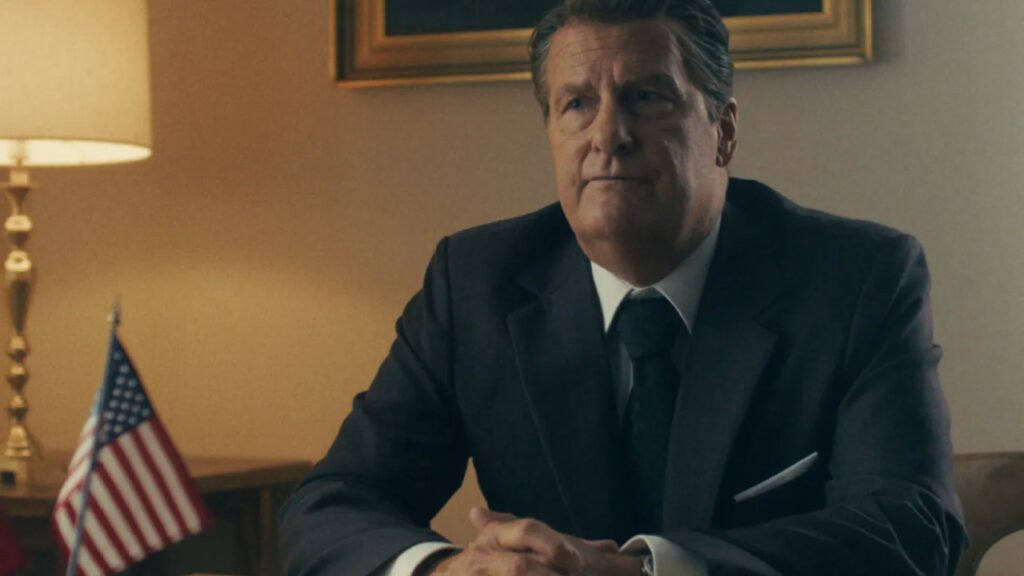
Fans walking into The Brink of War this weekend are getting a very different side of Jared Harris, one that trades his usual brooding intensity for a bald cap, a wig, and one of the most recognizable birthmarks in modern history.
The new political drama from writer-director Michael Russell Gunn dramatizes the 1986 Reykjavík Summit, the tense two-day standoff between the United States and the Soviet Union that nearly ended the nuclear arms race for good.
Harris stars alongside Jeff Daniels and J.K. Simmons, with a supporting cast that includes Hope Davis, Aya Cash, and Branka Katić. It’s a role that required Harris to disappear into a real, still-controversial world leader rather than a fictional one, and that’s exactly why fans are asking who he’s actually playing.
Who Is Jared Harris Playing in The Brink of War?
Harris plays Mikhail Gorbachev, the Soviet General Secretary who sat down with Ronald Reagan at Höfði house in Reykjavík, Iceland, in October 1986 to hash out a possible end to the nuclear standoff.
Getting into character wasn’t a quick fix. Harris has said the transformation took roughly three and a half hours in the makeup trailer each day, though it didn’t involve facial prosthetics. Instead, the work centered on the bald cap, the wig, and Gorbachev’s famous birthmark, the small, unmistakable detail that made the Soviet leader instantly recognizable on the world stage.
The production itself moved fast. The film wrapped shooting in just 20 days, with the cast working through eight to 12 script pages a day, according to director Gunn.
Cinematographer Magdalena Górka has said the approach leaned on letting the three leads carry the scenes with minimal interference, since the movie lived or died on the strength of Harris, Daniels, and Simmons in the room together.
Meet the Real Mikhail Gorbachev
The man Harris is playing wasn’t just another Soviet bureaucrat. Gorbachev became General Secretary of the Communist Party in 1985 and quickly became known for glasnost and perestroika, his policies of openness and economic restructuring that reshaped the final years of the USSR.
By the time he reached Reykjavík, he was pushing hard to slow an arms race that had left, as Daniels’ Reagan puts it in press interviews around the film, roughly 70,000 nuclear warheads pointed between the two superpowers with no real defense against them.
The Reykjavík talks came stunningly close to a deal that would have eliminated nuclear weapons entirely. They collapsed at the last minute over Reagan’s refusal to confine the Strategic Defense Initiative to laboratory testing, but the summit wasn’t a failure.
The groundwork laid in Iceland helped pave the way toward the Intermediate-Range Nuclear Forces Treaty signed the following year, a turning point that eventually contributed to the end of the Cold War.
That history is a big part of why The Brink of War is landing the way it is. With global tensions flaring again, the film’s central question of whether two adversarial leaders can still choose dialogue over disaster feels less like a period piece and more like a warning shot.
The Brink of War is now playing in theaters.
You May Also Like
Add us as a preferred source on Google.