

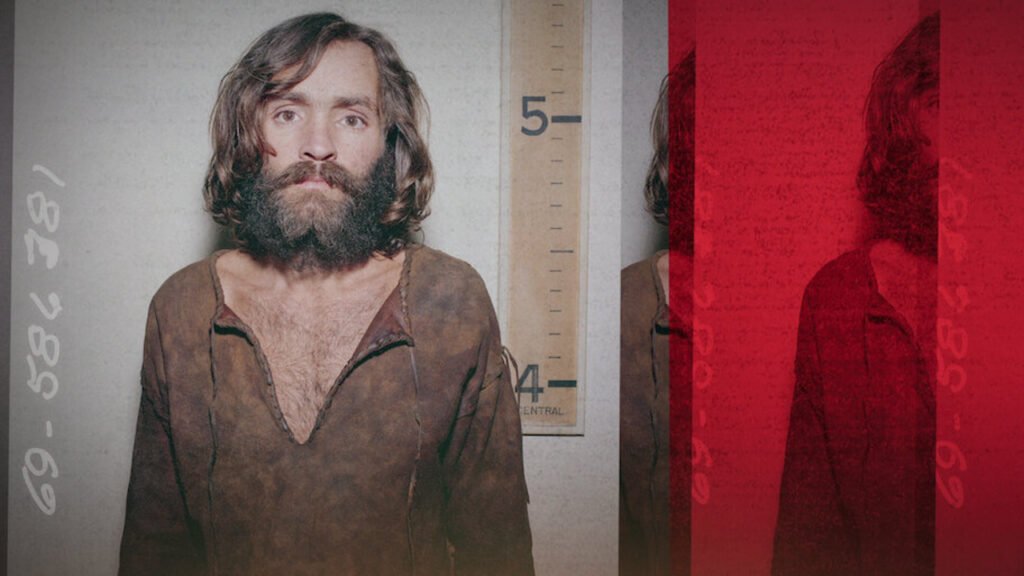
Charles Manson remains one of the most infamous figures in American criminal history, more than five decades after his followers carried out a series of murders in Los Angeles in August 1969. The crimes, which included the killing of pregnant actress Sharon Tate and four other people at her home, shocked the country and turned Manson and his followers into the center of one of the most notorious criminal cases of the 20th century.
Netflix’s CHAOS: The Manson Murders revisits that case through journalist Tom O’Neill’s investigation, challenging parts of the story that became accepted after prosecutor Vincent Bugliosi successfully convicted Manson and his followers.
The documentary does not simply retell the murders. It examines disputed aspects of the investigation, Manson’s connections, and the theory that the official explanation for the killings may not tell the entire story.
How Charles Manson Became The Leader Of The Manson Family
Manson was born Charles Milles Maddox in Cincinnati, Ohio, in 1934. His childhood was unstable from the beginning. His mother was only 16 when he was born, and after she was imprisoned for armed robbery, he was moved between relatives, institutions, and boys’ homes.
His early years were marked by repeated attempts to run away and escalating criminal behavior. By his teenage years, he was already committing theft and other offenses.
A grocery store robbery at age 13 was among his early crimes, while the offenses became more serious as he grew older. During the 1950s, convictions and arrests included burglary, auto theft, and violations involving stolen property. He also spent time in federal institutions after transporting a stolen car across state lines.
Much of his early adulthood was spent moving between correctional facilities. When he was released from prison in 1967, he was 32 and had already spent more than half his life in institutions. California was undergoing major cultural changes at the time, providing an environment where he soon began building a new life.
A music career became one of Manson’s main ambitions. He moved through Los Angeles’ music scene, formed a friendship with Dennis Wilson of the Beach Boys, and eventually crossed paths with record producer Terry Melcher.
A recording career never materialized, however, and the failure added to his growing frustration as he continued attracting followers around him.
That group eventually became known as the Manson Family. Many of the followers were young people who had become disconnected from their families and conventional society. Through a combination of manipulation, ideology, and personal influence, Manson established himself as the group’s spiritual and ideological leader.
The group’s beliefs became increasingly extreme. Prosecutors later argued that Manson developed an apocalyptic worldview centered around his interpretation of the Beatles song “Helter Skelter.”
According to Vincent Bugliosi’s prosecution theory, he believed a race war was approaching and wanted to trigger it through a series of murders that would be blamed on Black Americans.
That explanation became central to the prosecution’s case and eventually shaped much of the public understanding of the murders. In August 1969, members of the Family carried out a series of killings in Los Angeles.
On August 8, followers entered Sharon Tate’s Benedict Canyon home and murdered the pregnant actress along with Jay Sebring, Abigail Folger, Wojciech Frykowski and Steven Parent.
The following night brought another attack. Leno LaBianca and his wife, Rosemary, were murdered at their Los Feliz home. Although Manson did not personally carry out every killing, prosecutors established that he had directed the group and was responsible for the murders under California law.
He and several followers were convicted of first-degree murder and initially sentenced to death. Those sentences were later commuted to life imprisonment after California temporarily abolished the death penalty.
Manson remained incarcerated for the rest of his life and died in prison in 2017 at age 83.
What Netflix’s CHAOS: The Manson Murders Questions About The Case
Netflix’s documentary takes a different approach by examining Tom O’Neill’s years-long investigation into the Manson murders. O’Neill’s research became the foundation for the 2019 book Chaos: Charles Manson, the CIA, and the Secret History of the Sixties, which the documentary adapts.
Rather than accepting the familiar Helter Skelter explanation without question, the film examines whether Bugliosi’s theory completely accounts for the events surrounding the murders. O’Neill’s investigation raises questions about inconsistencies in the case, the people surrounding Manson, and the information available to authorities before and after the killings.
Law enforcement is one of the documentary’s major areas of interest. O’Neill’s research examines how police handled information connected to Manson and his followers before the murders and whether certain individuals received unusual treatment during the investigation.
Another controversial part of the film involves alleged connections between the Manson Family and government programs associated with mind-control research. These claims form part of the documentary’s broader investigation, but they should not be confused with facts about the murders. The film presents them as questions and theories that have surrounded the case rather than definitive explanations.
That distinction matters because CHAOS is less interested in providing another straightforward retelling than in examining how the accepted version of the case came together. Some critics have argued that the documentary spends too much time pursuing conspiracy theories and raises questions that it cannot conclusively answer.
Even so, the approach gives the story a different angle. The central facts remain firmly established: Manson’s followers murdered Tate, LaBianca and the other victims, while Manson was convicted for his role in directing the crimes. What remains disputed is how completely the traditional explanation accounts for the motivations, circumstances and connections surrounding those events.
More than five decades later, the case continues to attract attention because of the unusual combination of cult psychology, celebrity culture, criminal manipulation and political speculation surrounding it. Manson’s failed music ambitions, his influence over vulnerable followers and the brutality of the killings have all contributed to the case’s enduring place in American true-crime history.
CHAOS: The Manson Murders uses that history as a starting point rather than an endpoint. By revisiting O’Neill’s research, the documentary asks whether the story Americans have heard for decades contains unanswered questions that deserve another look.
That does not mean every theory presented in the film is proven. Instead, its significance lies in reopening a case that many believed had already been fully explained. The murders themselves are settled history, while the debate over exactly what motivated them and whether every surrounding detail has been uncovered continues to this day.
You May Also Like
Add us as a preferred source on Google.