

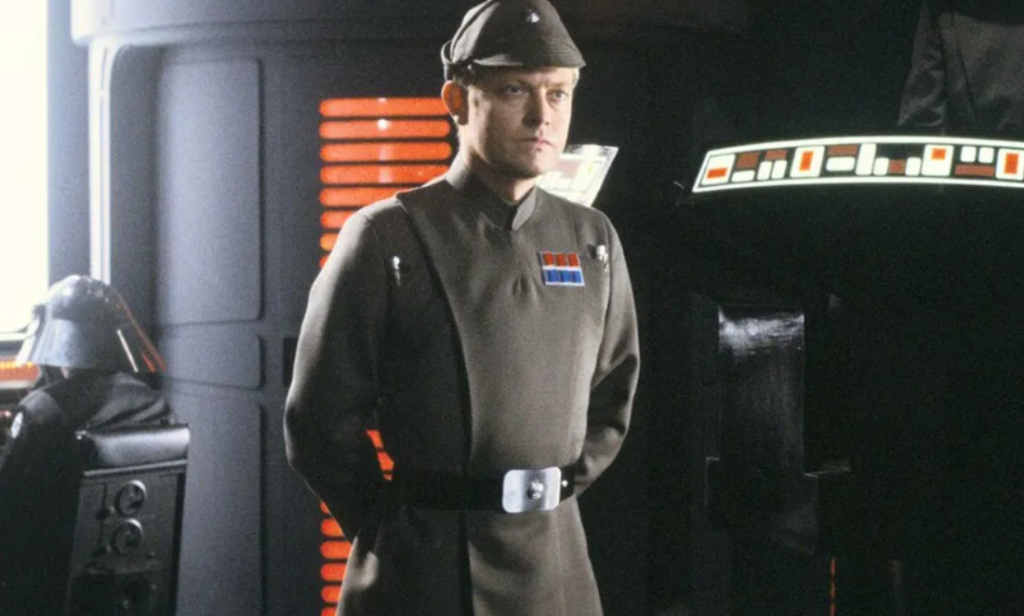
Many Star Wars fans probably would not recognize his name immediately. But the moment Darth Vader stepped off the transport ship, locked eyes with him aboard the second Death Star, audiences instantly knew exactly who he was.
Following the death of British actor Michael Pennington at the age of 82, Star Wars fans have been paying tribute to Moff Tiaan Jerjerrod, an underappreciated character who wielded no lightsaber and possessed no Force abilities, yet still managed to leave a lasting impression in the original trilogy. Here’s a closer look at the man responsible for overseeing the construction of the second Death Star.
Moff Tiaan Jerjerrod in Star Wars: Who Is He?
In Star Wars: Episode VI – Return of the Jedi, Moff Tiaan Jerjerrod serves as the Imperial officer overseeing construction of the second Death Star above the Forest Moon of Endor. Holding the rank of Moff places him high within the Empire’s hierarchy. Moffs function as regional governors who answer directly to the Emperor and his closest enforcers while ranking above the average officers stationed throughout the Empire.
When Darth Vader first meets Jerjerrod, he informs him that Emperor Palpatine is dissatisfied with the pace of construction. Jerjerrod becomes one of the few Imperial officers willing to openly admit that the project is incredibly difficult and requires additional manpower. Vader’s now-iconic response immediately establishes the power dynamic between them: “Then perhaps you can tell him when he arrives.”
That exchange reveals everything audiences need to understand about Jerjerrod’s place within the Empire. He is not portrayed as a fanatic or a power-hungry zealot. Instead, he feels more like a stressed administrator trapped beneath the expectations of two of the most dangerous individuals in the galaxy. Michael Pennington’s performance conveys that fear perfectly through subtle hesitation and nervous delivery.
Interestingly, the character’s full name only appears once in the film’s ending credits. There is also evidence that Alan Rickman auditioned for the role before Pennington ultimately landed the part.
How Much More Complex Moff Tiaan Jerjerrod Could Have Been
What many viewers may not realize is just how much more layered the character was originally intended to be. Several scenes filmed during production were ultimately cut from the final version of Return of the Jedi, and they significantly change Jerjerrod’s role in the story.
In one deleted subplot, Emperor Palpatine orders Jerjerrod to fire the Death Star at the Forest Moon of Endor and destroy everyone on its surface if the Rebels succeed in taking down the station’s shield generator. Although the sequence was removed from the theatrical release, it remained part of the film’s novelization and later appeared in bonus material included with the Star Wars: The Complete Saga Blu-ray collection.
The subplot becomes even more interesting because Jerjerrod appears deeply reluctant to carry out the order. In another deleted scene, he even attempts to block Darth Vader from entering the Emperor’s chambers, insisting that Palpatine does not wish to be disturbed. While he eventually backs down when Vader pressures him, the moment is surprisingly bold for a character with such limited screen time.
The novelization explores Jerjerrod’s psychological state in far greater depth, presenting him as a far more conflicted and tragic figure than the film itself does. In the theatrical version, however, audiences mainly see a man desperately trying to survive under impossible pressure while working for two terrifying superiors.
Ironically, although the scene showing Jerjerrod refusing to destroy Endor was cut, viewers can still briefly see the second Death Star rotating toward the moon before its destruction, subtly implying Palpatine’s command was already in motion.
Why Moff Tiaan Jerjerrod Became One of the Original Trilogy’s Most Likable Minor Characters
That realism is exactly why Jerjerrod became such a memorable fan-favorite despite his relatively small role. Unlike many characters in Star Wars, he feels genuinely human. He is neither exaggerated nor entirely evil. Instead, he comes across as an ordinary man trapped in an impossible situation, struggling to complete an overwhelming task while trying not to anger Darth Vader or Emperor Palpatine.
That kind of grounded portrayal required genuine talent, and it stands as one of the many reasons Michael Pennington’s contributions to film and theater are fondly remembered by audiences.
You May Also Like
Add us as a preferred source on Google.
Conversation