

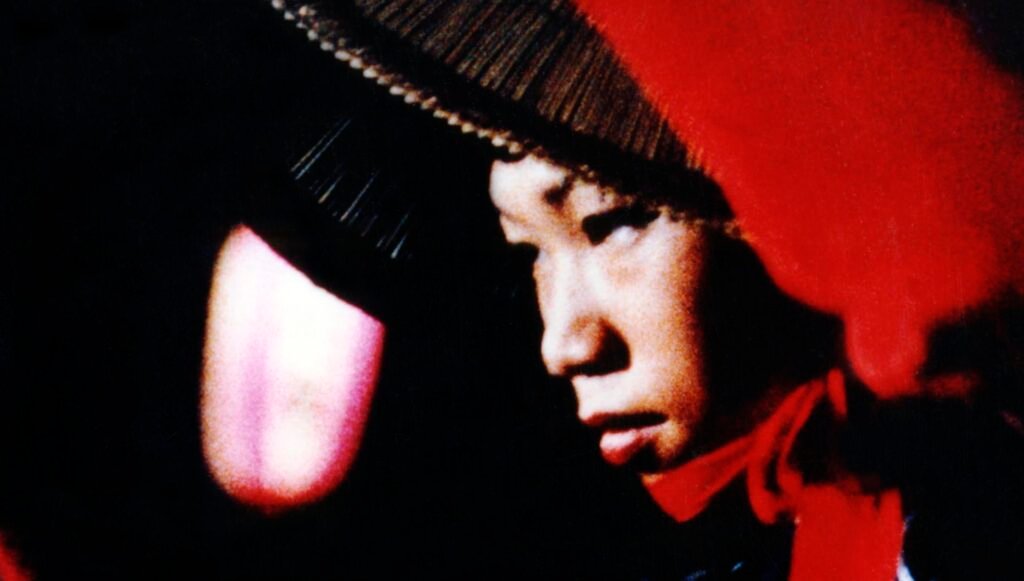
Chris Marker’s Sans Soleil is one of the most remarkable films that explores the boundaries of human ethics in cinema. Marker tries to construct a whole cinematic structure around the idea of seeing and recording the world. He does not use his film in order to impose his vision of reality. Instead, he creates a narrative structure that makes the viewer question his perception of reality. As a result, his film is an attempt to create an attitude toward representation and ethics in general, as well as towards the world.
Declaring the image as a construction
Marker tries to demonstrate that film never shows us objective reality. For that reason, it should make the viewers aware of what the images show and how they change their understanding. In order to achieve such an effect, he manipulates the quality of images during several scenes that can be defined as “the zone.” In these scenes, footage was edited with the help of electronic synthesizers operated by Hayao Yamaneko.
Such an alteration made the images distorted. In this case, their colors were altered, some parts were blurred, and some shapes disappeared completely. The idea of this approach to editing can be understood with the help of Marker’s words. According to him, after transformation, images become honest because they cannot claim to show reality directly. Therefore, when filming people, Marker declares that film cannot tell viewers about the world honestly.
This principle can be viewed as one of the major ideas in Marker’s film and, generally, in Marker’s philosophy of film studies. Namely, Marker demonstrates how representation can declare that it cannot show something objectively. Consequently, such a technique can help to avoid imposing one’s opinion on the viewer.
Equality between the filmmaker and the subject
As was mentioned earlier, traditional filming presupposes that the existence of the camera is not obvious to the subjects of film recording. However, Marker takes quite a different approach to filming. Namely, he tries to find occasions when subjects realize that they are filmed. One of the scenes, when such an equality between a subject and the filmmaker occurs, can be found in the marketplace sequences in Cape Verde.
Marker waits for the women who are filmed to turn and look at the camera. The subject recognizes its existence and decides how to react to its presence. This approach shows us that a subject and filmmaker are on the same level. They have the ability to choose how they want to act in certain situations. Such an approach eliminates the idea of the filmmaker having superiority over his subjects.
Memory, history, and the act of witnessing
The whole structure of Marker’s film can be compared to a process of memory creation. It can be seen from the fact that Sans Soleil consists of letters written by Sandor Krasna and read by an unnamed narrator. Therefore, there is a separation between the viewer and the filmmaker. The latter tells the stories of other people to the viewer.
He also states that remembering is not equal to not forgetting. This idea reflects his belief in changing memory through time. Thus, Marker applies this idea to editing. For instance, he mixes various images of the places he visited, including scenes from Japan, Guinea-Bissau, Iceland, and Paris. The combination of these scenes creates associations and does not try to solve the differences between cultures.
Marker’s approach to editing can be described as creating thoughts via images. Thus, the viewer sees how different realities co-exist in his mind. The aim of this technique is to emphasize similarities between different realities. Therefore, Marker compares the differences between realities without exploiting them. His approach is quite modest, just like he described his film – a kind of home movie.
You May Also Like
Add us as a preferred source on Google.
Conversation