
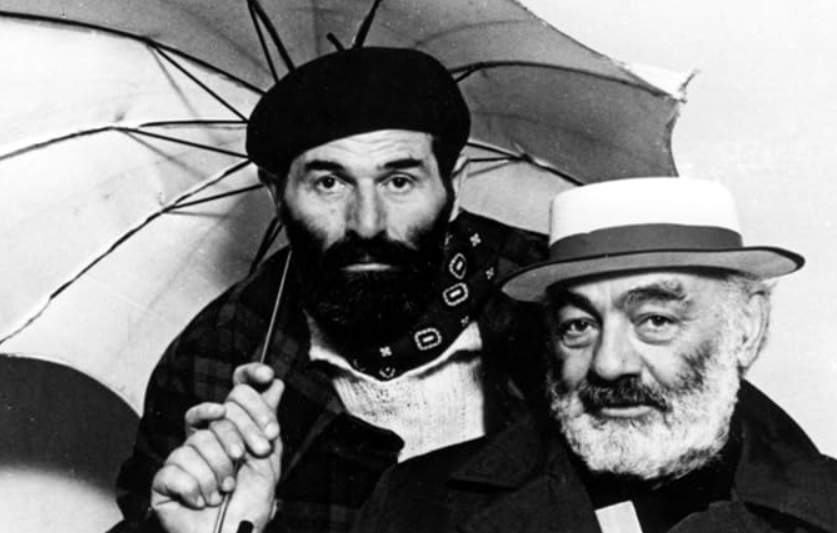
Parajanov: The Last Spring is one of the most unusual documentaries in cinema history. It was shot during a war, edited under a one-hour daily electricity limit due to Armenia’s wartime blockade, and completed in 1992. The fact that it exists at all is the story.
Mikhail Vartanov, born February 21, 1937, was a Soviet filmmaker and cinematographer whose work became inseparable from that of Sergei Parajanov. Their bond was not just artistic. It was a friendship maintained at personal cost across decades of Soviet persecution, and The Last Spring is its document.
How Vartanov and Parajanov First Met
Vartanov first encountered Parajanov’s work in 1964, watching Shadows of Forgotten Ancestors and test footage of the unfinished Kyiv Frescoes as a student at Moscow’s Gerasimov Institute of Cinematography. Their lifelong friendship began in 1967 in Armenia, when they met to discuss the screenplay of The Color of Pomegranates.
Vartanov’s debut film, The Color of Armenian Land (1969), featured his dissident friends, including Parajanov and painter Minas Avetisyan. The Soviet authorities promptly blacklisted him for it. The Last Spring is the final film of a trilogy that includes The Color of Armenian Land, for which Vartanov was blacklisted in 1969 for refusing to delete the scenes featuring Parajanov.
What Soviet Authorities Did to Both Men
In December 1973, Parajanov was arrested in Kyiv and accused of homosexuality, sodomy, and the propagation of pornography. The charges were widely understood as pretextual. Nearly all of Parajanov’s film projects from 1965 to 1973 were banned by Soviet film administrations, often without discussion.
After Parajanov’s arrest, Vartanov immediately protested to the Prosecutor General of Ukraine. Recently declassified documents proved it was that letter which prompted the intensified harassment Vartanov endured, and his subsequent firing from Armenfilm Studios four months after Parajanov’s imprisonment.
A wave of international protests followed from filmmakers including Truffaut, Buñuel, Pasolini, and Antonioni. Poet Louis Aragon’s petition to the Soviet government was instrumental in securing Parajanov’s release in December 1977. He had served four years of a five-year sentence.
What The Last Spring Actually Contains
The film is a wordless montage expressing the two artists’ friendship while Parajanov was imprisoned by the Soviets. It draws on three distinct layers of material.
It features behind-the-scenes footage of Parajanov shooting The Color of Pomegranates, the filmmaker’s prison art, and a tour of his Tbilisi home, now the Sergei Parajanov Museum. Vartanov’s camera also documents Parajanov’s last day at work in 1990 during the making of the unfinished The Confession, the original camera negative of which survives inside The Last Spring. Parajanov died of lung cancer that same year.
The film also reveals a request Parajanov sent to Vartanov in an unpublished 1974 letter from the Ukrainian prison. The contents of that letter are disclosed in the film rather than summarized here, and they carry significant weight.
Why the Film Matters Beyond Its Subject
The documentary was made under a one-hour daily electricity limit in a blockaded, war-torn Armenia. That context is not incidental. It mirrors the conditions under which both men spent much of their careers: making work inside a system designed to prevent it from existing.
Francis Ford Coppola wrote that the film “exemplifies the power of art over any limitations.” Jim Jarmusch called it an important and alluring film for anyone who loves cinema. The documentary has since been restored in 4K by the UCLA Film and Television Archive in collaboration with the Parajanov-Vartanov Institute.
Vartanov died in Hollywood on December 29, 2009. The Parajanov-Vartanov Institute was established in 2010 to study, preserve, and promote the artistic legacies of both men. The restored print continues to screen at institutions including the Museum of the Moving Image and the Academy Museum of Motion Pictures in Los Angeles.
You May Also Like: