

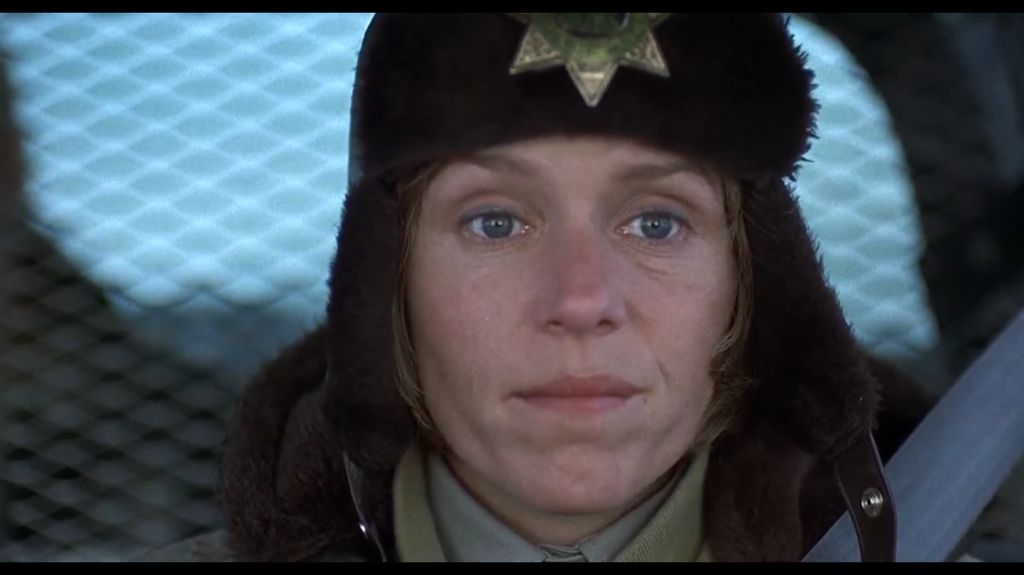
Most people who argue about Fargo argue about the wrong things. They debate the wood chipper, the accents, and Steve Buscemi’s hair. But the film’s entire moral weight rests on one character, and she’s the one most easy to overlook: Marge Gunderson, the seven-months-pregnant police chief of Brainerd, Minnesota.
She’s not the villain. She’s not caught up in the scheme. She barely appears until the film is half over. And yet, without Marge, Fargo is just an extremely well-made crime movie. With her, it becomes something genuinely rare.
The Chaos Around Her Makes Marge’s Decency Land Harder

The Coen Brothers structure Fargo around a specific kind of contrast. Jerry Lundegaard is spineless and self-pitying. Carl Showalter is petty and vicious. Even the “innocent” characters are passive, checked out, or motivated by greed. The world of the film is one where people consistently choose the worst version of themselves.
Marge does not do that. She’s competent without being cold. She’s cheerful without being naive. When she works a crime scene at 7 in the morning in subzero temperatures while visibly pregnant, she does it without complaint, without drama, just focus. The Coens never play her warmth as a joke. That’s the key choice that separates Fargo from a hundred other neo-noirs.
Her famous closing monologue, delivered to a handcuffed Gaear Grimsrud in the back of her patrol car, isn’t a speech about justice. It’s quieter than that. She just says she doesn’t understand it. All this for a little bit of money, and there’s more to life. She sounds genuinely sad, not righteous. Frances McDormand won the Academy Award for Best Actress for the role, and it’s that specific note of baffled grief that earned it.
Why She’s the Film’s True Center, Not Its Comic Relief
There’s a temptation to read Marge as a figure of gentle parody, a walking “Minnesota nice” caricature. The Coens invite that reading and then quietly pull the rug out from under it. Watch how she handles the Mike Yanagita scene, a strange, seemingly irrelevant detour where an old acquaintance lies to her face about his life. Marge clocks it. She doesn’t make a scene, she just files it away and follows up the next morning. That’s not comic relief. That’s a portrait of a genuinely sharp person who happens to be warm.
The film’s final image belongs to her: Marge in bed with her husband, Norm, talking about his painting being featured on the three-cent stamp. It’s small, domestic, and completely ordinary. After 90 minutes of greed and carnage, the Coens land on a couple being quietly happy about a small thing. The contrast is the point. Marge’s entire arc is an argument that decency is not weakness, and that ordinary goodness can coexist with genuine competence.
That’s the idea Fargo is built around. Jerry and Carl don’t understand it. Marge lives it without even trying to explain it. That’s why she’s the most important character in the film, even if she’s the last one viewers remember to bring up.
Fargo celebrated its 30th anniversary in 2026, and the debate over what makes it work has never really stopped.
You May Also Like:
Add us as a preferred source on Google.
Conversation