

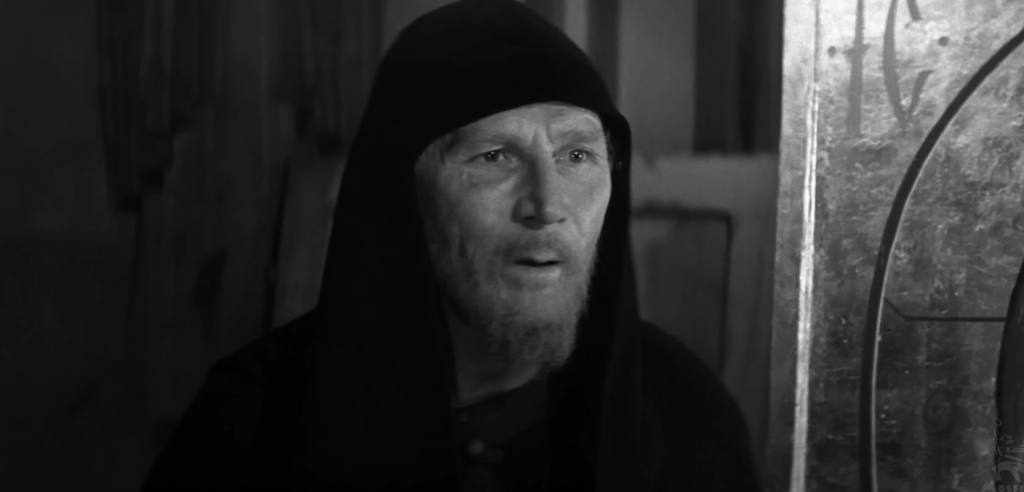
If you want to understand what it costs to make something true, Andrei Rublev is the film to watch. Tarkovsky made it in 1966, and Soviet authorities promptly shelved it for five years.
The film runs close to three hours and follows the 15th-century Russian icon painter Andrei Rublev across a series of loosely connected episodes. It is not a biopic in any conventional sense. Rublev spends long stretches of the film silent, observing, or doing almost no painting. That’s the point.
Why Andrei Rublev Is Not Really About Painting
Tarkovsky wasn’t interested in dramatizing the act of artistic production. He was interested in what the world does to a person trying to create something honest inside it.
The Russia Rublev moves through is brutal. There are Tatar raids, peasant uprisings, religious persecution, and famine. Rublev witnesses atrocities he cannot stop. At one point, he takes a vow of silence and stops painting entirely for years. The film treats this not as failure but as a morally serious response to what he has seen.
Tarkovsky shot the film in black and white, with one striking exception: the final minutes switch to color to show Rublev’s actual surviving icons, including the famous Trinity, painted around 1411 and still held at the Tretyakov Gallery in Moscow. The shift lands like a gut punch. Everything the film has built toward becomes visible in those images.
What the Bell-Casting Sequence Gets Right About Making Anything
The film’s final and longest episode follows a teenage boy named Boriska who claims to know the secret of casting a great bell, a secret his dead father supposedly passed to him. He doesn’t actually know it. He is improvising under enormous pressure, with his life effectively on the line.
The bell works. When Boriska breaks down after it rings, Rublev speaks for the first time in the film, telling the boy they will work together again. It is the only moment of direct connection between the artist and the successor over the entire three hours.
The sequence is the film’s thesis made concrete. Great work does not come from inherited certainty. It comes from committed action under conditions of doubt, with no guarantee of outcome.
Why Soviet Authorities Suppressed ‘Andrei Rublev’ for Five Years
Mosfilm submitted the completed film in 1966, but the Soviet cultural authorities found it too dark, too ambiguous about Russian history, and insufficiently heroic in its depiction of the medieval period. It was banned from domestic release until 1971, though a cut version screened at Cannes in 1969, where it won the FIPRESCI Prize.
The suppression backfired. The film’s reputation grew through restricted screenings and word of mouth, and by the time it received wide release, it was already regarded internationally as a major work. It now regularly appears on lists of the greatest films ever made, including the Sight and Sound poll.
Andrei Rublev remains Tarkovsky’s longest film and, for many, his most complete statement on what art demands from the person making it, a question he’d return to more personally in Mirror.
You May Also Like:
Add us as a preferred source on Google.
Conversation