

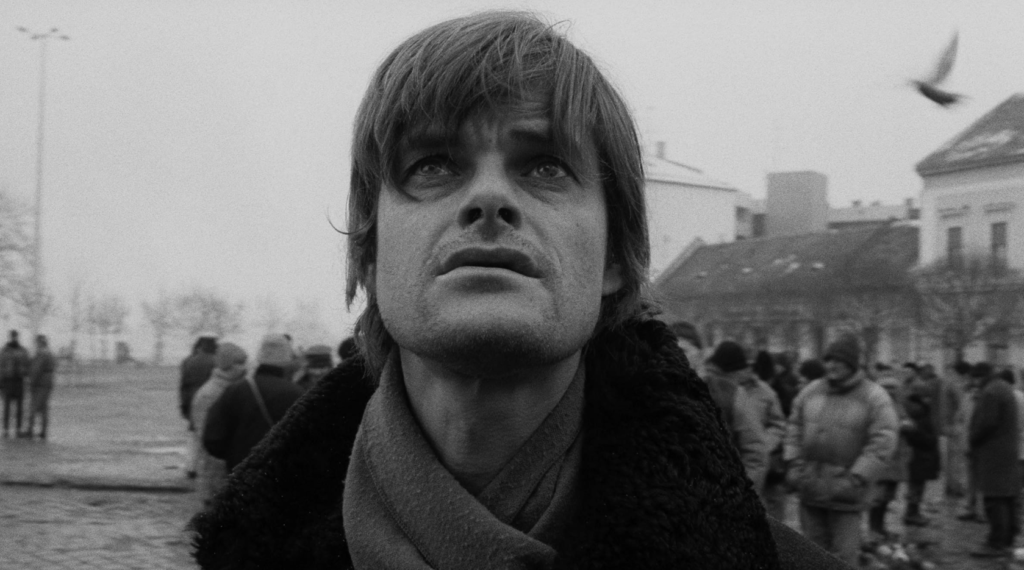
Werckmeister Harmonies does not explain itself. It does not need to.
Released in 2000 and based on László Krasznahorkai’s novel The Melancholy of Resistance, Béla Tarr’s film follows János, a gentle young man in a decaying Hungarian town, as a traveling circus arrives carrying a giant stuffed whale and a mysterious figure known only as The Prince. What follows is not really a plot. It is a feeling that slowly tightens around your chest and does not let go.
How Béla Tarr Builds Dread Without Dialogue
Tarr shoots Werckmeister Harmonies in 39 long, unbroken takes across its 145-minute runtime. The camera moves constantly but calmly, tracking characters through fog, down corridors, across empty squares at night. Nothing is rushed. Nothing is explained.
This is a deliberate strategy. By refusing to cut away, Tarr forces you to sit inside each moment rather than process it from a safe distance. The film’s opening sequence, in which János orchestrates a drunk bar crowd into a physical model of a solar eclipse, runs nearly seven minutes without a single edit. It is patient, strange, and completely absorbing.
The black-and-white cinematography by Gábor Medvigy does the rest. Every frame looks like a photograph of something already lost. Light falls through windows onto empty floors. Faces are caught half in shadow. The town itself feels abandoned even while people still live in it.
The Whale, The Prince, and What Tarr Leaves Unsaid
The stuffed whale at the center of the film is one of cinema’s great images. It sits in a truck, enormous and dead, drawing the townspeople toward it out of a fascination they cannot articulate. Tarr never tells you what it means. That is the point.
The Prince is even more elusive. We never see his face. We hear his voice once, speaking to a crowd, inciting something violent and formless. He functions less as a character and more as a force, the way political dread works in real life: faceless, sourceless, spreading through a population before anyone can name it.
The riot sequence that follows is one of the most unsettling scenes in modern cinema precisely because Tarr films it quietly. No score. No dramatic cutting. Just a slow, steady procession of men moving through a hospital, destroying everything, for reasons the film refuses to package neatly.
Why the Atmosphere Hits Harder Than Any Plot Could
Tarr has said he is not interested in stories, only in time and reality. Werckmeister Harmonies bears that out. The film works on you the way the weather does: gradually, physically, without asking for your permission.
By the time the film reaches its final images, something has shifted. You feel the collapse of order, the failure of innocence, the weight of a world going wrong. Tarr did not tell you any of that directly. He just made you stand in it long enough for it to become yours.
That is what separates atmosphere from decoration. Decoration sits on the surface. The atmosphere gets into the room and stays there.
Werckmeister Harmonies remains one of the defining films of world cinema. If you have not seen it, clear two and a half hours and go in cold.
You May Also Like:
Add us as a preferred source on Google.
Conversation