

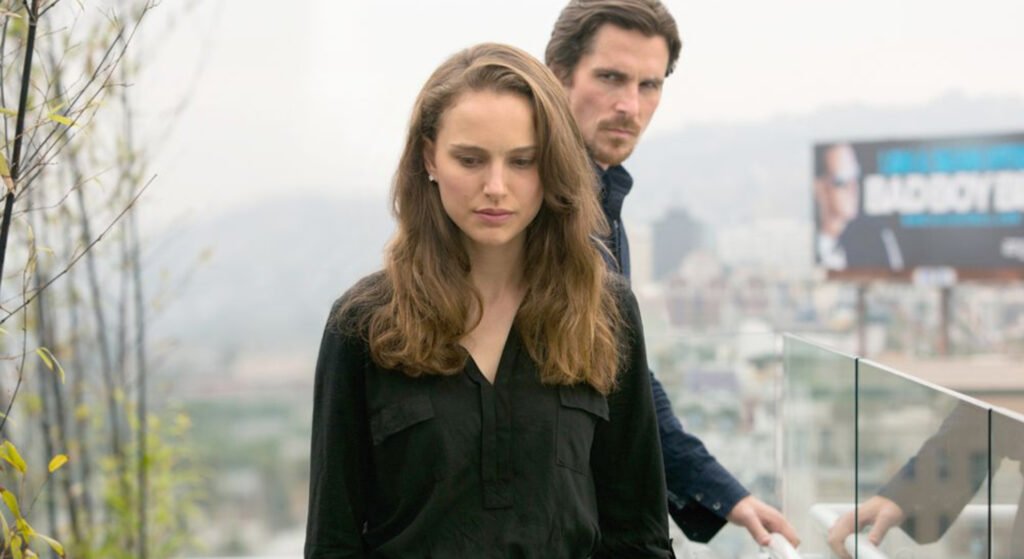
Knight of Cups has just 47% positive reviews on Rotten Tomatoes. It also has people who call it one of the most profound films they have ever seen. Both things are true, and the gap between them comes down entirely to how you decide to watch it.
Terrence Malick‘s 2015 film follows Rick, a successful Hollywood screenwriter played by Christian Bale, as he drifts through Los Angeles and Las Vegas, moving between women, parties, and desert landscapes, voice-over murmuring over everything like half-remembered thoughts. There is no plot in any conventional sense. There are no scenes that build toward a climax.
What there is, is two hours of some of the most extraordinary images ever committed to film, organized around a spiritual question that the movie never answers directly. If you sit down expecting a story, the film will feel empty. If you sit down expecting an experience, it might change you.
What Knight of Cups Is Actually Doing
The film is loosely structured around eight chapters, each named after a tarot card, and opens with a voiceover from the “Hymn of the Pearl,” an ancient gnostic text about a prince sent to retrieve a pearl from Egypt who drinks a cup of forgetting and loses himself entirely. That’s Rick. A man of talent and privilege who has forgotten what any of it is for.
Malick doesn’t dramatize Rick’s emptiness. He recreates the texture of it. Cinematographer Emmanuel Lubezki, who won three consecutive Oscars during this period of his career, shoots everything with a restless handheld camera that drifts between faces, light, and architecture, never settling for long. The effect is exactly what it feels like to be a person who is present in his own life but not really there. You watch it, and you recognize the feeling before you can name it.
Why Watching It Wrong Ruins It
The most common complaint about Knight of Cups is that nothing happens. And if you are watching it for the plot, that is completely accurate. Nothing happens. Characters appear and disappear. Conversations start and trail off. Rick walks through rooms and across rooftops and through waves on a beach, and none of it adds up to a narrative arc.
But Malick isn’t telling a story about Rick. He is asking you to feel what Rick feels, and then to sit with the question of why someone surrounded by beauty, money, and interesting people could feel so completely unmoored. That question doesn’t have a plot. It has weight, and the film conveys that weight through images, music, and the rhythm of its editing rather than through dialogue or cause-and-effect.
Matt Zoller Seitz of RogerEbert.com gave it four out of four stars and said nobody else is making films like this. Richard Brody of The New Yorker called it one of the great recent bursts of cinematic artistry. They were watching a different film than the people who walked out. The difference wasn’t taste. It was an approach.
How to Actually Watch ‘Knight of Cups’
The practical advice is simple. Don’t try to follow a story. Don’t wait for things to connect. Instead, treat each shot as you would a painting, something to be felt rather than decoded. Let the voiceover wash over you without trying to pin it to a specific meaning. Pay attention to the light, because Lubezki’s work here is a masterclass in what a camera can do with the way afternoon sun falls through glass or how a face looks half-lit in a nightclub.
And watch it alone, or with someone who will not talk. Knight of Cups requires a kind of receptive silence that is hard to maintain if someone next to you keeps asking what is going on. What is going on is the whole point. You have to let the film find you rather than going looking for it.
Terrence Malick has made more coherent films. He has made more narratively satisfying ones. But few filmmakers have ever made something that feels this much like the inside of a human mind that has everything and still cannot find its way home.
You May Also Like:
Add us as a preferred source on Google.
Conversation