

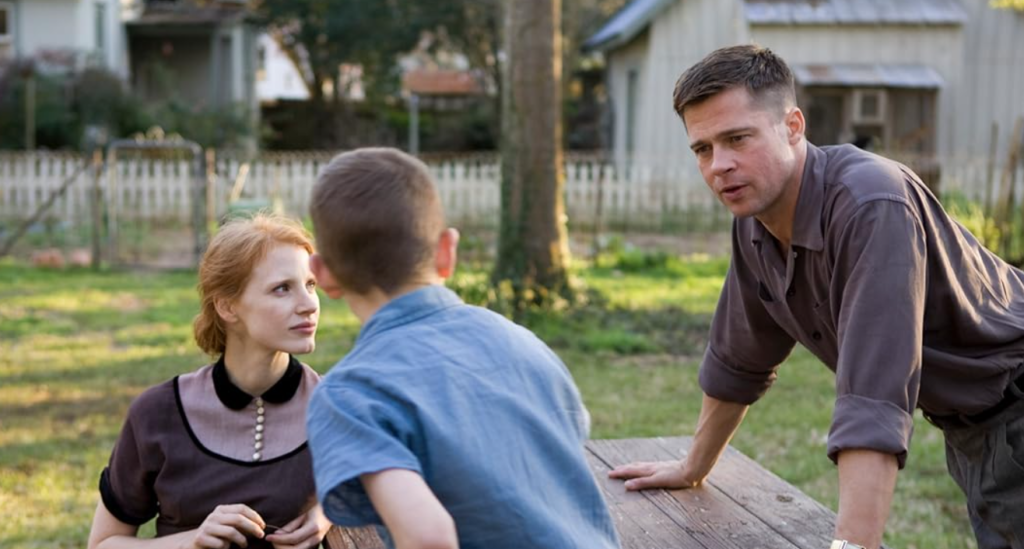
Terrence Malick’s 2011 masterpiece The Tree of Life stands as a singular achievement in cinematic history, transcending traditional storytelling to function almost as a visual liturgy. Rather than adhering to a conventional plot, the film unfolds through Jack O’Brien‘s memories, capturing his inner struggle between the forces of nature and grace.
At its heart, the film is a profound meditation on the human condition, juxtaposing the intimate details of a 1950s Texas childhood with the vast, cosmic birth of the universe. This shifting sense of scale, from the ripples in a backyard pond to the formation of galaxies, gives the film its searching, almost prayer-like quality.
The Dialogue Between the Soul and the Infinite
The structure of the film is less narrative than contemplative, built around whispered questions directed toward the divine. Through fragmented voiceovers, a hallmark of Malick’s style, characters ask questions such as “Where were you?” and “Who are we to you?” These lines are not meant for one another but seem addressed to something greater, creating a sense of intimate spiritual inquiry.
Emmanuel Lubezki‘s cinematography deepens this feeling of closeness. Using natural light and fluid, wide-angle movement, the camera drifts through moments that might otherwise feel insignificant. A mother’s touch, a shifting shadow, or a child’s quiet curiosity is elevated into something sacred. In this way, the film suggests that attention itself, the simple act of noticing, becomes a form of reverence.
The film’s central tension is introduced early as a struggle between two ways of being: nature and grace. Nature, embodied by the father, played by Brad Pitt, reflects ambition, discipline, and the instinct to survive and dominate. Grace, represented by the mother, portrayed by Jessica Chastain, offers a counterpoint rooted in compassion, surrender, and quiet acceptance.
This opposition is not presented as a simple moral divide but as an internal conflict that shapes the human experience. It mirrors the tension within prayer itself, where individuals grapple with their earthly impulses while reaching toward something transcendent.
The film’s extended creation sequence, which traces the origins of the cosmos, reinforces this idea by placing human struggle within an immense, almost incomprehensible framework, suggesting both insignificance and belonging at once.
A Visual Amen: The Reconciliation
In its final movement, the film leaves behind the grounded reality of the O’Brien family and enters a more abstract, metaphysical space. On a symbolic shoreline, time dissolves as past, present, living, and dead converge in a quiet act of reconciliation.
This sequence feels less like a traditional conclusion and more like a moment of spiritual resolution, akin to the closing Amen of a prayer. By stripping away conventional dialogue and narrative structure, Malick creates a deeply sensory experience that invites reflection rather than explanation.
The film does not attempt to resolve the mysteries it raises. Instead, it offers a space in which those questions can exist, encouraging the viewer to sit with uncertainty, wonder, and awe. In doing so, it achieves something rare, connecting the finite nature of human life with the vast, unknowable expanse beyond it.
You May Also Like:
Add us as a preferred source on Google.
Conversation