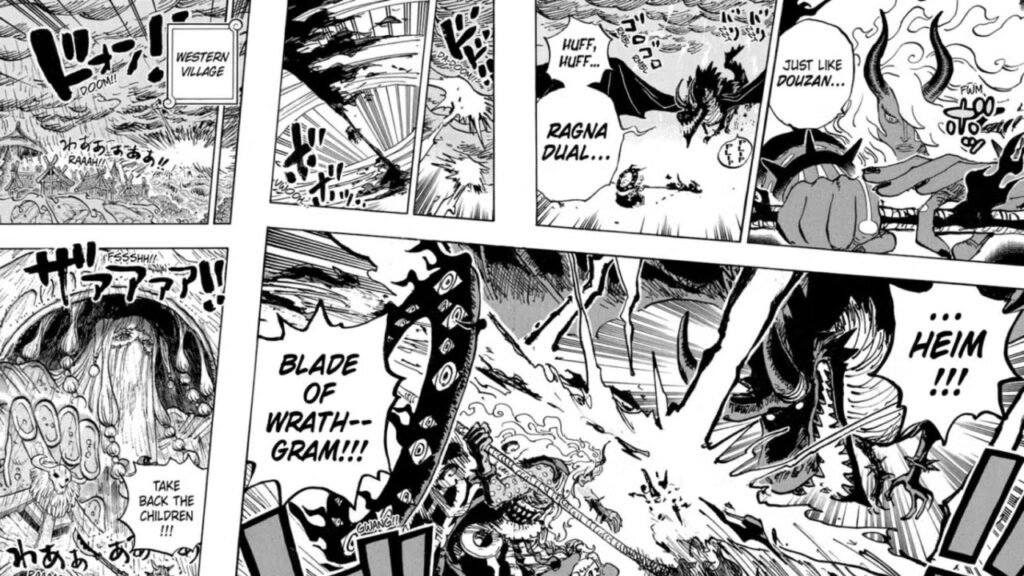
‘One Piece’ Chapter 1183 quietly introduced one of the most important new names in the series’s entire Void Century storyline. During the escalating events in Elbaf, Imu casually referenced a mysterious figure named Douzan, also translated in some scans as Dozan. The moment lasted only a few panels, but it immediately triggered major speculation across the fandom because of the way Imu described the character.
The critical moment came when Imu stated that neither Luffy nor Loki could ever become “Mu’s soldiers” because they were impossible to control. Imu then declared that both of them must be erased “just like Douzan.”
That line confirmed two major things at once. Douzan was once dangerous enough for Imu to still remember him, and the World Government either killed him or erased him from history completely. In a story centered on hidden truths and erased history, the statement instantly made Douzan one of the series’ biggest mysteries.
Why Imu’s Words Changed Everything

The most important part of Chapter 1183 is not simply that Douzan existed. The fact is that Imu grouped him with Luffy and Loki. Throughout the Final Saga, Imu consistently refers to people by symbolic identities and mythical powers rather than by their normal names. Luffy becomes Nika. Loki becomes Nidhogg. That pattern immediately led fans to believe that Douzan might represent another mythical title tied to one of the ancient gods.
One of the strongest theories suggests Douzan was the user of a legendary “Earth God” Devil Fruit. Back during the Skypiea arc, the series referenced four gods connected to the ancient world. Fans already associate Luffy with the Sun God Nika, while Loki increasingly connects to serpent mythology and Nidhogg imagery. That leaves room for another ancient god figure who opposed Imu in the distant past.
Some readers also noticed that “Dozan” loosely carries associations with mountains, mines, and earth-based imagery in certain interpretations. That detail only strengthened theories linking Douzan to a possible Earth God power. If Imu specifically mentioned Nika, Nidhogg, and Douzan together, the implication is that all three figures belonged to the same category of world-changing threats.
Another major interpretation ties Douzan to the “Hellflame Serpent” referenced in the Harley texts. Instead of being an Earth God, Douzan may have wielded another ancient, mythical power associated with destruction and rebellion. Since Oda frequently blends mythology from multiple cultures into a single narrative, the serpent connection has become one of the most discussed possibilities since Chapter 1183 was released.
The wording also revealed how Imu views rebellion itself. Imu did not speak of Douzan as a failed revolutionary or a forgotten king. The line sounded deeply personal, almost as if Imu were recalling someone whose existence nearly destabilized the entire system of power controlling the world. That instantly separates Douzan from ordinary historical figures in the series.
The Biggest Theories Right Now

One of the most convincing theories holds that Douzan was the previous wielder of the same power now associated with Loki. Since the Elbaf storyline already revolves around giant mythology and Nidhogg symbolism, many readers believe Douzan was an ancient giant warrior who rebelled against the World Government centuries earlier.
This version of the theory paints Douzan as a former “God of War” figure from Elbaf who directly challenged Imu before ultimately falling. Because Imu is actively monitoring Loki in the current timeline, referencing the previous rebel tied to the same power makes narrative sense.
Another massive theory suggests Douzan is actually Joy Boy’s real name. The series consistently treats “Joy Boy” more like a title than a personal identity. Fans have spent years wondering what the original Joy Boy was actually called before history erased him. Since Imu mentioned Douzan while discussing the regime’s greatest threats, many readers believe the answer may have finally appeared.
The “Man Marked by Flames” theory continues gaining momentum as well. According to this interpretation, Imu failed to completely kill Douzan. Instead, Douzan survived an attack involving Imu’s black flames before disappearing from public history. His burns supposedly became the origin of the mysterious “marked by flames” description associated with the man linked to the final Road Poneglyph.
Supporters of this theory believe Douzan now travels aboard the pitch-black ship repeatedly mentioned throughout the Final Saga. Rather than dying centuries ago, he has been hiding and waiting for someone capable of finishing the war against the World Government.
Some theories go even further, connecting Douzan to ancient cursed figures like Zunesha or Emeth. The idea is that Imu punished defeated rebels by transforming them into immortal servants or wandering monsters after stripping away their identities. Zunesha’s endless punishment already feels suspiciously tied to the Void Century, making the connection difficult to ignore.
The Fish-Man Island Theory Might Explain the 200-Year Mystery

The theory attracting the most attention after Chapter 1183 revolves around Fish-Man Island and the unexplained historical events from 200 years ago. That timeline has repeatedly appeared throughout the Final Saga, but Oda still has not fully explained why it matters so much.
Around 200 years before the current story, Fish-Men finally gained recognition from the World Government and received a seat at the Reverie. During that exact same era, Emeth suddenly attacked Mary Geoise. Several other strange global incidents involving Green Bit and Dressrosa also happened around this period.
According to the theory, Douzan served as the king or revolutionary leader of Fish-Man Island during those events. Instead of accepting centuries of oppression, he allegedly led a rebellion against the World Government in an attempt to free Fish-Men permanently.
Supporters believe the Government responded publicly with diplomacy while secretly preparing an ambush during the Reverie negotiations. During the conflict, Douzan supposedly confronted Imu directly and died while protecting the Mermaid Princess from capture.
The theory becomes even more important when connected to Emeth. Many readers believe Emeth’s attack on Mary Geoise was direct retaliation for Douzan’s death. That possibility would finally explain why the Iron Giant suddenly activated after remaining dormant for centuries.
Right now, none of these theories has official confirmation. Chapter 1183 revealed almost nothing concrete about Douzan beyond Imu’s statement. No silhouette appeared. No race was identified. Even the translation of the name remains disputed between “Douzan” and “Dozan.”
But Oda rarely introduces names connected directly to Imu without attaching enormous historical significance to them. Whether Douzan turns out to be Joy Boy, an ancient giant, the Man Marked by Flames, or a forgotten king tied to Fish-Man Island, Chapter 1183 established one thing clearly. Long before Luffy challenged the World Government, another figure once rose against Imu strongly enough to be erased from history itself.