

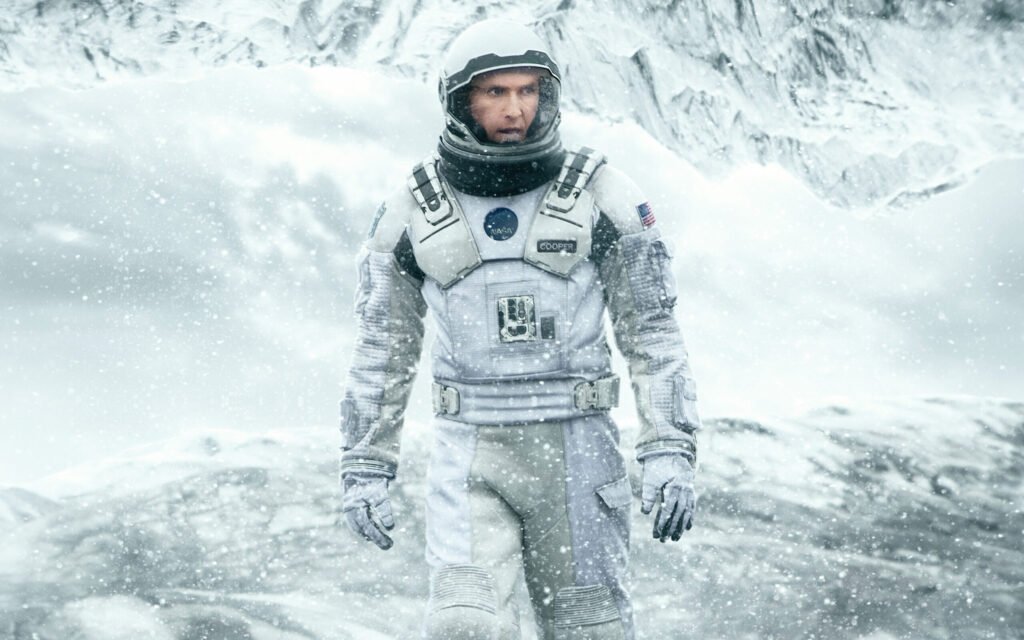
Interstellar ends with Cooper tumbling into a tesseract inside a black hole and using gravity to send Morse code across time, and if you have watched it more than once, you have probably wondered how much of that is actual science and how much is Christopher Nolan just making things up. The answer is more complicated and more fascinating than most people expect.
The tesseract sequence is one of cinema’s most ambitious attempts to visualize real theoretical physics. And the keyword there is real. Kip Thorne, the Nobel Prize-winning theoretical physicist who served as executive producer and scientific consultant on the film, spent years working with Nolan to make sure the science held up. Not all of it does perfectly, but far more of it does than you might think.
What a Tesseract Actually Is, and Why It Matters Here

A tesseract is a four-dimensional hypercube. To understand what that means, think about how a square is to a cube. A square is a two-dimensional shape. A cube is the three-dimensional version of that same idea. A tesseract is the fourth-dimensional extension of a cube, a shape that exists in a spatial dimension beyond the three we can perceive. We cannot truly visualize a tesseract any more than a flat drawing on paper can fully represent a cube, but we can represent it through projections, which is exactly what Nolan and his production team did with the visual environment Cooper finds himself in.
In the film, the five-dimensional beings (implied to be future humans who have evolved beyond our dimensional limitations) have constructed a physical tesseract inside the singularity of Gargantua, the film’s black hole.
The tesseract serves as a kind of interface. It translates five-dimensional space into something a three-dimensional human like Cooper can navigate and survive. The bookshelves that stretch infinitely in every direction are not random imagery. They represent different points in time in Murph’s bedroom, laid out spatially so Cooper can physically move through them, as we move through rooms.
This is a direct reference to what physicists call a timelike dimension being rendered as a spacelike one. Normally, time is a dimension we can only move through in one direction, forward. Inside the tesseract, time has been rotated so that Cooper can traverse it like space. He is not traveling back in time in the science-fiction sense. He is moving laterally through it, the way you might walk sideways along a wall.
Gravity, Quantum Data, and Why a Ghost Had to Be the Answer
Here is where the film makes its most scientifically grounded bet, and also its most controversial one. The central premise of Interstellar is that gravity, unlike the other fundamental forces, can transcend dimensional boundaries. Cooper uses gravity to communicate across time because gravity is, in the language of string theory and brane cosmology, a force that can leak between branes, the term physicists use for membrane-like surfaces that represent different universes or dimensional planes.
In the real physics of extra dimensions, particularly the Randall-Sundrum model developed by physicists Lisa Randall and Raman Sundrum in 1999, gravity is uniquely weak compared to other forces because it is not confined to a single brane.
Electromagnetism, the strong nuclear force, and the weak nuclear force are all bound to our three-dimensional brane. Gravity bleeds into the extra dimensions, which is theorized to be why it is so much weaker than the other forces. Nolan and Thorne took this idea and built the film’s entire premise around it. If gravity can cross dimensional boundaries, then in principle, a being operating in a higher dimension could manipulate gravity in ours.
The Morse code Cooper taps out using the second hand of the watch is conveying quantum data that TARS, the film’s AI, collected from inside the singularity of Gargantua. The singularity is the point inside a black hole where our current laws of physics break down entirely.
In the film, the premise is that quantum-gravitational data from that singularity contains the information needed to solve the equation of gravity, which, in the story, would allow humanity to build spacecraft capable of lifting entire populations off Earth. The watch functions as a receiver because it is the object in Murph’s bedroom with the most precise, readable mechanism for encoding binary data through physical displacement. Cooper is not sending a magic message. He is encoding data into gravitational anomalies at a scale precise enough to move a watch hand.
Thorne has written at length about this in his companion book, The Science of Interstellar. The idea of a benevolent five-dimensional intelligence constructing a physical structure inside a black hole singularity for Cooper to inhabit is not something that falls cleanly within known physics. Singularities are, by definition, regions where our equations stop working. What is inside them is genuinely unknown. But the framework around it, the dimensional mechanics, the behavior of gravity across branes, the visual representation of time as a traversable spatial axis, all of that is grounded in real theoretical physics in ways that almost no other blockbuster has attempted.
The closed timelike curve at the heart of the plot, where Cooper enters the tesseract, is the very reason Murph received the data that saved humanity, and it is also the reason the future humans built the tesseract in the first place. It is a direct application of a concept that physicists actually debate. Closed timelike curves are solutions to Einstein’s field equations that allow for paths through spacetime that loop back on themselves. They do not necessarily require time travel in the popular sense. They are features of the geometry of spacetime under extreme gravitational conditions. The physicist Kurt Godel first identified solutions to Einstein’s equations that permitted them back in 1949.
Whether you find the ending satisfying or not, Interstellar’s tesseract is one of the most earnest attempts in mainstream film to make real theoretical physics emotionally legible. The science is not decoration here. It is load-bearing.
Interstellar is currently in a theatrical re-release to mark its 10th anniversary in select markets worldwide.
You May Also Like:
Add us as a preferred source on Google.
Conversation