

Christopher Nolan‘s Interstellar makes a bold claim near its climax: love is the one force that transcends dimensions. It sounds like a cinematic reach, but the film’s scientific framework, built with input from theoretical physicist Kip Thorne, makes the idea harder to dismiss than you’d expect.
The question fans keep coming back to is whether the movie is being metaphorical or genuinely proposing something grounded in physics.
What Interstellar Actually Says About Love and Dimensions
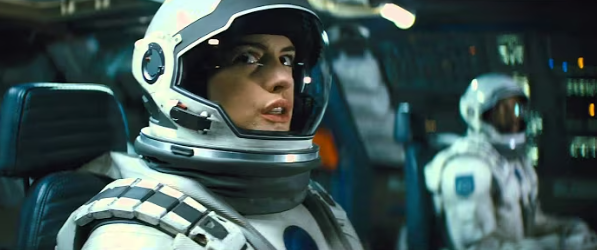
The key scene is Dr. Amelia Brand’s monologue, where she argues that love is observable across time and space in ways we don’t fully understand. She says it transcends the dimensions of time and space and suggests it may be evidence of a higher plane we haven’t yet perceived.
“Love isn’t something that we invented. It’s observable. Powerful. It has to mean something. Maybe it means something more, something we can’t yet understand. Maybe it’s some evidence, some artifact of a higher dimension that we can’t consciously perceive.
“Love is the one thing that we’re capable of perceiving that transcends dimensions of time and space,” Brand says.
The film doesn’t ask you to take this as poetry. Brand frames it as a hypothesis, and the third act pays it off literally: Cooper navigates the tesseract inside the black hole Gargantua, uses gravity to send Morse code through time to Murph, and the mechanism that makes this possible is his bond with his daughter.
The “bulk beings,” evolved future humans, build the tesseract specifically around a bookshelf because that is where Cooper’s emotional connection to Murph is strongest.
The Real Physics Nolan and Kip Thorne Built Around
Kip Thorne, who won the 2017 Nobel Prize in Physics for his work on gravitational waves, served as executive producer and scientific consultant on Interstellar. The film’s depiction of Gargantua’s accretion disk and the time dilation on Miller’s planet are based on genuine general relativity calculations, some of which Thorne published in peer-reviewed papers after the film’s release.
The tesseract sequence draws on the real concept of a four-dimensional hypercube, where a three-dimensional being experiences all points in a fourth dimension simultaneously. In the film, Cooper experiences all the moments in Murph’s bedroom at once because time becomes a spatial dimension within the tesseract. That part is grounded in legitimate physics reasoning, not invented for drama.
Gravity is the connective thread throughout. It is the only fundamental force that bleeds across dimensions in string theory models, which is also why Brand’s speech picks gravity as the analogy for love.
Why Cooper and Murph’s Bond Is the Structural Core, Not a Subplot
The film ties its emotional and scientific logic together through one specific relationship. Cooper does not navigate the tesseract using general intelligence or training. He finds Murph’s room because that emotional anchor is the only coordinate that works.
This is also why the film opens with their relationship in such granular detail: the bookshelves, the watch, the promise, the ghost. Every object becomes load-bearing later. The watch Cooper leaves Murph is the means by which she transmits the quantum data she needs to solve the gravity equation. Love, in the film’s internal logic, is literally the data transfer mechanism.
What the Film Gets Right (and Where It Stretches)
Thorne has said publicly that the science in Interstellar sits at the boundary between established physics and speculation, which he considered a fair place for a film to operate. The idea that future humans will evolve into five-dimensional beings capable of manipulating spacetime is speculative. The mechanics of how gravity carries information across dimensions is not something current physics can confirm.
What holds up is the film’s framing of love not as a mystical override but as a signal that persists. Cooper and Murph’s bond doesn’t break the rules of the universe Nolan builds. It operates within them.
Interstellar celebrated its tenth anniversary in 2024, with a theatrical re-release that brought the tesseract sequence back to IMAX screens worldwide.
You May Also Like:
Add us as a preferred source on Google.
Conversation