


Jane Schoenbrun’s 2026 film Teenage Sex and Death at Camp Miasma is built around a horror franchise that does not actually exist, but its fictional history is detailed enough to feel like something audiences could have discovered on an old VHS shelf.
At the center of the movie is Camp Miasma, a long-running slasher series whose mythology, merchandise and increasingly strange sequels become a window into the characters’ obsessions.
The fictional franchise is also where Schoenbrun’s love of horror becomes impossible to miss. Camp Miasma deliberately recalls the world of Friday the 13th, from its summer-camp setting and masked killer to its sprawling sequel history. The movie even invents the kind of franchise detours that longtime horror fans will recognize immediately, including a poorly received entry that sends its killer to Manhattan.
But Camp Miasma is more than a parody of an old slasher series. Its history and central villain, Little Death, become closely connected to the story of Kris, a filmmaker who is given the chance to revive the franchise that shaped her.
The Lore Of Camp Miasma

Within the film, Camp Miasma is a hugely successful slasher franchise that began with a 1980 movie and eventually expanded into roughly a dozen films, along with VHS releases, toys, advertisements and other merchandise.
The fictional series is an unmistakable Friday the 13th homage. Its first movie centers on the Miasma camp and a mysterious killer who returns to punish those connected to the tragedy surrounding the camp. Later installments continue expanding the mythology, even as the quality of the franchise begins to decline.
That history is part of the joke. Schoenbrun recreates the messy evolution of a real horror franchise, including the point where a studio starts stretching the concept beyond its original setting. The fictional Camp Miasma movie that sends its killer to Manhattan is an obvious nod to Friday the 13th Part VIII: Jason Takes Manhattan.
The film surrounds this invented history with the kind of memorabilia that horror fans know well. VHS tapes, newspaper advertisements, toys and other pieces of merchandise appear throughout the movie, making Camp Miasma feel like a franchise with decades of history behind it.
Who Is Little Death?
At the center of the fictional series is Little Death, a supernatural killer whose story deliberately echoes Jason Voorhees while taking the character in a much stranger direction.
Little Death is the spirit of a child who was raised by their parents as both a boy and a girl. After being drowned in the lake near Camp Miasma by hateful campers, the child returns as a vengeful supernatural figure who periodically kills people who trespass on the property.
The character’s design is one of the movie’s most memorable jokes. Instead of the familiar hockey mask associated with Jason, Little Death wears what looks like a metal ceiling air-conditioning vent over their head. The unusual mask still allows the character’s eyes to be visible through an opening, giving the killer an eerie, almost theatrical appearance.
Little Death also carries a double-bladed spear, which serves as the character’s signature weapon. The name itself has another layer. “La petite mort,” or “little death,” is a phrase traditionally associated with orgasm, making the name particularly fitting for a film that connects horror, sexuality, desire and identity.
How Camp Miasma Connects To The Film
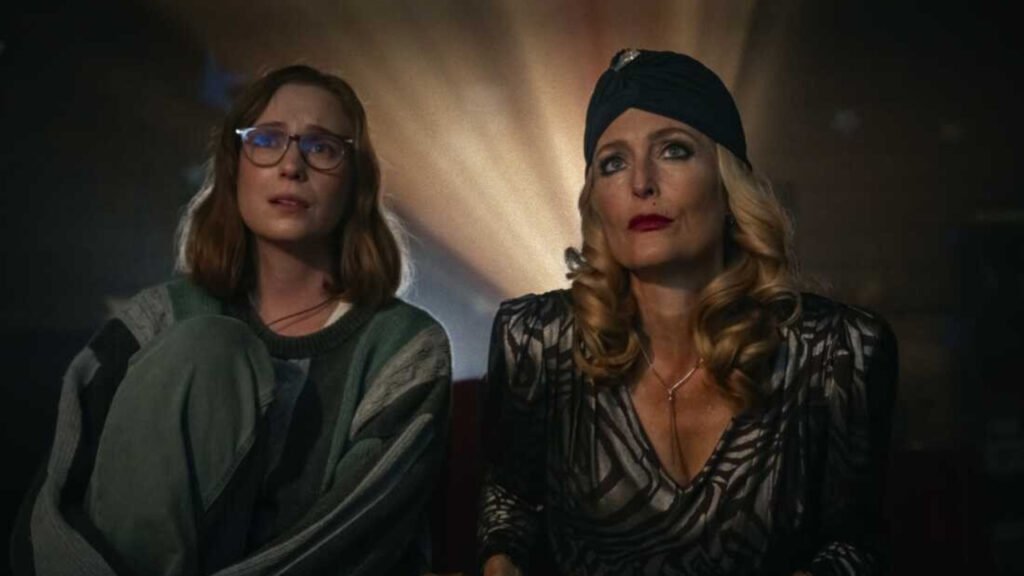
The fictional franchise becomes important because Kris, played by Hannah Einbinder, has been hired to revive it. She is an emerging filmmaker who previously broke through at Sundance and now finds herself responsible for resurrecting what the studio considers a fading “zombie IP.”
Kris is not approaching the project as just another job. She genuinely loves Camp Miasma, particularly the original movie and the actress who played its final girl, Billy Presley, portrayed by Gillian Anderson.
Presley starred in the first Camp Miasma movie and now lives in isolation at the location where the original was filmed. Kris travels to find her, hoping to convince her to participate in the reboot.
Their relationship becomes one of the film’s central dynamics. Kris is initially interested in getting Presley involved with the new movie, but her fascination gradually becomes more personal. She wants to understand why the original Camp Miasma affected her so deeply and how that influence shaped the filmmaker she eventually became.
That is where the fictional franchise becomes much more than a clever Friday the 13th imitation.
Why Camp Miasma Matters To The Story
Schoenbrun uses Camp Miasma to examine what happens when a piece of pop culture becomes inseparable from someone’s identity. Kris did not simply watch these movies. She grew up with them, found meaning in them and connected personally with their characters and imagery.
The original Camp Miasma is also described within the film as having become controversial over time. Its treatment of Little Death’s gender identity has been reassessed as problematic, particularly because the character was portrayed as a girl one day and a boy the next.
That gives the fictional franchise another purpose. Schoenbrun can use a deliberately exaggerated slasher movie to explore how horror can blur ideas about gender, sexuality, desire and death.
The result is a horror franchise within a horror film that functions on several levels at once. Camp Miasma is a loving parody of the slasher movies that inspired Schoenbrun, a deliberately ridiculous piece of fictional franchise history and, most importantly, the cultural object through which Kris understands herself.
That is why the fictional series feels so much larger than a movie-within-a-movie. For Kris, Camp Miasma is not just something she watched growing up. It is part of the reason she became the person she is.
You May Also Like
Add us as a preferred source on Google.
[…] What Is Camp Miasma? The In-Universe Horror Series Explained […]
[…] Related: What Is Camp Miasma? The In-Universe Horror Series Explained […]
[…] Read More: What Is Camp Miasma? The In-Universe Horror Series Explained […]