

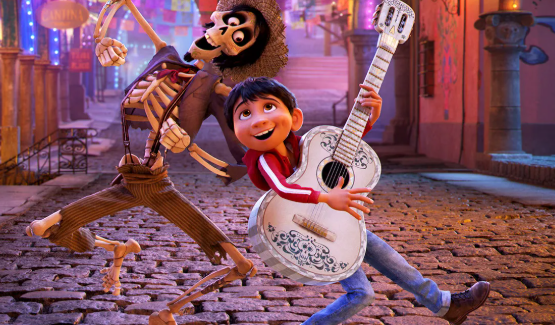
Most animated films about death try to soften the blow. Coco does the opposite. It walks straight into grief, sits down with it, and comes out the other side with something that feels closer to the truth than most live-action dramas ever manage.
Released in 2017, Pixar’s Coco follows twelve-year-old Miguel Rivera, an aspiring musician in a family that has banned music for generations. On Día de los Muertos, he crosses into the Land of the Dead and meets the ancestors his family has almost forgotten.
What looks on the surface like a bright, crowd-pleasing adventure is actually one of the most emotionally sophisticated films Pixar has ever made, and one of the few mainstream movies to treat death not as an ending, but as a relationship that keeps going.
How Coco Reframed Death for Western Audiences
Hollywood has a well-worn playbook for handling death in family films. Someone dies, someone grieves, someone moves on. The dead stay dead, and the living keep living. Coco throws all of that out.
The film is built around the central idea of Día de los Muertos: that the dead are not gone, they are simply somewhere else, and that it is the responsibility of the living to keep them present.
Every family maintains an ofrenda, an altar lined with photographs and marigold flowers, because the dead can only cross back to visit on Día de los Muertos if someone living still remembers them. Forget them, and they fade away entirely, suffering what the film calls the Final Death.
That concept alone is a radical departure from how death gets handled in most Western storytelling. Here, forgetting isn’t a natural part of grieving. It’s the worst thing you can do to someone. Memory is an act of love, and maintaining it is a genuine responsibility.
What Coco Gets Right About Family That Most Films Get Wrong
The Rivera family in Coco isn’t a backdrop. It’s the whole argument of the film. Six generations of stubborn, loving, complicated people, and the movie takes every single one of them seriously.
What’s unusual is that the film doesn’t position family obligation as something to escape. Miguel chafes against his family’s ban on music, and the story initially frames this as a classic conflict between individual dream and family tradition. But by the end, the film has quietly shifted the question. It’s not about whether Miguel gets to pursue music. It’s about whether he understands why his family is the way it is, and whether love can survive that kind of misunderstanding across generations.
That’s a much harder, much more honest question. And the answer Coco gives, that you have to earn the full story before you can judge anyone in it, lands harder than almost any twist a more conventional film could pull off.
The Land of the Dead and Why It Matters That It Looks Like That
Director Lee Unkrich and his team spent years researching Mexican culture before production began, visiting homes, cemeteries, and public spaces across the country to understand Día de los Muertos from the inside. The Land of the Dead they built reflects that care in every detail.
It’s not an eerie underworld. It’s a city, sprawling, lit up, and full of noise, built on spiraling foundations inspired by Mexico City’s history of being constructed atop ancient Aztec cities. The brightness is the point. A culture that celebrates death with flowers, food, and music is telling you something specific about how to live, and Coco translates that into images that make the idea feel not just beautiful but genuinely true.
The film earned the Academy Award for Best Animated Feature and Best Original Song in 2018. But its real achievement is harder to quantify. It changed the conversation. Parents who watched it found themselves talking to their children about death in a way they hadn’t before, and children who watched it came away less afraid. That’s not nothing. That’s actually everything.
You May Also Like:
Add us as a preferred source on Google.
Conversation