

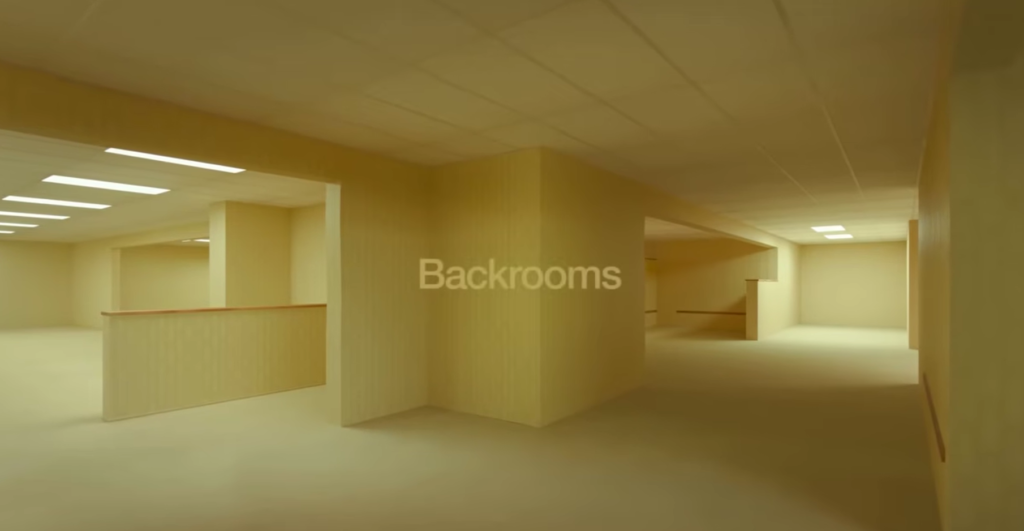
Before A24 partnered with filmmakers like James Wan and Shawn Levy to bring Backrooms (2026) to theaters, it had already become one of the internet’s most unsettling horror ideas.
It began in 2019 with a single, low-quality image posted online: a yellow, empty hallway with harsh lighting and no clear exit. That image quickly spread, capturing attention because of how strangely familiar it felt.
Over time, it evolved into a much larger myth. People added stories, videos, and theories, turning one image into a full horror universe.
What Is The Backrooms? Understanding the Core Idea
At its core, the Backrooms concept is built around a simple but unsettling idea. If you “no-clip” out of reality, a term from video games meaning to pass through solid objects, you might fall into another dimension.
This place, often called “the Complex,” is an endless maze of empty rooms. The spaces resemble offices or hallways, but something always feels off. The walls repeat too perfectly. The lighting hums constantly. The environment feels unnatural.
This is what’s known as a “liminal space,” a place that sits between two states, creating discomfort because it feels both familiar and wrong at once.
As the idea spread online, fans created multiple “levels” within the Backrooms, each with its own rules and dangers. However, the upcoming film focuses on a more structured version of the story, set at the fictional Async Research Institute.
In this version, set in the 1990s, researchers open a doorway into the Backrooms. Their goal is practical, solving storage and housing issues, but they discover a space that doesn’t follow the laws of physics. The environment shifts, behaves unpredictably, and may even be aware of those inside it. It also contains “Lifeforms,” strange entities that can mimic human sounds to lure and hunt people.
Backrooms Movie Explained: Story, Characters, and Key Details
The film adaptation, titled Backrooms, brings the concept into a more grounded story. It follows Clark, played by Chiwetel Ejiofor, a furniture store owner who discovers a portal opening in his basement.
This connects everyday life with something unknown and dangerous. What starts as curiosity quickly becomes a fight to survive. Clark, along with characters played by Renate Reinsve and Mark Duplass, must navigate the maze-like environment. To make this world feel real, the production built around 30,000 square feet of physical sets, focusing on tight, repetitive layouts to create a sense of claustrophobia.
A few elements are key to understanding how the film builds its horror.
The first is sound. The constant electrical hum, often described as a “hum-buzz,” is central to the atmosphere. It creates tension over time, making the environment feel oppressive. The second is the Async storyline. The film may explore how much was known about the Backrooms before the events unfold, adding a layer of mystery and possible conspiracy.
Finally, there’s the structure of the space itself. Director Kane Parsons has suggested the rooms follow a pattern. They are not random but are built using an unfamiliar logic that imperfectly imitates real-world spaces.
This is what makes the Backrooms unsettling. They are not completely alien; they are almost normal, but never quite right. When Backrooms releases on May 29, 2026, it won’t just be a typical horror film. It explores a deeper fear: being trapped in a place that feels familiar, yet offers no way out.
You May Also Like:
Add us as a preferred source on Google.
Conversation