
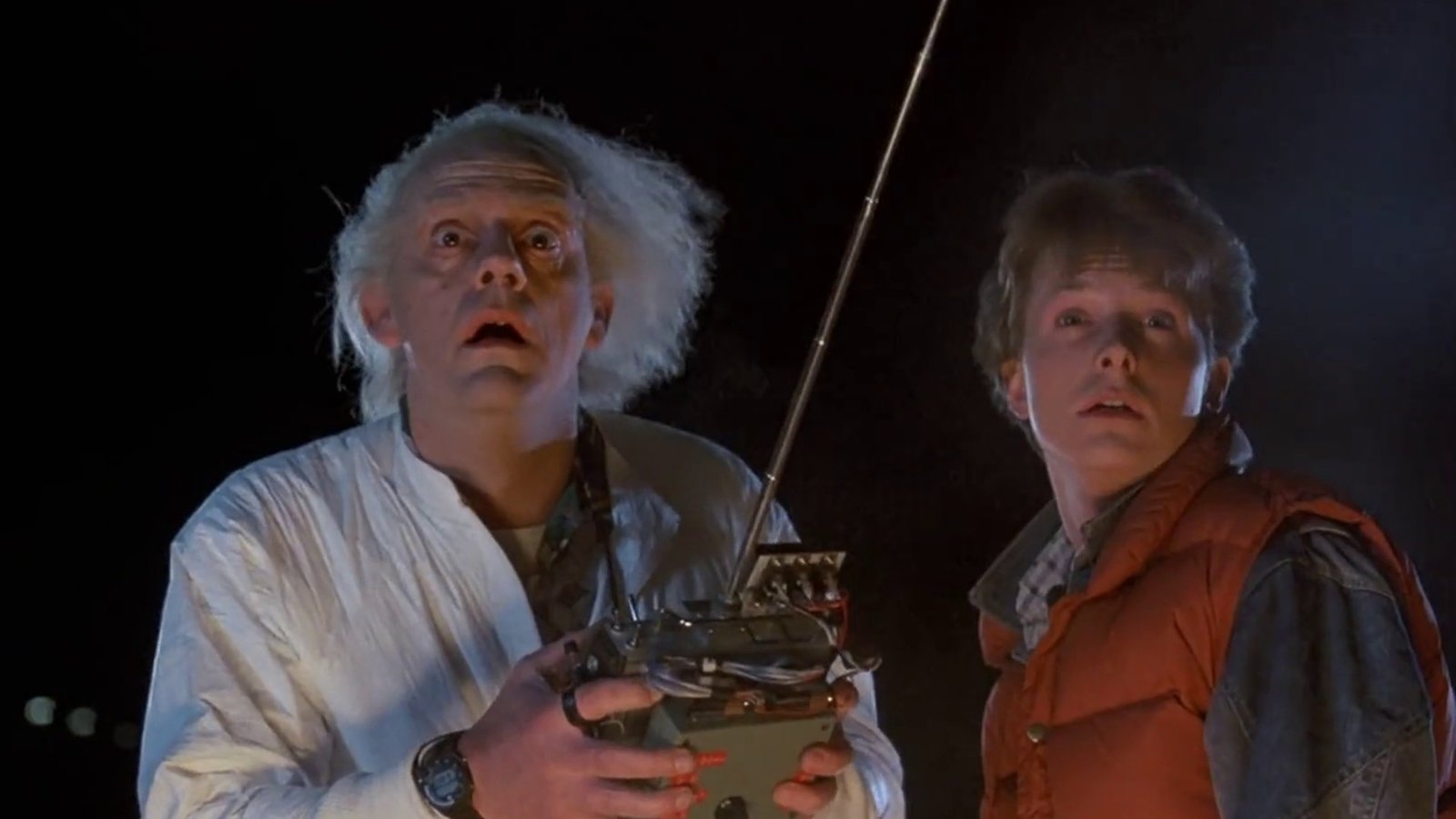
Many time travel movies do not stand up to scrutiny since their characters tend to erase themselves instantly, their timelines are reset without logical explanations, or paradoxes can be ignored. However, Back to the Future stands apart because Robert Zemeckis and Bob Gale built a system with clear internal logic and then followed it across the trilogy.
It should be mentioned that the movies do not claim scientific precision; however, they offer a set of clear rules that make it possible to predict what will happen. Marty McFly‘s interventions change the reality of his universe with a noticeable ripple effect, which is why people do not disappear instantly, and the new reality emerges gradually, allowing the audience to track and evaluate potential changes.
The trilogy offers precise rules, which were used consistently
In particular, the “ripple effect” rule explains how Marty’s actions influence his future life and how he can change the future without disappearing instantly. In 1955, Marty makes a mistake, preventing his parents from meeting. As a consequence, his siblings vanish from the family photo one by one until he manages to restore the initial timeline.
This rule is further developed in Back to the Future Part II, when Doc explains the phenomenon of branching time using the famous diagram with the chalkboard. After Marty’s action, the original 1985 does not become a dystopia instantly; instead, an alternative branch of history – 1985A – emerges in which Biff becomes the ruler of Hill Valley.
Other key rules concern physical displacement that affects the main characters. In particular, Marty does not vanish even when the surrounding reality is changed. For example, at the end of the first film, he finds himself in the altered version of 1985 and observes how another version of himself travels back in time. In addition, the trilogy suggests that time travelers preserve their identity regardless of temporal changes.
Finally, the trilogy uses consistent fictional mechanics. Time travel is made possible by means of the Flux Capacitor, and the DeLorean requires 1.21 gigawatts of electricity for acceleration to 88 miles per hour. Throughout the trilogy, those requirements are satisfied by such sources as plutonium, lightning, and Mr. Fusion’s garbage.
Some scientific facts can be discovered about the trilogy
From a scientific point of view, parts of the Back to the Future trilogy correspond to several theories quite accurately. For instance, Einstein the dog’s ability to travel one minute into the future is related to the idea of Einstein’s Theory of Relativity according to which time tends to slow down at high speed.
However, the movie has flaws concerning backward time travel and the “grandfather paradox.” Marty’s prevention of his parents’ meeting creates a logical paradox: since they do not meet, he cannot travel in time, but then there should be no Marty who interferes with the process. This problem can be solved by considering the period of grace offered by the ripple effect theory.
Almost 40 years after the release of the first movie in 1985, the trilogy continues to evolve successfully, and there is no talk of a reboot. The latest production Back to the Future: The Musical continues playing in several countries such as Canada, Japan, and the UK and also on board of Royal Caribbean’s Star of the Seas ship.
Zemeckis and Gale still maintain complete control over the franchise rights and continue enforcing their long-standing agreement against any reboot or remake during their lifetimes. The series also celebrated its 40th anniversary in 2025 with IMAX and 4DX theatrical re-releases, anniversary Blu-ray editions, and a limited-edition screenplay collection overseen by Bob Gale himself.