

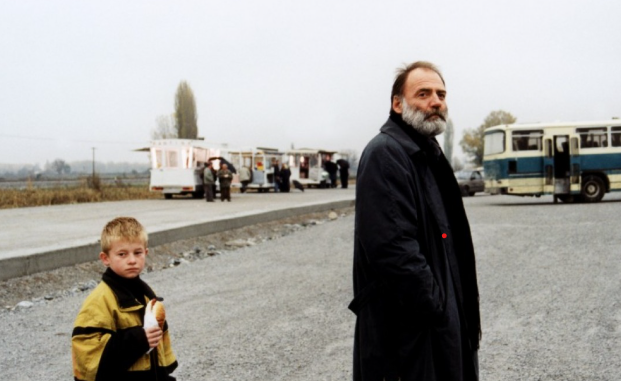
Some films tell stories. Eternity and a Day asks questions, and the questions hurt.
Theo Angelopoulos’s 1998 Palme d’Or winner follows Alexandros, a terminally ill writer in Thessaloniki, spending one last day in the world before checking into the hospital. That’s the plot on paper. What it actually is is something closer to a dream you can’t shake after waking.
A Film That Lives in the Space Between Past and Present
Angelopoulos doesn’t let time behave. Memories bleed into the present without warning. Alexandros speaks in his mind to his dead wife Anna, who appears to him still young, untouched by the years that have worn him hollow. These aren’t flashbacks in any traditional sense. They’re intrusions. Time refusing to stay where it belongs.
The long takes Angelopoulos is famous for aren’t slow for their own sake. They navigate collective space and collective history through the lens of one individual, a dying man suspended between yesterday and tomorrow, desire and grief.
Bruno Ganz carries the film with a devastating stillness. Every glance out a rain-streaked window, every hesitation on a doorstep, feels loaded with a lifetime of what went unsaid.
Words Bought, Time Lost
Threaded through the film is an Albanian refugee boy, Alexandros, who shelters from the police — a child with no country, no papers, no place to belong. Their unlikely bond becomes the film’s moral and emotional spine.
There’s also a recurring metaphor that lands like a gut punch: a poet from another age who purchases unrelated words and assembles them into verse. Angelopoulos is making a point about art, about life, that we are all just collectors of scattered moments, trying to make them mean something before time runs out.
What Does Tomorrow Actually Mean?
The title itself is the answer Alexandros receives while pondering the meaning of Tomorrow, how long is it, exactly? An eternity and a day. It’s a question that sounds poetic until you sit with it and realize it’s terrifying.
Eternity and a Day is an exquisite contemplation on home, borders, and the meaninglessness of the lines we draw between ourselves, national, emotional, and temporal. Angelopoulos draws none of those lines. He lets everything bleed together, the way memory actually works.
This film doesn’t offer resolution. It offers the feeling that a single day, lived fully, might just be enough.
You May Also Like:
Add us as a preferred source on Google.
Conversation